Most Wichita homeowners think about their trees only when something goes wrong — a branch falls on a fence, a root buckles the sidewalk, or a storm drops a trunk across the driveway. By that point, a problem that could have been handled with a planned removal has become an emergency. Knowing when a tree has shifted from an asset to a liability is one of the most valuable things you can do as a property owner. This guide walks through the five most common warning signs that a tree on your property needs to come down — before it comes down on its own.
1. Dead or Dying Branches Throughout the Crown
A few dead branches in an otherwise healthy canopy is normal. Trees naturally shed low-light interior growth as they age. But when deadwood appears throughout the upper crown — especially large-diameter branches that should be vigorous — that is a red flag that demands a closer look.
Signs to watch for include branches that lack foliage during the growing season, bark that is falling away in large plates, and fungal conks (shelf mushrooms) growing on the wood. Conks are the fruiting bodies of decay fungi, and their presence means the wood inside has been decomposing — often for years before you see visible evidence on the surface. By the time conks appear, structural integrity in that section is already significantly compromised.
Kansas winters are especially hard on marginal trees. Ice storms — common across Sedgwick County — load branches with weight they were never designed to bear, snapping limbs and cracking bark. Trees that were already in decline frequently do not recover from that kind of stress. If you lost a large portion of the crown in an ice event and new growth the following spring was sparse or absent, the tree may be in terminal decline.
Dead trees do not fall on a schedule. A standing dead tree can look stable for years and then fail catastrophically during a wind event. If more than 50 percent of the crown is dead or dying, removal is almost always the right call.
2. The Trunk Shows Deep Cracks or Cavities
The trunk is the load-bearing column of a tree. When that column is compromised, everything above it is at risk — and so is everything around it. Deep vertical cracks, seams where bark has separated from the wood, and cavities large enough to put your hand inside are all indicators of serious structural failure.
Hollow trees are particularly deceptive. A tree can appear healthy from the outside — full canopy, green leaves, no obvious decay — while the interior of the trunk is essentially gone. Trees with hollow trunks can and do stand for a long time, but their resistance to failure during a storm is a fraction of what a sound tree would have. In a straight-line wind event, which are common across the Kansas plains, a hollow trunk becomes a catastrophic failure point.
On Sedgwick County properties, we frequently encounter trees — particularly older cottonwoods, silver maples, and green ashes — that have developed internal decay over decades. Homeowners are sometimes reluctant to remove a tree that looks green and healthy, but internal decay is not visible from the street. A professional arborist can probe cavities, assess the wall thickness of remaining sound wood, and give you an honest evaluation of whether the tree is safe to leave standing.
The general industry standard is that if the cavity or hollow area represents more than one-third of the trunk's diameter, the tree's structural integrity is too compromised to rely on.
3. The Tree Is Leaning More Than It Used To
There is a difference between a tree that has always grown at an angle and a tree that has recently begun leaning. Natural lean — a gradual tilt developed over years as a tree grows toward light — is usually stable. Progressive lean, where a tree that previously stood straight is now visibly off-vertical, is a warning sign that something has changed underground.
Root heaving is one of the most telling indicators. When you see soil cracking or mounding on the opposite side of the lean, the root system on the tension side is pulling up and out of the ground. That process accelerates under saturated soil conditions, which are common in Wichita after heavy spring rains or prolonged wet periods. Clay soil — prevalent throughout much of the Wichita metro — holds water longer than sandy or loam soils, which means root systems stay under stress long after a rain event ends.
A tree leaning toward a structure, driveway, or power line with visible root heaving is a tree that could fall with very little additional provocation. A moderate wind event — not a tornado, not a derecho, just a typical Great Plains thunderstorm — can be enough to take it over. If you have noticed a lean that has increased over one or two seasons, do not wait for the next storm to force a decision.
4. Roots Are Damaging Your Foundation or Driveway
Wichita's soil is predominantly clay-heavy, which creates an environment where tree roots spread aggressively in search of moisture and oxygen. That spreading root system is exactly what makes trees resilient during droughts — but it also makes them destructive neighbors to concrete, asphalt, and building foundations.
Lifted sidewalk panels, cracked or heaved driveway sections, and foundation cracks on the side of your home nearest a large tree are all symptoms of root intrusion. Roots do not typically punch through solid concrete — instead, they follow paths of least resistance, growing under slabs and expanding as the tree grows, exerting pressure that cracks and buckles the surface above.
Foundation damage is the most serious consequence. Once roots penetrate a foundation, they create channels for water intrusion, and water in a foundation accelerates structural deterioration. In older Wichita neighborhoods — College Hill, Riverside, Delano — mature trees planted close to homes decades ago are now reaching root systems that were never anticipated when the houses were built. If a root system is actively damaging your foundation or has caused significant hardscape damage, the cost of tree removal is almost always less than the cost of the structural repairs the tree will eventually force.
It is worth noting that root pruning is sometimes an option for less severe intrusion, but it carries its own risks — cutting major roots can destabilize a tree and increase the risk of wind failure. Once a tree does come down, you are still left with the stump — our complete guide to stump grinding covers what Wichita homeowners should know about that process.
5. The Tree Is Too Close to Your Home or Power Lines
Proximity to structures and utilities is not a death sentence for a tree, but it does require honest assessment of the risk. Industry guidelines generally recommend that large-canopy trees maintain a minimum clearance of 20 feet from a home's foundation, though this varies based on species, growth rate, and prevailing wind direction on your property.
Trees growing into or over power lines are a separate category of concern. Evergy — the utility serving most of the Wichita area — performs right-of-way pruning, but their clearance cuts are designed to protect the lines, not to maintain a healthy tree form. A tree that has been repeatedly topped or side-pruned to accommodate a utility line often develops weakly attached epicormic growth that is prone to failure. In many cases, removing the tree and replacing it with a smaller-stature species is the right long-term solution.
From an insurance standpoint, a tree that falls on your home during a storm is typically covered by your homeowner's policy — but an insurer may contest a claim if there is evidence that the tree was obviously dead or diseased and you did not take action. Proactive removal of a hazard tree is far less expensive than a contested insurance claim after a loss.
What to Do If You Spot These Signs
If one or more of these warning signs applies to a tree on your property, the next step is a professional evaluation. Some trees can be saved with targeted pruning, cabling, or bracing. Others need to come down, and the sooner that decision is made, the safer and less expensive the removal process typically is. Emergency removals — where a tree has already partially failed or is leaning acutely over a structure — cost more and carry more risk than a planned removal of a tree that is still standing.
"Safety is always the first consideration. I would rather have a difficult conversation with a homeowner about removing a tree they love than get a call after the tree has already come down on their house. A tree can be replaced. The damage it causes when it fails cannot always be undone."
— Joe Kohnen, Kohnen's Tree Service
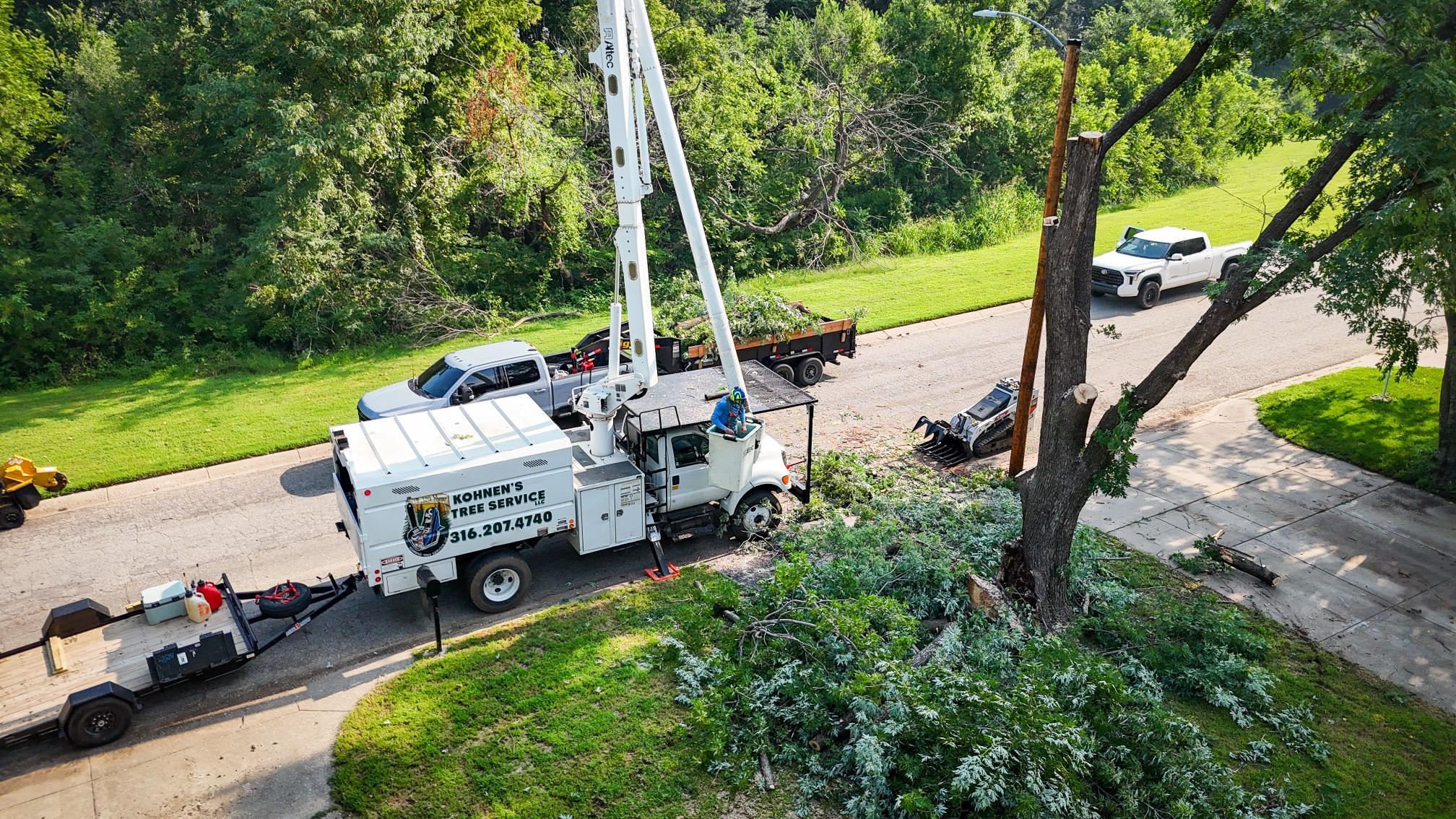
At Kohnen's Tree Service, we provide free estimates for tree removal throughout Wichita and the surrounding communities, including Derby, Andover, Goddard, and Park City. We assess each tree on its individual merits — there is no pressure to remove a tree that does not need to come down, and no reason to leave one standing that does. If you have a tree you are concerned about, give us a call and we will come take a look.
Kansas weather does not wait for convenient timing. Getting ahead of a hazard tree now means you are not dealing with an emergency removal in the middle of a storm — or worse, filing a claim after it has already caused damage.