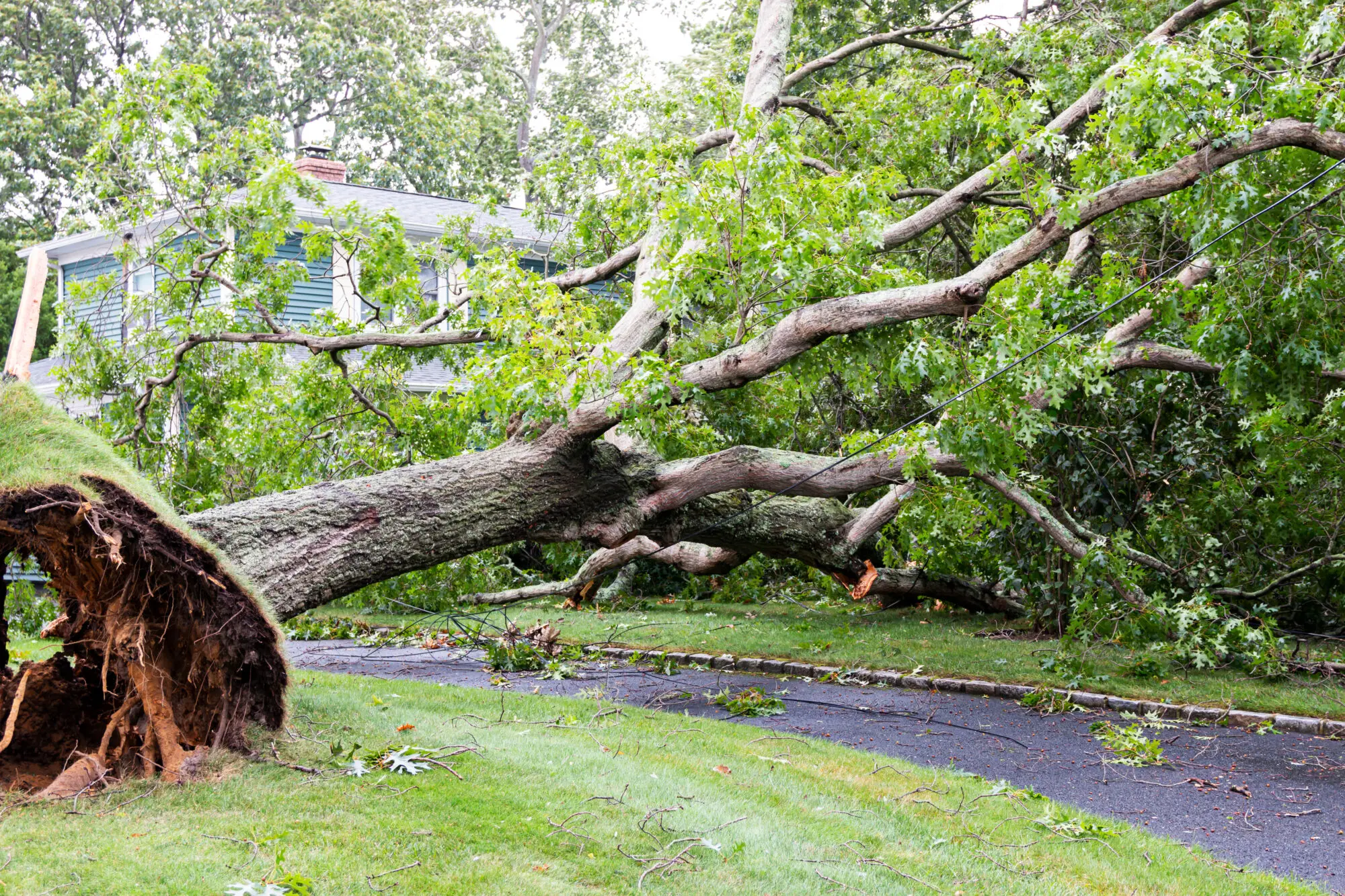
Kansas severe weather is not a matter of if — it is a matter of when. Tornadoes, derechos, straight-line winds, and ice storms are a routine part of life across the Great Plains, and Wichita sits squarely in some of the most active severe weather territory in North America. When a major storm passes through, the aftermath can be overwhelming: trees down across driveways, branches through roofs, debris covering entire yards, and in the worst cases, a massive trunk resting against the side of a house. Knowing what to do in those first hours after a storm — and what not to do — can make a significant difference in your safety, your insurance claim, and your recovery.
Stay Safe First
Before you do anything else, assess the immediate danger. Fallen trees frequently bring down power lines, and a line on the ground — or a line draped across a tree trunk — can still be energized and lethal. Do not approach a downed tree if there is any possibility that utility lines are in contact with it. Do not touch the tree, the lines, or anything that may be in contact with either. Call 911 and Evergy's emergency line and keep everyone away from the area until the utility company confirms the lines are de-energized.
If a tree has fallen on your home, stay inside and move to a part of the house not affected by the impact — unless you have reason to believe the structure is compromised. A tree on the roof or against the wall transfers significant load to the building, and in some cases that load can cause secondary failures. If you hear cracking, see walls shifting, or smell gas, exit immediately and move well clear of the structure. Call 911 for any situation involving structural damage, gas leaks, or fire risk.
Do not attempt to move a fallen tree yourself, and keep children and pets away from the area. What looks like a stationary fallen tree is often under significant stored tension — branches bent against the ground, the trunk pinned under other debris — and that tension can release violently when disturbed.
Assess the Damage Without Touching Anything
Once you have confirmed that the immediate area is safe to approach — no downed lines, no structural instability, no active hazards — begin documenting the damage from a safe distance. Your smartphone camera is your most important tool in the first hour after a storm.
Photograph everything before anyone touches anything. Shoot from multiple angles. Capture the full extent of the fallen tree, the point where it contacted your property, any secondary damage (broken fences, crushed vehicles, damaged roof sections), and the condition of the stump and root zone. If power lines are down or entangled, photograph those too but maintain your distance. Wide shots establish context; close-up shots capture detail. Take more photos than you think you need — your insurance adjuster will want thorough documentation.
Note whether the tree originated on your property or a neighbor's. Kansas law generally holds that property owners are liable for damage caused by trees that were demonstrably dead, diseased, or hazardous prior to the storm — if a neighbor had a dead tree that you had previously brought to their attention in writing, that matters to your claim. If the tree was healthy and the storm was the direct cause of failure, the situation is treated differently.
Also check for gas line damage. If the tree or its roots disturbed ground near a gas meter or underground service line, call your gas utility immediately and leave the area until they clear it.
Call Your Insurance Company
Contact your homeowner's insurance company as soon as it is practical — ideally within the first 24 hours of the storm. Most policies cover storm damage tree removal when the tree has impacted a covered structure (your home, an attached garage, a fence). Removal of a tree that fell in your yard without hitting a structure is often not covered, or is covered up to a lower sub-limit.
When you call, have your policy number ready and be prepared to describe the damage in specific terms: what fell, where it landed, what structures were affected, and approximately when the storm occurred. Ask your adjuster about your deductible, your coverage limits for debris removal, and the timeline for getting an adjuster to your property. In major storm events across Sedgwick County, adjusters can be backed up for days, so ask whether you are authorized to begin emergency protective measures (tarping a damaged roof, for example) before they arrive.
Kansas has specific deadlines for filing storm damage claims, and prompt notification to your insurer protects your rights under the policy. Document every conversation — write down the date, time, representative's name, and what was discussed.
"Kansas is in the heart of Tornado Alley, and our severe weather season runs nearly year-round. Derechos in summer, ice storms in winter, tornadoes in spring and fall — there is no off-season. Every homeowner in this state should have a plan for what to do when a tree comes down, because eventually, one will."
— Joe Kohnen, Kohnen's Tree Service
Why You Need a Professional Tree Service
Storm-damaged tree removal is among the most dangerous work in the tree care industry. It is not the same as a planned removal of a standing tree, and it should not be treated as a DIY chainsaw project — even by people who are comfortable with a chainsaw under normal circumstances.
The problem is stored energy. When a large tree falls, it rarely lands flat and evenly. Portions of the trunk and major branches may be pinned under other debris, bent against the ground, or held under tension by limbs still partially attached. When you cut into a section of a tree that is under that kind of tension, the wood does not simply fall away — it can kick back violently, spring upward, or roll in unpredictable directions. Chainsaw operators have been seriously injured and killed by not recognizing the tension in a piece of wood before cutting it.
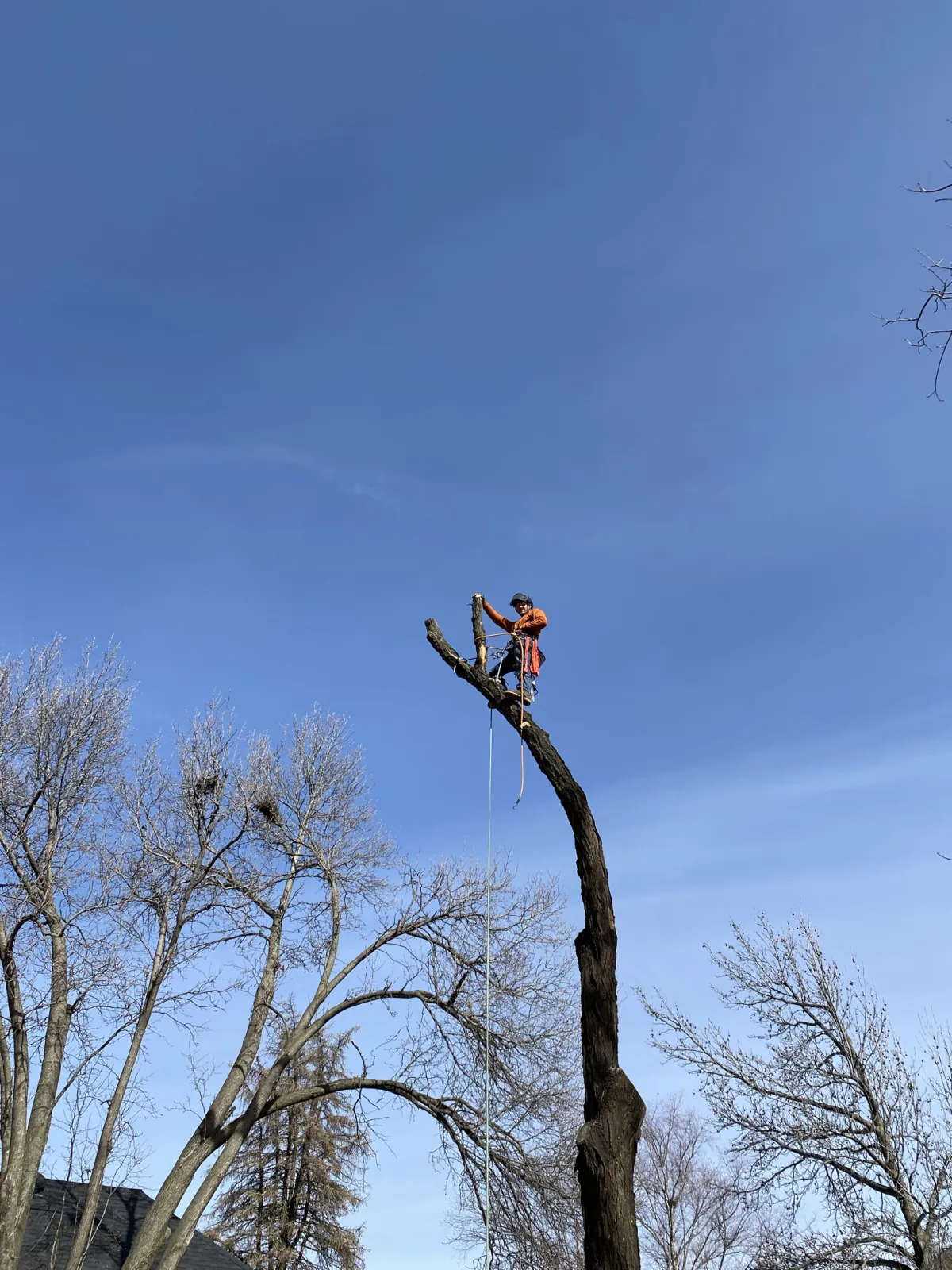
In addition, trees that have fallen across roofs, fences, or vehicles require careful rigging to remove without causing additional damage. Dropping a section of trunk incorrectly onto an already-damaged roof can turn a manageable repair into a catastrophic one. Professional crews have the training, equipment, and experience to read the forces at work in a fallen tree and cut in the correct sequence to release tension safely.
Kohnen's Tree Service operates 24 hours a day, 7 days a week for storm emergency response throughout Wichita and the surrounding communities. When a major storm moves through the area, our crews mobilize to begin responding to calls — we do not wait for business hours. If a tree is on your house or blocking access to your property, call us at (316) 207-4740 regardless of the time.
How Insurance Direct Billing Works
One of the biggest sources of stress after a storm is the financial uncertainty — you have damage to deal with, you are not sure what is covered, and you do not know how much out-of-pocket exposure you are facing. At Kohnen's Tree Service, we have invested in insurance billing training specifically to reduce that burden on homeowners.
Joe Kohnen is trained in insurance claim procedures and works directly with insurance adjusters on storm damage removals. In many cases, Kohnen's can bill your insurance company directly for covered storm damage work — which means you pay nothing out of pocket beyond your deductible. We document the work thoroughly with photographs and detailed invoices that meet insurance company standards, and we handle the communication with your adjuster so you do not have to.
This process works for homeowners throughout Sedgwick County and Butler County, including Wichita, Derby, Andover, El Dorado, and Augusta. If your tree damage is the result of a covered storm event, we can work with virtually any major homeowner's insurance carrier. When you call us after a storm, let us know you have coverage and we will walk you through the process from the first conversation.
The key is to call us before you authorize any other work. Once debris has been moved or removed by another party without proper documentation, it becomes much harder to support a claim. We arrive, assess, document, and communicate with your insurer before a single cut is made — that sequence protects you.
After the Tree Is Removed
Once the fallen tree has been safely removed and the immediate hazard is resolved, you have some decisions to make about what comes next. If the tree fell from a stump — as most do — you now have a stump remaining in your yard. Left in place, that stump will decay over years, can become a home for carpenter ants and other insects, and creates an obstacle for mowing and landscaping. Stump grinding removes the stump to several inches below grade, eliminating the obstacle and allowing the area to be filled and re-graded.
For large storm events that leave significant debris across the yard — large limb sections, brush piles, root balls — our grapple truck service is the most efficient way to clear the site quickly. The grapple truck can grab and load large debris without the manual labor of cutting everything into small sections, significantly reducing the time and cost of cleanup on major storm damage jobs.
We can also assess the remaining trees on your property for storm damage that may not be immediately obvious — split crotches that are now structurally compromised, major wounds that expose heartwood to decay, or trees that were partially uprooted and may be unstable. A post-storm assessment gives you a complete picture of what else may need attention before the next severe weather event.
If you are dealing with storm damage now, do not wait. Call Kohnen's Tree Service at (316) 207-4740 for 24/7 emergency response throughout Wichita and surrounding areas, or visit our contact page to request a free estimate. We will be there when you need us.