Every spring and fall, the same scenario plays out across Wichita neighborhoods. A homeowner looks at a dead oak in their backyard, does a quick search for chainsaw rentals, and convinces themselves that with a Saturday afternoon and a YouTube tutorial, they can handle it. The money saved sounds real. The danger does not. That gap in perception is exactly why DIY tree removal is one of the most reliably dangerous decisions a homeowner can make — and why the emergency room statistics on the subject are so consistent year after year.
This is not a scare tactic. It is a straightforward look at what tree removal actually involves, what can and does go wrong when untrained people attempt it, and why the cost of hiring a licensed professional is almost always far lower than the cost of getting it wrong.
The Numbers Don't Lie: Tree Work Is Deadly
The Occupational Safety and Health Administration classifies tree care as one of the most hazardous occupations in the United States — ranking it alongside roofing, commercial fishing, and structural steel work. OSHA data consistently shows that tree-related fatalities account for dozens of deaths per year in the tree care industry alone, and that number climbs sharply when you include homeowners and non-professional workers.
The Consumer Product Safety Commission estimates that chainsaws are responsible for approximately 36,000 emergency room visits in the United States every year. The majority of those injuries do not involve professional arborists. They involve homeowners who rented or borrowed a saw, had limited training, and encountered a situation the saw — or the tree — did not behave the way they expected.
Chainsaw injuries are among the most severe in emergency medicine. A saw moving at full speed does not stop when it makes contact with skin, and cuts tend to be deep, fast, and often to the legs and hands. The injury patterns are predictable. The prevention is also predictable: don't use a chainsaw without proper training, proper protective equipment, and a clear understanding of the work you're about to do.
Gravity Doesn't Follow YouTube Tutorials
The most dangerous misconception in DIY tree removal is the belief that a tree will fall in the direction you want it to fall. Sometimes it does. Often it does not, and the consequences of being wrong are severe.
Weight distribution in a living tree is rarely what it appears from the ground. A trunk that looks straight may carry the majority of its canopy mass to one side. Roots that have been damaged by drought, disease, or nearby construction may give way unpredictably. A tree that leans slightly toward the house may be held in place by nothing more than root structure you cannot see.
Two specific failure modes kill and injure homeowners with regularity. The first is called a barber chair — a split that occurs when a tree trunk fails before the cut is complete, sending the top section backward toward the person holding the saw with tremendous speed and force. It happens when the saw is positioned incorrectly for the weight of the tree, and it gives no warning. The second is spring-back from bound branches: a branch under tension releases when cut and snaps back with enough force to knock a person off a ladder or out of a tree entirely.
Professional arborists read trees before they cut them. They identify lean, tension, rot, and root damage. They use wedges, rigging, and ropes to control the direction of fall. That process takes years to learn and cannot be replaced by an afternoon of video watching.
Power Lines Turn Tree Removal Into a Life-or-Death Situation
In Wichita, as in most established neighborhoods, overhead utility lines run through backyards, along alleys, and parallel to streets. Many of the trees that need removal in residential areas are growing into or near those lines. If you are not specifically trained to work around energized electrical conductors, you should not be anywhere near that work.
A branch contacting a power line does not always produce visible sparks or an obvious arc. Current can travel through the branch, down the trunk, and into the ground — including through the soil beneath a person standing nearby. The minimum safe working distance from energized lines for untrained workers is ten feet. Most residential trees that have grown into lines make that clearance impossible to maintain during removal.
Xcel Energy and other utilities serving the Wichita area have specific protocols for tree work near lines. Licensed, insured tree service contractors coordinate with utility providers on jobs that require line clearance. Homeowners do not have that access, and they do not have the equipment — insulated tools, rubber-lined bucket trucks, personal protective equipment rated for electrical work — that makes proximity to energized lines survivable if contact occurs.
If the tree you want removed is within reach of any overhead line, stop. Call a professional. This is the single category of tree work where the risk of death is immediate, requires no sequence of mistakes, and provides no second chance.
Your Homeowner's Insurance Won't Cover DIY Accidents
Homeowners insurance is designed to cover accidents. It is not designed to cover foreseeable risks that a homeowner chose to take on without adequate preparation. When an insurer reviews a DIY tree removal claim — a chainsaw injury, a tree that fell on a neighbor's fence, a branch that came through a window — the question their adjuster asks is straightforward: was this a professional job performed by a licensed, insured contractor?
If the answer is no, coverage for resulting property damage, medical bills, and liability to third parties may be denied or significantly reduced. Neighbor's property damaged by a tree you were removing yourself is a liability claim, and your insurer's response to that claim depends heavily on the circumstances of the work.
Wichita and Sedgwick County do not require permits for most residential tree removal, but they do have codes governing work near utilities and right-of-way. More importantly, the liability exposure from an untrained tree removal that damages adjacent property, injures a bystander, or falls on a vehicle can exceed the cost of professional removal by an order of magnitude.
Licensed tree service contractors carry general liability insurance and workers' compensation. If a Kohnen's crew member is injured on your property, our insurance covers it. If a homeowner's helper is injured during a DIY removal, the homeowner is likely responsible.
The Hidden Costs of DIY Tree Removal
The financial case for DIY tree removal tends to collapse when the actual costs are itemized. A chainsaw rental runs $60 to $100 per day, and most homeowners need it for more than one day. A wood chipper capable of handling anything larger than small brush rents for $200 to $350 per day. Stump grinding equipment rents for $150 to $250 per day and requires experience to operate safely. Disposal fees for debris that exceeds what the city's bulk pickup will accept add up quickly.
Beyond equipment, there is the time investment: a single medium-sized tree that a professional crew can remove in two to four hours can consume an entire weekend for an inexperienced homeowner, and that assumes nothing goes wrong. If the tree falls the wrong direction, if the chainsaw kicks back, if a branch lands on a fence or a car, the cost calculation changes entirely.
Professional tree removal in Wichita for a typical residential tree runs from several hundred dollars for a small, accessible tree to more for large or hazardous trees. That price includes labor, equipment, liability coverage, debris removal, and the knowledge to do the job without incident. Compared to the actual cost of a DIY attempt that includes equipment rental, disposal, and the non-zero risk of property damage or injury, professional removal is frequently less expensive in total.
What Professional Tree Removal Actually Looks Like
When Kohnen's Tree Service arrives at a removal job, the first thing that happens is an assessment. Joe walks the tree, reads the lean, looks at the root structure, identifies any hazards — power lines, structures, fences, vehicles — and determines the safest and most efficient approach to the work before a saw is started.
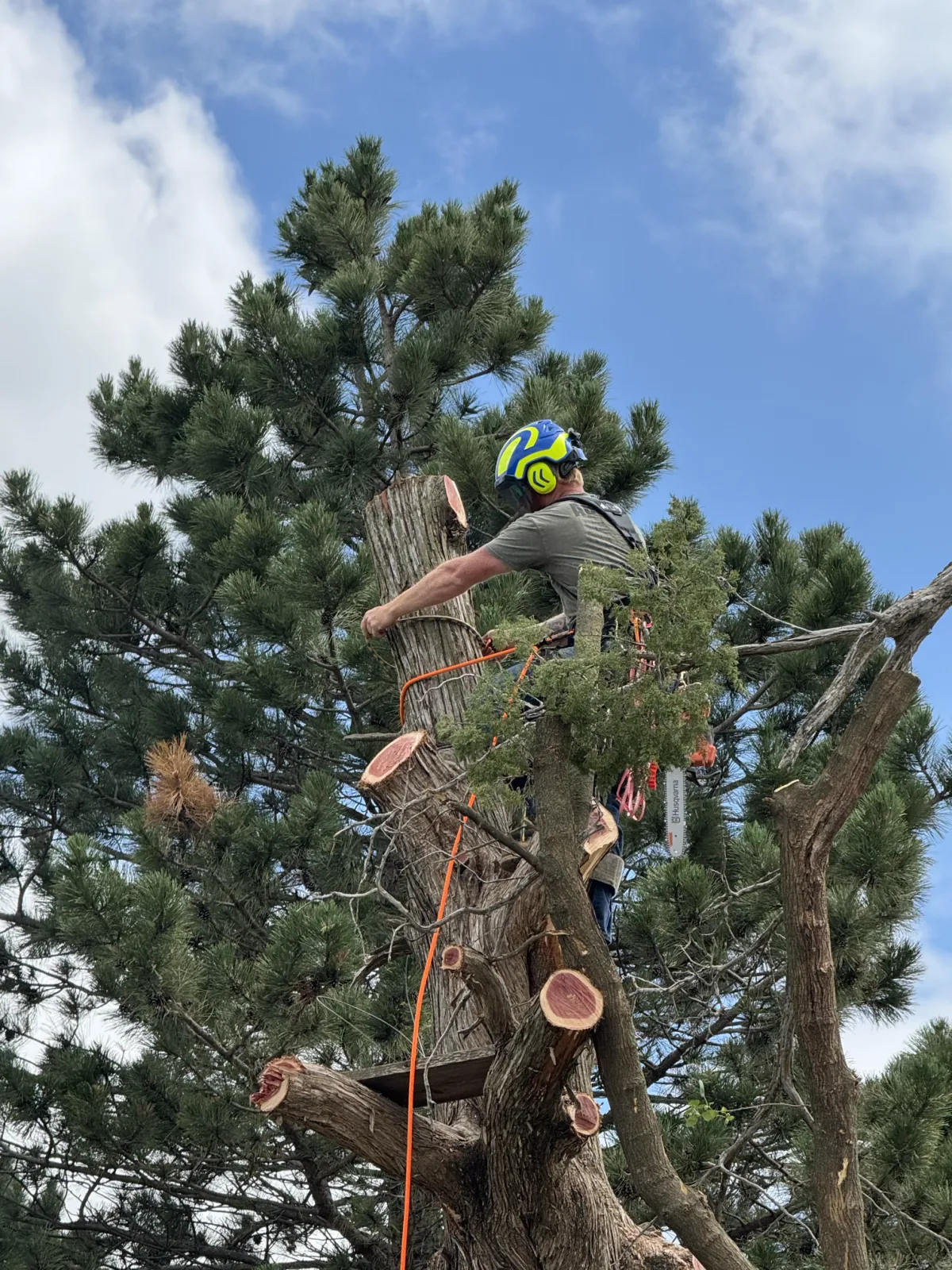
Depending on the tree's location and condition, removal may involve sectional dismantling: cutting the tree from the top down in manageable sections rather than felling it whole. This requires rigging — ropes, pulleys, and friction devices — to lower sections in a controlled direction. It requires someone in the tree making cuts and someone on the ground managing the rigging, both trained to work together. It is not a one-person job, and it is not a job for people who learned rigging from a video.
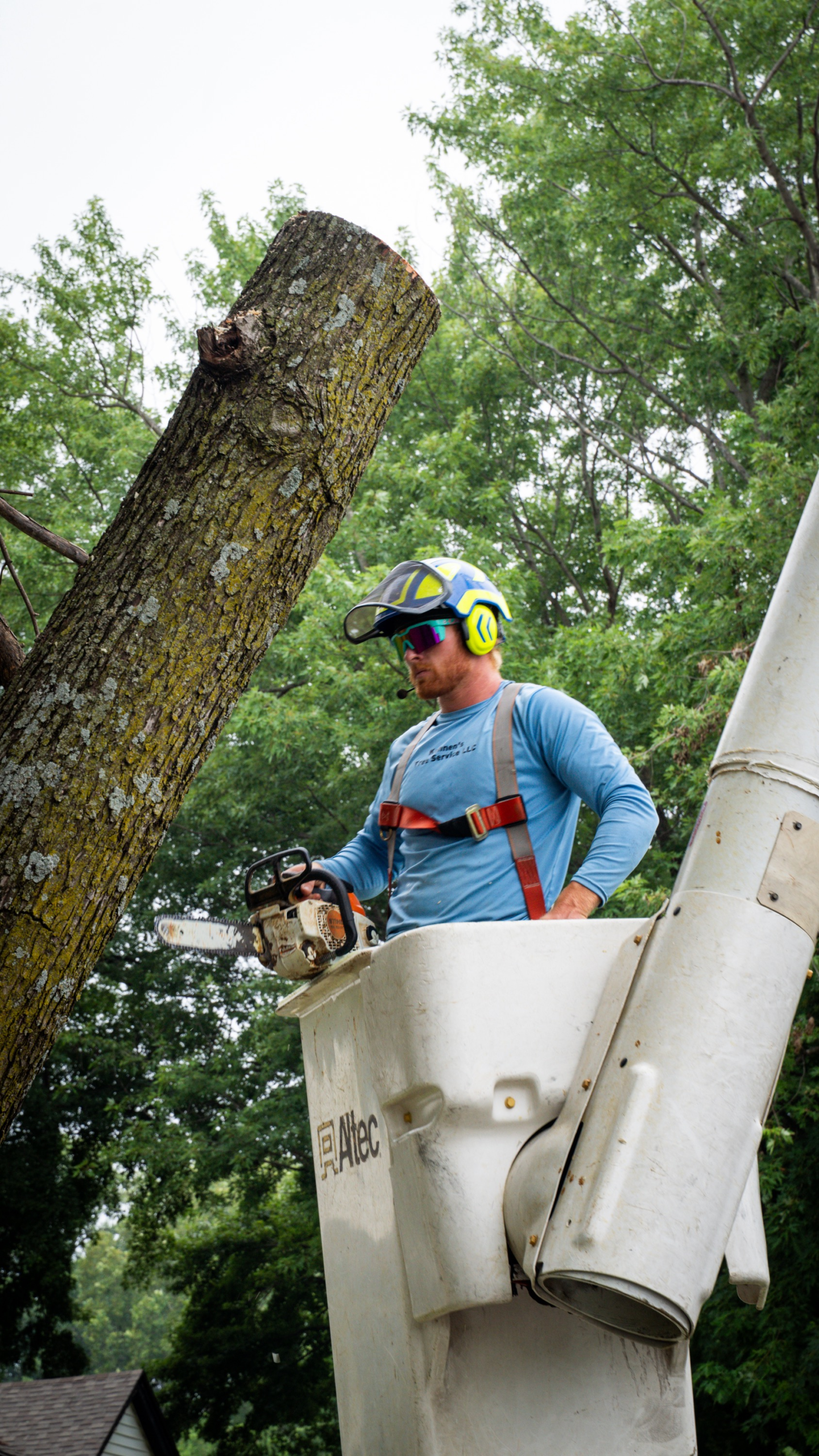
For large trees in tight spaces, crane work may be required. Kohnen's uses a grapple truck for debris handling and has access to equipment that makes large-scale removals efficient and safe. The combination of proper equipment, trained crew, and job-specific planning is what separates professional tree removal from the kind of work that ends up as a damage claim or an ER visit.
"Every job I take on gets my personal attention from the first walk-around to the final cleanup. I've seen what goes wrong when tree work is done without the right training and equipment, and that's exactly why I show up to every job myself. You're not dealing with a subcontractor you've never met. You're dealing with me."
— Joe Kohnen, Owner, Kohnen's Tree Service
When to Call a Professional
There are situations where a homeowner with basic tools can handle tree work safely: trimming low branches on a small ornamental tree, cutting a shrub that has outgrown its space, removing a sapling. There is a clear line between that work and tree removal, and it is crossed well before most homeowners think it is.
Call a professional for any of the following:
- Any tree taller than ten feet, regardless of its condition or location
- Any tree within striking distance of a structure, fence, vehicle, or utility line
- Any tree that is dead, partially dead, or showing signs of structural failure
- Any tree that is leaning — even slightly — toward something you do not want it to land on
- Any tree that has been damaged by a storm, including trees that appear intact but may have hidden root or trunk damage
- Any tree requiring work at height beyond what a six-foot stepladder can safely reach
If you are in Wichita or the surrounding area and you have a tree that needs to come down, the most important thing you can do is get a professional assessment before you do anything else. Kohnen's Tree Service provides free estimates with same-day response. Joe Kohnen will walk the property, evaluate the tree, and tell you exactly what the job requires and what it will cost. There is no obligation, and the information you get from that walk-around is worth having regardless of what you decide to do.
The cost of a phone call is zero. The cost of getting tree removal wrong is not.