
If a tree just came down on your Wichita home and you are reading this on your phone in the next room, slow down. The first hour after a tree falls on a structure is when the most expensive mistakes happen — safety mistakes, insurance mistakes, and contractor mistakes. There is a right order of operations, and following it costs you nothing but ten minutes of careful thinking.
I have been the call after the call on more of these than I want to count, and the patterns are the same every time. Here is what we recommend, in the order to do it, for any Wichita-area homeowner staring at a tree on their roof, garage, fence, or car.
Step 1: Get everyone out and stay out.
The tree on your roof has done its visible damage. What you cannot see is what is happening inside the framing, the ceiling, and the walls. A tree that has crashed through roof sheathing is supported by whatever bent or broken structure caught it — usually a few rafters and trusses, sometimes a single load-bearing beam. That support is rarely stable. Aftershocks — settling, more weight transfer, an internal joist failure — can collapse a ceiling without warning, even hours after the initial impact.
Get everyone out of the house. Yes, even if it looks fine on the interior. Then stay out until the tree has been removed and the structure has been inspected. Don't go back in for laptops, cats, or the safe. Those are insurance items. Your life is not.
Step 2: Look for power lines before you do anything else.
This is the single most dangerous mistake people make in the first ten minutes — walking out to the tree before checking what came down with it. If the tree took out the service drop from the pole to your house, there is a live wire somewhere in or under that mess. Evergy considers any downed wire in the Wichita area energized until they themselves have disconnected and verified it. So should you.
From a safe distance, look up. Trace the line from your meter to the nearest pole. If it is intact and overhead, you are probably fine to walk near the tree. If the wire is hanging low, sagging into the canopy of the fallen tree, or laying on the ground, call Evergy at 1-800-383-1183 before anything else. Do not approach. Do not let kids or pets approach. Wait for Evergy to verify the line is dead. We have walked away from jobs more than once because a downed wire was still hot and the homeowner had been standing within five feet of it for an hour.
Step 3: Call your insurance carrier's 24-hour claims line.
Once you and your family are clear of the structure and you have ruled out (or called in) downed lines, call your homeowner's insurance carrier. Not your agent — the 24-hour claims line, which is a different number printed somewhere on your policy or your declarations page. Open the claim immediately, even at 2 a.m. The earlier the claim timestamp, the less friction you get later about whether damage was pre-existing or storm-caused.
You do not need photos for the claims call. You do not need a contractor estimate. You do not need to know what is covered. You just need to open the claim, get a claim number, and write down the adjuster's name when they assign one.
Step 4: Document everything before anything is moved.
From a safe distance, photograph the damage from every angle you can get. Wide shots showing the whole tree-on-house scene. Closer shots showing the impact point. Photos of any broken windows, downed gutters, or interior damage you can see from outside. If safe and the tree did not come down onto a vehicle, photograph your vehicle in its original location too — adjusters occasionally try to argue a car was moved post-event.
Don't touch anything yet. Don't have a neighbor with a chainsaw start cutting limbs because they're “trying to help.” Insurance carriers strongly prefer the scene to be documented before any cleanup begins, and an over-eager helper can create coverage questions that take weeks to sort out.
Step 5: Call a professional tree service. Specifically a real one.
This is where Wichita homeowners get into the most trouble. After a major storm, the parking lots of every gas station in the metro fill up with out-of-town “tree services” soliciting work door-to-door. Most of them have no insurance, no permanent local address, and no intention of being reachable if they damage your house worse than the tree already did.
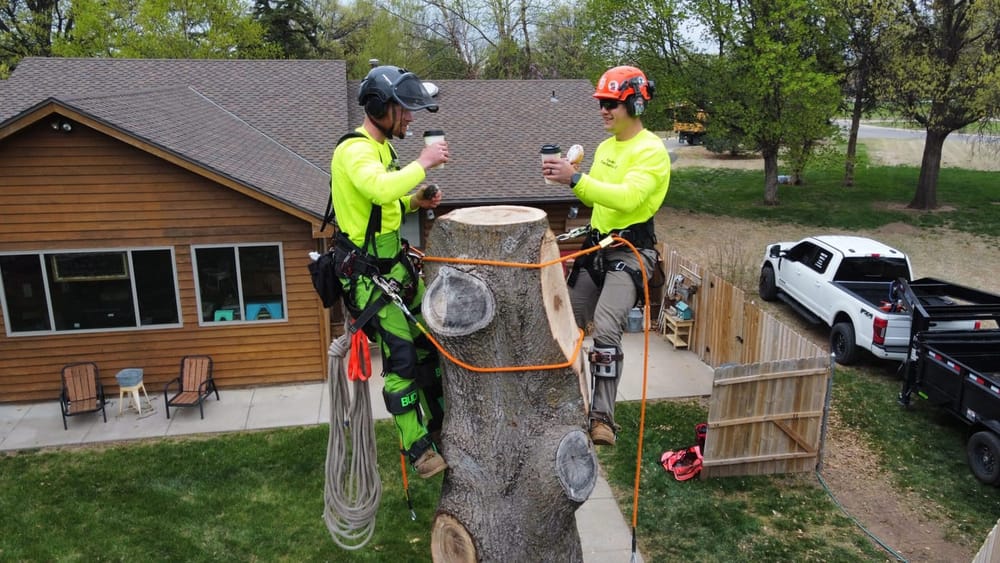
The right call is a local, fully-insured, owner-operated tree company that you can verify with a quick search. We are obviously one of those — Kohnen's Tree Service is Wichita-metro and we work emergencies 24/7 with no after-hours surcharge. But the principle holds even if you call someone else: verify they have a Kansas address, current insurance (general liability AND workers' comp — ask for the certificate), and online reviews older than the storm itself. Storm-chaser companies show up overnight; legitimate local operators have a track record stretching back years.
Ask three questions before you let anyone touch your tree:
- Are you licensed and insured in Kansas, and can you email me your certificate of insurance before you start?
- Will you bill my insurance carrier directly, or do I pay you and submit for reimbursement?
- Are you doing the tree removal AND the structure tarping today, or are those separate calls?
Any “no” or evasive answer to question one is the end of the conversation. We bill insurance directly for covered storm damage and tarp the roof opening the same day as the tree comes off — both should be part of any reasonable emergency tree service in Wichita.
Step 6: Get the tarp on the roof the same day.
Once the tree is off, the structure has an exposed opening. Wichita weather rarely cooperates with patience — the storm that brought your tree down likely has a follow-up cell or front coming through in the next 24–72 hours. Tarping the opening before the next round of rain is critical. Water intrusion damage compounds the original storm damage and is dramatically more expensive to remediate than a single roof opening.
A proper emergency tarp is screwed into intact framing around the opening, not just laid over the hole and weighted down. We carry the right materials on the truck for this and finish the tarp as part of the same emergency call. If the tree-removal company you call cannot tarp the opening that day, find one that can — or have a roofer scheduled to arrive within an hour of the tree being removed.
Step 7: Wait for your adjuster before scheduling the structural repair.
Tree removal and emergency tarping are time-critical. Structural repair is not. Once the tree is off, the roof is tarped, and the scene is stabilized, slow down. Your adjuster typically wants to see the damage in person before signing off on repair scope. Schedule the adjuster's visit before you start collecting roofer or general contractor bids. Premature repair work can complicate the claim.
The exception is anything that could cause further damage if not addressed immediately — for example, a broken window that the tarp cannot cover, or a load-bearing wall that needs to be temporarily supported. For those, document the issue, call the adjuster, and proceed with mitigation under the “reasonable steps to prevent further damage” clause that exists in essentially every homeowner's policy.
What about the tree that's still standing but cracked?
Sometimes the bigger problem isn't the tree that came down — it's the second one in the yard that lost a major leader and is now structurally compromised but still standing. Don't leave that. A cracked tree near a structure is a delayed insurance claim. Have it assessed during the same emergency call. For trees that can be saved, we cable and crown-reduce; for trees that can't, we recommend immediate removal while the area is already mobilized and the costs are still part of the same storm event.
This is also worth understanding before the next storm: Wichita's most failure-prone species are cottonwood, silver maple, Bradford pear, and Austrian pine. If you have one of those within striking distance of your home and have not had it professionally inspected in five-plus years, the next storm is not the time to find out it was structurally compromised.
The short version
Get out of the house, look for downed lines, call insurance, document, call a real local tree service, tarp the same day, wait for the adjuster before structural repair. That order matters. We are reachable any hour at (316) 207-4740 for Wichita-metro tree emergencies — insured, owner-operated, insurance-direct billing for covered storm damage, no after-hours surcharge.