Certified
Arborist Servicesin Wichita, KS
Tree work guided by tree science. Owner Joe Kohnen is an ISA Certified Arborist — every assessment, every pruning plan, and every save-or-remove call comes from someone trained to read what a tree is actually telling you.
An ISA Certified Arborist
on Every Job
Plenty of crews can take a tree down. The harder questions come before the saw starts: Is this tree failing, or just aging? Will pruning help it or stress it further? Is that lean new? Owner Joe Kohnen answers those questions as an ISA Certified Arborist — credential MW-389993A, issued by the International Society of Arboriculture and kept active through continuing education in tree biology, diagnostics, and safe arboricultural practice.
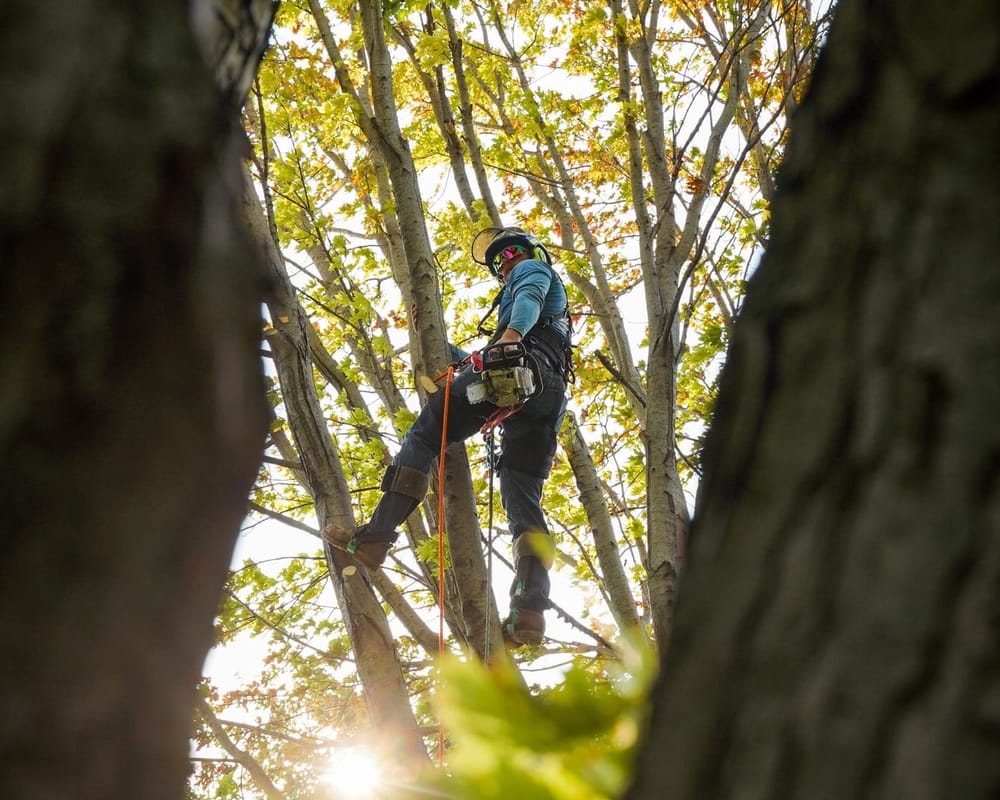
And because Kohnen's is owner-operated, the certification doesn't sit behind a desk — it climbs. The arborist who assesses your tree is the same person who plans the work and runs the crew that performs it.
What a Certified
Arborist Handles
Call when the question is about the tree itself — its health, its safety, its future — not just about cutting.
Tree Health Assessments
A walk-through of the trees you're worried about — canopy density, leaf color, deadwood, fungal signs, root-zone condition — with a straight explanation of what's normal aging and what's a real problem.
Tree Risk Assessment
Structural evaluation of the defects that lead to failure: cracks, included bark, cavities, dead limbs over targets, a lean that wasn't there last year. You learn which trees are safe to watch and which need action before the next windstorm.
Diagnosis & Treatment Plans
Identification of what's actually attacking the tree — emerald ash borer, bagworms, iron chlorosis, storm stress — and an honest read on whether the tree can still be kept. That diagnosis is where our plant health care starts.
Save-or-Remove Decisions
The call homeowners wrestle with most. When a tree sits on the line between salvageable and dangerous, you get a recommendation grounded in its actual condition — not in whichever answer earns the bigger invoice.
Science-Based Pruning Specs
Where to cut, how much to take, and which season to do it in — pruning planned around how the species heals. And we never top trees, period.
Arborist-Led Tree Removal
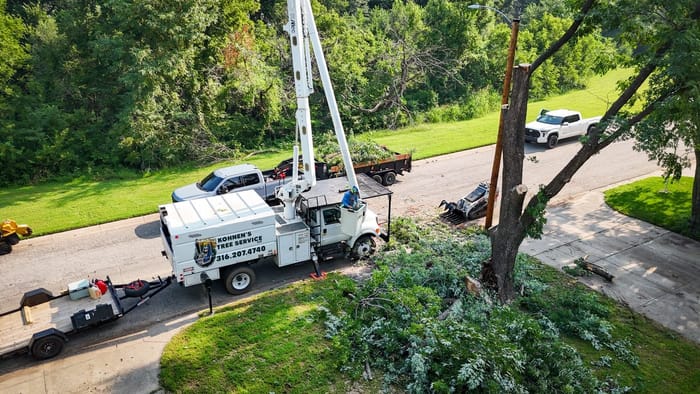
When the assessment says a tree has to come down, the same arborist plans and runs the job — from routine tree removal to dead, split, or leaning trees over a roof taken down in rigged sections through our hazardous tree removal service.
 The Credential
Verify Joe’s ISA
Credential
ISA credentials are public record. Joe's certificate — MW-389993A, issued July 7, 2026 and valid through December 31, 2029 — is published by the International Society of Arboriculture. View it on the ISA site. We'd rather you check than take expertise on faith.
Is a Tree Service the
Same as an Arborist?
Not always. A tree service is a company that does tree work. An arborist is a person trained in how trees grow, fail, and respond to cuts. Some tree services have a certified arborist on the crew and some don’t, and nothing in Kansas requires one.
What a Tree Service Is
A business that removes, trims, and cleans up trees, often with stump grinding and debris hauling alongside. Kansas has no statewide license for general tree work on private property, so a company can call itself a tree service without an exam, a credential, or anyone trained in tree biology on the crew. For that work, insurance and a local track record are what protect you.
What an Arborist Is
A tree professional trained in tree biology, diagnosis, pruning, and safe work practice. The usual proof is the ISA Certified Arborist credential: the International Society of Arboriculture awards it after a comprehensive exam, and the holder has to recertify every three years through continuing education. Anyone can look a credential up in the ISA’s public directory.
When the Difference Matters
For a dead tree that plainly has to go, what you need most is an insured crew that can take it down safely. The training matters when the question is about the tree itself: whether a crack or a lean is dangerous, why a crown is thinning, whether pruning will help or hurt, or whether a big shade tree can be kept at all.
How It Works at Kohnen’s
You don’t have to choose. Owner Joe Kohnen is the ISA Certified Arborist, and he also runs the crew. The person who assesses your tree is the person who plans the cuts or the takedown and works the job, so the advice and the work come from the same place.
How Do I Hire an
Arborist in Wichita?
Six checks, whichever company you call. Each takes a few minutes, and each is a fair thing to ask. Here is what to look for, and how we answer.
Check the Credential
Ask for the arborist’s name and certification number, then look it up in the ISA’s public directory and make sure it is current. Ours: Joe Kohnen, MW-389993A, valid through December 31, 2029.
Ask Who Comes Out
The certified arborist should be the person who sees the tree, not a salesperson passing notes back to the office. Here, Joe does every assessment in person.
Get Proof of Insurance
Ask for a certificate of insurance before anyone starts work. If an uninsured crew drops a limb on your roof or gets hurt in your yard, the bill can land on you. We are fully insured and send a certificate on request.
Get It in Writing
A real assessment names the tree, what is wrong with it, what to do, and what that costs. Any work we recommend gets a written price before it is scheduled, and a written scope and photos are available on request.
Ask How They Prune
The right answer to “do you top trees?” is no: topping leaves weak regrowth and decay, and we never do it. If anyone recommends spraying or injecting a tree, that work needs a Kansas Department of Agriculture pesticide license, which is separate from an arborist credential.
Walk Away From Pressure
An arborist should explain the risk, not sell fear. “Sign today,” a demand for full payment up front, or a door knock right after a storm are reasons to keep looking. Our assessment is free and carries no obligation.
HOA boards and property managers can use the same checks; ask for the findings in writing so the board has something to vote on. Our commercial & HOA tree service page covers certificates of insurance and written scopes for properties. More questions to ask, and the storm-chaser red flags, are in our guide to choosing a tree service in Wichita.
How an Arborist
Assessment Works
Every arborist engagement starts the same way: with the trees, in person, at no charge.
Walk the Property
Joe looks at the trees you're concerned about — and flags anything else worth knowing about while he's there. Free and in person, like every Kohnen's estimate.
Get the Diagnosis
Species, condition, stressors, structural defects — explained in plain language, not jargon. You'll know what kind of tree you have, what's wrong with it, and how urgent it actually is.
See Your Options
What needs action now, what can wait a season, and where treatment beats removal — with exact numbers for each path before anything is scheduled.
Decide Without Pressure
The assessment costs nothing either way. If the right answer is "leave the tree alone," that's the answer you'll get.
What the Free Arborist
Assessment Covers
One visit, one tree or several, as part of every free in-person estimate. You don’t need to know what’s wrong before you call; working that out is the point of the visit. The same assessment is where our plant health care starts.
What Is Wrong With the Tree
Joe identifies the species and what is behind the symptoms: insects such as emerald ash borer or bagworms, a nutrient problem such as iron chlorosis, a disease such as pine wilt, or plain drought and storm stress. Several of these look alike from the ground, which is why the call is made in person.
Whether It Is Safe
Cracks, cavities, fungus at the base, a lean that has changed, dead limbs over the roof, drive, or lines, and included bark: bark trapped inside a tight fork, which is far weaker than solid wood. You learn which trees are fine to watch and which need action before the next ice or wind storm.
Whether It Can Be Kept
An honest keep-or-remove answer, based on the tree’s actual condition. If it can’t be saved or isn’t safe to keep, you hear that plainly, and the removal is quoted as its own job.
Your Options, With a Written Price
For a tree worth keeping: the pruning it needs and any treatment the problem calls for, including what that involves and how often it would have to be repeated. Then a written price for the work we would do. Nothing goes on the calendar until you approve it.
What the assessment isn’t: a promise that a sick tree will recover, a menu of treatments, or a sales visit. If you need the findings on paper for an HOA, an insurance claim, or your own records, ask for a written scope of work and photos. If the tree or a limb touches a power line, say so when you call: Evergy has to make the line safe before any crew can work the tree.
Pruning, Removal, or No Work:
Where an Assessment Leads
Most assessments end one of three ways. Which one depends on the tree, not on which job is bigger.
Pruning
When the trunk and roots are sound and the trouble is up in the crown: deadwood, broken or crossing limbs, a limb over the roof, or a crowded canopy. The fix is selective cuts back to healthy wood, timed for the species; oaks are not pruned electively from April through July. Our tree trimming & pruning work follows Joe’s cut plan.
Removal
When the defect is in the trunk, the base, or the roots and there isn’t enough sound wood left to keep the tree: a split running down from a tight fork, a crack that moves in the wind or touches decay, decay fungus growing from the root flare, a dead tree, or a pine with pine wilt. Trees over a roof or lines come down in controlled, rigged sections through our dead & hazardous tree removal service.
No Work
Sometimes the right answer is to leave the tree alone. A single narrow frost crack on the south side of a sound trunk, mushrooms out in the lawn or mulch, or leaves yellowing early in a dry summer often land here. You’ll hear what to keep an eye on and what change would be worth another call, and the visit still costs nothing.
Read the Signs Before You Call
Two guides help you describe what you’re seeing: how to tell a frost crack from a trunk split that could fail, and whether mushrooms at the base of a tree are harmless or a sign of root rot. Both end in the same place: if the tree can reach the house, the driveway, or a line, have it looked at before winter.
Can’t wait for a visit? If a tree is cracking, leaning harder, or hanging over the house right now, call (316) 207-4740. The line is answered 24/7, and true hazards go ahead of scheduled work. See 24/7 emergency tree service.
MW-389993A
one credential ID — verify it yourself in the ISA public directory
What Customers Say
About Working With Joe
"Kohnen's Tree Service is an outstanding choice for anyone needing professional tree care in Wichita and the surrounding areas. Their team is highly skilled, responsive, and genuinely passionate about their work. I was particularly impressed by their attention to safety, professionalism, and the thorough consultation they provided before starting any work. They handled a large and complex tree removal efficiently, and their crew was courteous and respectful throughout the process."
 Dane Johnson
Google Review
"Joe was very easy to contact, responded quickly, answered all of the questions I had and did so professionally. He showed up exactly when he said he would, did the job exactly how we agreed upon and did it very quickly and for a reasonable price. I haven't had a lot of experience with tree trimming companies but I guarantee the next time I need tree work done I won't be calling anyone else."
 Nic Mans
Google Review
"I'll never use another tree service! Joe killed the backyard for us. He took down an old cottonwood tree with ease that had overhead lines going to the house within feet of the trunk. He also pruned the walnut tree that had some limbs hanging over the lines as well. Hard working honest young man. My yard was cleaner after the project than it was before!!!"
 Colter Thoma
Google Review
Certified Arborist
FAQ
Have a question about your tree? Call (316) 207-4740 and ask the arborist directly.
Ask for the arborist’s name and ISA certification number and check it in the International Society of Arboriculture’s public directory. Make sure that person sees the tree in person, get a certificate of insurance before work starts, get the findings and the price in writing, and confirm the company never tops trees. Walk away from pressure to sign the same day or pay everything up front. At Kohnen’s, ISA Certified Arborist Joe Kohnen (MW-389993A) does every assessment himself, free. The hiring checklist above has the details.
Not necessarily. A tree service is a company that removes, trims, and cleans up trees, and Kansas has no statewide license for that work. An arborist is a person trained in tree biology, diagnosis, pruning, and safety; an ISA Certified Arborist has passed the International Society of Arboriculture’s exam and keeps the credential through continuing education. Some tree services have a certified arborist on the crew and some don’t. At Kohnen’s the owner is both: Joe assesses the tree and runs the crew that does the work.
It's a credential awarded by the International Society of Arboriculture to tree professionals who pass a comprehensive exam covering tree biology, diagnosis, pruning, and safety — and who keep it active through required continuing education. Owner Joe Kohnen holds credential MW-389993A.
Open Joe's ISA certificate, or search the International Society of Arboriculture's public credential directory for MW-389993A or Joseph Kohnen. It takes under a minute, and we genuinely encourage it — verifying credentials is exactly the kind of homework we tell homeowners to do on any tree company.
No. Assessments are part of our free, in-person estimates. Joe looks at the tree, explains what's happening, and gives you your options with exact numbers before any work is scheduled.
Any time the question is about the tree's health or safety rather than just cutting: unexplained decline, suspected pests or disease, storm damage you're unsure about, or a save-or-remove decision. At Kohnen's you don't have to choose — the certified arborist is on every job anyway.
Often, if the cause is caught early. Bagworms, iron chlorosis, and early emerald ash borer infestations can often be managed in a tree that is otherwise healthy, and the assessment tells you whether yours is one of them. A tree that has already lost most of its canopy or has major structural failure usually can't be brought back — and if that's the case, we'll say so plainly.
Yes. When you need documentation — for an HOA, an insurance claim, or your own records — we provide a written scope of work, photos, and a certificate of insurance on request.
It does — ISA Certified Arborists must recertify every three years through continuing education, so the credential only stays active if the arborist keeps studying. MW-389993A is current — issued July 7, 2026 and valid through December 31, 2029 — and the ISA directory will show its status any time you check.
What is wrong with the tree, whether it is safe, whether it can be kept, and what keeping it would take, plus a written price for any work we would do. It is part of our free in-person estimate, it can cover one tree or several, and there is no obligation. Written findings and photos are available on request.
No. It ends in pruning, a removal, or no work at all, depending on the tree. If the right answer is to leave the tree alone, that’s the answer you’ll get, along with what to keep an eye on. The visit is free either way.
Not by themselves. A single narrow frost crack on a sound trunk, or mushrooms out in the lawn or mulch, are often harmless. A crack that runs down from a fork, moves in the wind, or touches decay, or fungus growing out of the trunk or root flare, points to a structural problem. If that tree can reach the house, the driveway, or a power line, have it assessed before winter. Our guides to trunk cracks and mushrooms at the base of a tree go through the signs.
Yes. Joe walks the trees in question with whoever manages the property and gives an honest answer on what to remove, prune, or keep. Any work comes with a written scope and price before it is scheduled, photos on request, and a certificate of insurance sent to the board or management company before work starts. See our commercial & HOA tree service page.
A Certified Arborist
for Greater Wichita
If you've been searching for a certified arborist in Wichita, Derby, Andover, or anywhere within our 40-mile service area, you'll talk to the arborist himself — Joe personally assesses every tree. Call (316) 207-4740 to schedule a free assessment.
Not Sure What Your
Tree Needs? Ask.
A certified arborist will look, explain what's going on, and lay out your options honestly — the assessment is free.
Can't call right now? Request a callback
Why Call the Arborist?
- A free, in-person look at the tree — no obligation
- You talk to the ISA Certified Arborist himself
- Straight save-or-remove answers, not upsells
- Recommendations grounded in tree biology, not guesswork
Free assessments • No obligation