
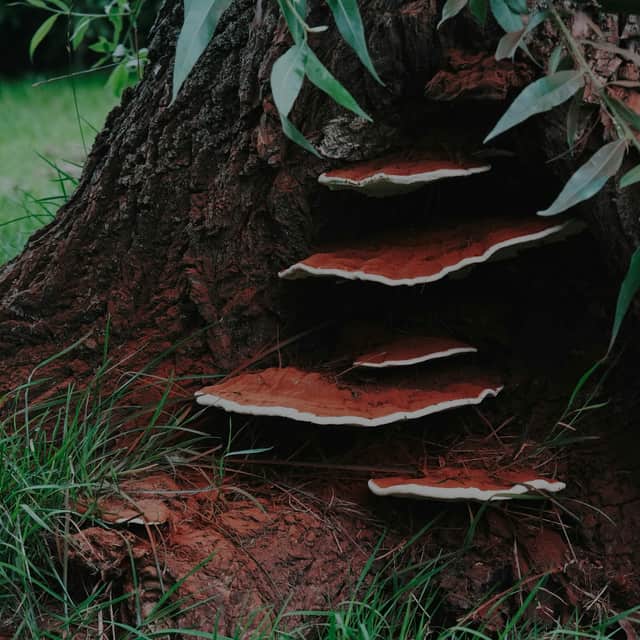
A few days of fall rain, and there they are: a cluster of mushrooms at the base of the big tree out front, or a row of brown shelves sticking out of the trunk just above the grass. It's one of the most common things Wichita homeowners ask us about in October and November, and the question is always some version of the same one: is my tree rotting?
Sometimes the answer is no. Plenty of the mushrooms that come up around a tree are feeding on buried dead wood or living as partners with its roots, and they do the tree no harm at all. Others are the only visible part of a fungus that is decaying the roots or the lower trunk, and those deserve a closer look before winter wind and ice put the tree to the test. The difference usually comes down to three things you can check from the ground: exactly where the fungus is growing, what kind of growth it is, and what else the tree is showing you. This guide walks through all three. If the mushrooms are on an old stump rather than a living tree, start with our guide to what sprouts, mushrooms and sinking soil around an old stump mean.
The Short Answer
- Mushrooms out in the lawn or in the mulch are usually harmless. They live on buried dead roots, old wood or wood chips, or they partner with the tree's roots. They come and go with the rain.
- Fungus growing out of the trunk, the root flare or a root attached to the tree is a different matter. It means a decay fungus is feeding on wood in that tree, and by the time it shows, the decay is usually well along.
- The mushroom is a symptom, not the problem. Picking it, knocking it off or spraying it doesn't touch the fungus inside the wood, and nothing cures wood decay once it is in a tree.
- The urgency depends on how much sound wood is left and what the tree could hit. A fungus at the base plus a lean, lifting soil, cracks, a cavity or a thinning crown is a tree to have looked at now.
- Root rot and winter don't mix. A tree with decayed roots standing within reach of the house, the driveway or a power line shouldn't wait for spring.
What a Mushroom at the Base of a Tree Actually Is
A mushroom is the fruiting body of a fungus, the part that pops up to release spores. The fungus itself is a network of fine threads called mycelium that lives out of sight in the soil or inside wood, sometimes for many years. When the ground stays wet for a few days and the nights cool off, the mycelium sends up mushrooms. When the soil dries out, they collapse and disappear. That's why they seem to appear overnight after a fall rain, and why their disappearing a week later means nothing. The fungus is still there.
The fungi you find around trees fall into three broad groups, and only one of them is a problem for the tree:
- Decomposers. Arborists call them saprophytes: fungi that feed only on dead material. Old roots from a tree that came out years ago, buried construction lumber, wood-chip mulch, thatch. They're harmless to living trees, and they fade once the food runs out.
- Root partners. Mycorrhizal fungi (from the Greek for "fungus" and "root") wrap around a tree's fine roots and trade water and nutrients for sugars. Many of the mushrooms that come up in the lawn under oaks and pines are these. K-State horticulture specialists advise against trying to kill them, because they help the tree.
- Decay fungi. These break down the wood of living trees. Root rot decays the roots. Butt rot decays the butt of the tree, the bottom few feet of trunk where it flares into the roots. They usually get in through wounds and injured roots; K-State notes that decay fungi can't successfully attack a tree through intact bark.
One caution before the checks. A fruiting body tells you a decay fungus is present. It doesn't tell you how much wood it has eaten. University of California integrated pest management specialists put it plainly: a fruiting body visible on a tree is usually associated with advanced decay, and decay can also be hidden, weakening the wood with no outward sign at all.
Check 1: Where Exactly Is It Growing?
This is the check that settles most cases. Get down close and work out which of these you're looking at, from least to most concerning:
- In the lawn, several feet or more from the trunk. Scattered mushrooms, or an arc or ring of them (a fairy ring), are almost always feeding on buried organic matter or partnered with roots. Leave them, mow them or rake them up.
- In the mulch ring. Wood chips grow their own fungi: tiny bird's-nest fungi, little tan mushrooms, and the yellow, foamy slime mold people call dog-vomit fungus. None of it hurts the tree. Do check how the mulch is laid, though. Mulch heaped against the bark keeps it wet, which invites rot. K-State's guidance is a flat ring 2 to 4 inches deep, with a 4- to 6-inch circle of bare soil left around the trunk.
- Where a tree or a stump used to be. Mushrooms over old roots are usually just decomposition. The exception is the honey mushroom (below), which can move from dead roots to living ones. If that's what is coming up and there's a tree you care about nearby, it's worth a look.
- Tight against the trunk, coming out of the soil. Trace it. Brush away the soil or mulch at the stem of one mushroom with a stick or a gloved hand. If it's attached to a root that runs back to the tree, treat it as growing on the tree. If it's coming out of a buried chunk of wood or plain soil, it's probably a decomposer.
- Out of the bark, the root flare, a crack, an old wound or an exposed root. The root flare is where the trunk widens out into the roots at ground level. Fungus growing from any of these places is a decay fungus feeding on that tree. Keep going with the next two checks.
Check 2: Soft Mushroom or Hard Shelf?
- Soft, gilled mushrooms that last a few days. These can belong to any of the three groups, so where they're growing tells you more than the mushroom does. The one worth learning on sight is the honey mushroom.
- Hard, woody or leathery shelves that stay put. Arborists call these conks. They're almost always wood-decay fungi, and some kinds last for years, adding a new layer each season. A conk means the fungus has had time to get established. A dusting of brown powder on the bark or the grass below a shelf is spores, and it's typical of Ganoderma.
- A big, ruffled rosette at the base. A large cluster of overlapping caps at the base of an oak is typically a butt-rot fungus, even though it's soft.
Fungi Worth Knowing on Wichita-Area Trees
You don't need a species name to make the right call. Where the fungus is growing and the condition of the wood matter more. But a handful of fungi turn up at the base of trees often enough to be worth recognizing.
Honey mushroom (Armillaria root rot)
Clusters of honey-colored to tan mushrooms at the base of the tree or coming up from its roots in fall, often with a ring around the stalk. Peel back a piece of loose bark at the base of an infected tree and you may find flat white sheets of fungus, called mycelial fans, between the bark and the wood. In the soil and under the bark there may be black strands that look like shoestrings, called rhizomorphs. Armillaria mostly takes hold in trees already stressed by drought, root injury or construction, and it spreads root to root and through the soil. The crown usually shows it too: poor growth, dead branches near the top, small or yellowish leaves. University of Minnesota Extension notes that infected trees frequently break or fall over in storms.
Artist's conk and other Ganoderma (root and butt rot)
Flat, semicircular shelves at the base of the tree or up to about three feet up the trunk, brown to reddish-brown on top, sometimes shiny as if varnished, and white underneath. The photo at the top of this page is a classic example, brown spore dust and all. Ganoderma causes a white rot: infected wood at the base turns white, soft, stringy or spongy. Texas A&M's plant clinic lists maples, oaks and honeylocusts as particularly susceptible, which covers a lot of Wichita's shade trees. Much of the decay is in the roots, so a tree can look solid at eye level and still have lost much of the anchorage that holds it up. There is no effective fungicide for it.
Hen of the woods and chicken of the woods (oaks)
A large rosette of overlapping gray-brown caps at the base of an oak in late summer or fall is usually hen of the woods, a fungus that rots the roots and the base of the trunk. Bright orange-and-yellow shelves on an oak, at the base or higher up, are chicken of the woods, also called sulfur shelf. It causes a brown rot that leaves the heartwood dry, brown and crumbly, and the University of California specialists note that its conks appear only after extensive internal damage.
Velvety brackets at the base of a pine
On pines and other conifers, a velvety, rusty-brown to mustard-yellow bracket at the base or growing up from the roots is usually dyer's polypore, which causes a brown butt rot. If a pine has turned brown all over this fall, though, the likelier culprit is pine wilt, a different problem with its own removal deadline.
The harmless crowd
Fairy-ring mushrooms, inky caps and shaggy manes, puffballs, stinkhorns, the bird's-nest fungi and slime molds in the mulch, and the mycorrhizal mushrooms that come up under oaks and pines. None of them hurt the tree. Some of them are seriously poisonous, though, including certain Amanitas that grow as root partners with oaks, so one rule holds for every mushroom in the yard: don't eat it, and pick it up where kids and dogs play.
Check 3: What Else the Tree Is Showing You
A decay fungus at the base matters most in combination with other signs. Walk all the way around the tree and look for:
- A lean that's new or getting worse. Compare with old photos, or line the trunk up against a house corner or a fence post and photograph it from the same spot every few weeks.
- Cracked, mounded or lifting soil on the side away from the lean, or roots rising out of the lawn. That's the root plate starting to move.
- A root flare you can't see. A trunk that goes straight into the ground like a telephone pole usually means soil or mulch has been piled over the flare, which keeps the bark wet and hides problems.
- Root injury in the last few years. Trenching for a sprinkler or utility line, a new driveway or patio, foundation work, a grade change, or fill dirt inside the drip line, the circle on the ground under the outermost branches. Mower and string-trimmer scars on the root flare count too. Every one is a way in for decay.
- Trunk defects. Vertical cracks, a seam opening between two stems, a cavity, bark that's loose or falling away at the base, or wood at the base that feels soft or spongy when you press it with your thumb.
- The crown. A thin canopy, leaves smaller or paler than last year, dead branches at the top or on one side (often the side the fungus is on), or a tree that colors and drops its leaves weeks before others of the same kind on the block.
- A repeat. The same mushrooms in the same spot every fall, or a conk that's bigger than it was last year.
Putting It Together: Three Likely Verdicts
Leave it be
Mushrooms in the lawn or the mulch, not attached to the tree. A full, even crown, no lean, and a visible root flare with sound bark. That's a healthy tree with fungi living around it. Rake or mow the mushrooms if they bother you, pull the mulch back if it's piled up, and stop worrying about it.
Have it looked at this fall
Fungus growing from the root flare, the trunk or an attached root, but the tree is otherwise holding up: no new lean, no lifting soil, a reasonably full crown. Or honey mushrooms coming up close to a tree you want to keep. Decay is present, and the question is how much. An arborist's assessment settles whether the tree can stay, with monitoring and the dead wood pruned out, or whether it belongs on a removal timeline.
Treat it as a hazard
A conk or mushrooms at the base plus any of the warning signs in check 3, such as a lean, lifting soil, cracks, a cavity or major dieback, on a tree within reach of something you care about. Arborists call that a target: the house, the garage, the driveway, a play area, the neighbor's yard, the street, a power line. That combination is a removal conversation, and the time to have it is before winter, not after the first ice storm. Our hazardous tree removal page explains how a compromised tree is taken down safely.
Why Root Rot Matters More Heading Into Winter
Root and butt rot work on the part of the tree that holds it up. A tree with decayed roots can tip over with its whole root plate, and the trunk above may look perfectly sound right up until it goes. Saturated ground loosens the grip of whatever sound roots are left, and a Kansas winter brings wind and, in some years, ice. K-State's fact sheet on trees with mushroom growth notes that trees weakened by decay can break during wind or ice storms, and that such trees near structures or where people gather can be a hazard.
Fall is also the practical time to deal with it. The fungi are fruiting, so they're easy to spot. Most trees are still in leaf long enough to judge the crown. And if the tree does have to come down, the dormant season ahead is a good time for removal work. Take your photos now, before the leaves drop.
What's Safe to Do Yourself, and What Isn't
Reasonable to do yourself:
- Pick and bag mushrooms where kids or dogs play, wearing gloves. If a child eats one, call Poison Control at 1-800-222-1222 right away; if a dog does, call your vet. Keep a sample for identification.
- Pull mulch back off the bark into a flat ring 2 to 4 inches deep, with bare soil right around the trunk.
- Keep mowers and string trimmers away from the root flare. A wide mulch ring does that job for you.
- Water deeply during dry spells this fall and through a dry winter, on days above freezing. A tree that isn't drought-stressed holds decay back better.
- Photograph the fungus, the base and the whole tree from the same spots, and keep the dates. Whoever assesses the tree will want to know whether the conk is new and whether the lean is changing.
Not a DIY job:
- Knocking off conks or digging out the rot. The fungus lives inside the wood. K-State's guidance is blunt: nothing can be used to kill mushrooms growing on a tree trunk, because the main body of the fungus is inside the tree and protected. Chopping at it only adds wounds.
- Fungicides and "root rot cures." University of Maryland Extension states that wood decay cannot be reversed or cured. Wound paints and sealers don't help either, and K-State doesn't recommend them.
- Cutting large limbs off a decaying tree, or anything that needs a ladder, climbing or a chainsaw overhead.
- Taking down a tree with root or butt rot. Decay changes how wood breaks. The hinge wood that is supposed to steer a falling tree may be rotten, so the tree may not go where it was aimed, and limbs that look solid may not hold. A decaying tree is the worst possible candidate for a homeowner removal.
- Anything near a power line. Stay well clear. Report a limb on a line to Evergy at 800-LIGHT-KS (800-544-4857), and call 911 if a line is down or sparking.
What an In-Person Assessment Looks At
A photo can narrow it down, but whether a decaying tree can stay is a call best made standing next to it. At a free in-person estimate, owner Joe Kohnen, an ISA Certified Arborist, walks the tree and checks everything in this guide, plus what's hard to judge from the lawn: canopy density and leaf color, deadwood, the fungal signs and exactly where they're attached, the condition of the root zone, the lean, and every target the tree could reach if it failed. Then you get a straight explanation of what's normal aging and what's a real problem, and a written price before anything is scheduled, whether the answer is to leave it and watch it, prune out the dead wood, or take it down. Our arborist services page covers what that visit includes.
If the Tree Has to Come Down
A tree with root or butt rot isn't a routine removal. Wood that can't be trusted to hold a climber or a rigging line is worked from a bucket truck or lift where access allows, with ropes controlling where each piece lands. The crown comes down first, then the trunk in sections, lowered away from the house, the fence and the lines. The longer a decaying tree stands, the more brittle and unpredictable it gets, which makes the job harder, not easier.
If the tree has already died outright, with no leaves this growing season, bark coming off in sheets and twigs that snap instead of bending, our guide to the signs of a dead tree and when to remove it covers that side of the decision.
After a removal, mention it if a root rot was involved. Honey mushroom and Ganoderma can live on in the stump and the roots left behind, so grinding the stump and choosing a different spot for the replacement tree are both worth talking through at the estimate.
When It Can't Wait
Most fungus questions are slow ones. A few things turn them into fast ones:
- A tree with fungus at the base that has started to lean, or leans further after a storm.
- Soil cracking or lifting at the base, or roots pulling up out of the lawn.
- A fresh crack in the trunk, or a split opening between two stems.
- A tree or a large limb already down on the house, a car, a fence or a line.
Those are calls for our 24/7 emergency tree service, not for next month's schedule. Keep people, pets and cars out of anywhere the tree could land, which is at least its full height in every direction, until it's dealt with.
Frequently Asked Questions
Are mushrooms growing at the base of a tree bad? Not always. Mushrooms in the lawn or mulch around a tree are usually decomposers feeding on buried dead wood, or fungi that partner with the roots, and they don't hurt the tree. Mushrooms or shelf fungi growing out of the trunk, the root flare or an attached root mean a decay fungus is feeding on that tree's wood, and the tree should be checked.
Does a mushroom on my tree mean the tree is dying? Not necessarily. It means some of the wood is decaying, and many trees live for years with some decay. What matters is how much sound wood is left, whether the roots are affected, and what the tree could hit if it failed. A fungus at the base plus a lean, lifting soil, cracks or a thinning crown is the combination to take seriously.
What does root rot look like at the base of a tree? Clusters of honey-colored mushrooms or hard, shelf-like conks at the base or on the roots, bark that's loose or falling away at the soil line, wood that's soft, spongy or crumbly, white fan-shaped fungus under loose bark, and black shoestring-like strands in the soil. Above ground, look for a thin crown, small or yellowing leaves, dead branches near the top, and sometimes a new lean.
Should I remove mushrooms growing at the base of my tree? You can pick and bag them where kids or pets play, wearing gloves. It won't help the tree or stop any decay, because the fungus itself lives in the soil or inside the wood. Don't knock off or cut out shelf fungi on the trunk; that only creates fresh wounds.
Can root rot in a tree be treated? It can't be cured. No fungicide stops wood decay inside a living tree. Watering in drought, keeping mulch off the trunk and avoiding root and trunk injuries help a tree hold decay back. When decay has compromised the roots or the base of a tree near a home or a street, removal is usually the safe answer.
Why do mushrooms appear around my tree after it rains? Mushrooms are the fruiting bodies of fungi that live in the soil or in wood year-round. A few days of wet soil, especially with cool fall nights, triggers them to fruit. When the soil dries they collapse, but the fungus is still there, which is why they come back in the same spots.
Are mushrooms around trees poisonous to dogs? Some are, and a few that grow near oaks can be deadly. Safe and dangerous mushrooms are hard to tell apart on sight, so pick up mushrooms where dogs and children play. If a dog eats one, call your vet right away; if a child does, call Poison Control at 1-800-222-1222.
Is a tree with shelf fungus on the trunk safe to keep? Sometimes. Shelf fungi mean decay that is usually well established, and some, like Ganoderma at the base, signal root and butt rot that can cause a tree to tip over. Whether the tree can stay depends on how much sound wood remains and what it could hit, and that takes an in-person assessment by an arborist.
What does a ring of mushrooms around a tree mean? Usually a fairy ring: a fungus growing outward through the soil and feeding on buried organic matter such as old roots or wood. It's harmless to the tree. A ring is only a concern when the mushrooms are honey mushrooms, or when they're coming up right against the trunk or from its roots.
Worried About the Fungus at the Base of Your Tree?
If the checks turned up a fungus growing from the tree itself, or you'd just like a second set of eyes on a big tree near the house before winter, that's what a free in-person estimate is for. Owner Joe Kohnen is an ISA Certified Arborist (credential MW-389993A) and climbs and works every job himself. Kohnen's Tree Service is family-owned, fully insured, based right here in the Wichita area, and has 135+ five-star Google reviews from homeowners across Wichita, Park City, Derby, Andover, Bel Aire and the surrounding towns.