
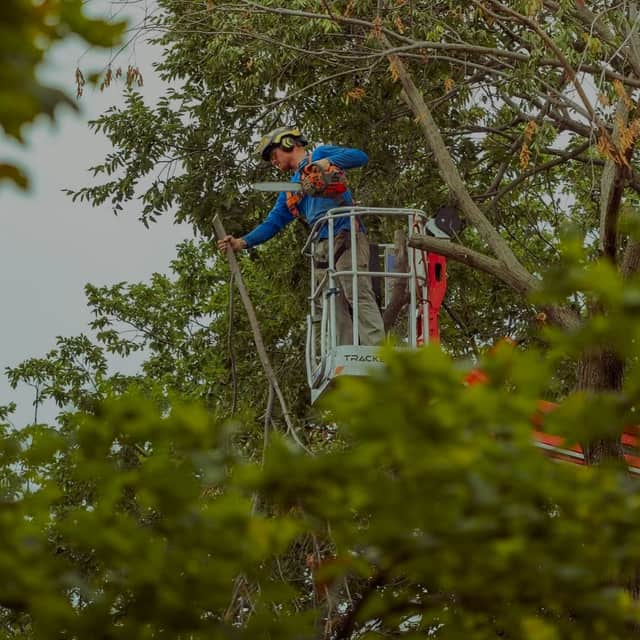
Most trimming calls start with one limb. The one scraping the roof, the dead one hanging over the driveway, the low one that catches the mower every week. By the time I’m standing in the yard, it usually turns out the tree needs a little more than that one cut — and sometimes a lot less than the homeowner was afraid of.
Hiring a tree trimming service for a big, established tree is an odd kind of purchase: you can’t easily see from the ground whether the work was done right, and the mistakes often don’t show for a year or two. This checklist is for Wichita-area homeowners with mature trees who are hiring the work out. It covers what to sort out before anyone comes, what a good estimate should tell you, what belongs in the written price, how to get the yard ready, and how to check the cuts after the crew leaves. If you’re planning to make a few small cuts yourself, our homeowner’s trimming checklist covers that side. This one is about the job you pay someone else to do.
The Short Version
- Before you call: know which trees, which limbs, and what sits under each one — roof, driveway, fence, the line to the house.
- At the estimate: the person should look at the tree in person, name the kind of pruning, point to the actual limbs, and tell you roughly how much is coming off.
- In writing: one price that lists every tree, the work on each, and the cleanup.
- On the day: clear everything out from under the tree, keep kids and pets inside, and stay out of the work area.
- After: cuts sit just outside the branch collar, limbs end at a living side branch, the inside of the tree still has branches, and nothing is topped.
- Timing: dead and broken limbs come off any time; heavy cuts wait for winter; oaks are not cut April through July.
- Safety: storm damage, chainsaw work, ladders, climbing, and anything near a power line belong to a professional crew.
What Tree Trimming Is Called — and the Five Kinds of Work It Covers
The arborist’s word for trimming tree branches is pruning. Homeowners say trimming, arborists say pruning, and on a shade tree they mean the same work. What helps more than the word is knowing the names you’ll hear on an estimate, because each one is a different job. Two terms first: the crown is the whole branching, leafy top of the tree, and a side branch (an arborist will say lateral) is a smaller branch growing off a bigger limb.
- Crown cleaning (often called deadwooding) — removing dead, dying, diseased, and broken branches. On most mature trees this is the bulk of the job and the part that matters most for safety.
- Crown thinning — removing a few selected live branches inside the crown so light and wind can pass through. It should be light and spread evenly through the tree, not a hollowing-out.
- Crown raising (also called lifting or limbing up) — removing the lowest limbs so you can walk, mow, and park under the tree.
- Crown reduction — making a tree shorter or narrower by cutting limbs back to a smaller side branch that takes over as the new tip. This is the right way to shrink a tree. It is not the same as topping.
- Clearance pruning — cutting limbs back from the roof, chimney, siding, fence, and the service line that runs from the pole to your house.
One more term you’ll hear: the branch collar, the slightly swollen ring of bark where a branch joins the trunk or a bigger limb. A proper pruning cut is made just outside it, because that collar is where the tree grows the wood that closes the wound. At Kohnen’s, our tree trimming and pruning service covers all five, and most mature-tree jobs are a mix of two or three of them.
Before You Call: A Five-Minute Walk Around the Yard
You don’t need to know anything about trees to do this. You just need to look up, and write down what you see. It makes the estimate faster and the price more accurate.
- List the trees and what bothers you about each. “The maple over the garage drops limbs,” “the elm by the drive is too low,” “the oak out back shades the whole garden.”
- Note what’s under every problem limb. Roof, driveway, deck, fence, a neighbor’s yard, the line to the house. What a limb hangs over changes how it has to come down.
- Look for dead wood while the leaves are still on. Right now, in October, a dead limb stands out as a bare or brown patch in a green or yellow crown. Once the leaves drop, it’s much harder to pick out. Snap a photo.
- Name the species if you know it. Oaks, elms, maples, and spring-flowering trees each have their own timing rules, so it helps to know what you have.
- Confirm whose tree it is. A tree on the property line, or one that belongs to the neighbor, needs a conversation before anyone cuts. Inside Wichita city limits, a tree in the strip between the sidewalk and the street is usually the City’s, and it can’t be trimmed beyond small clearance cuts without City consent. Our guide to neighbor tree laws in Kansas has the details.
- Check for wires. Note any branch near the service line to your house or the lines on the poles. If a limb is already touching a line, it has to be made safe by Evergy before any tree crew can work on it.
- Check for storm damage. A crack in the trunk, a split fork, or a hanger — a broken limb caught up in the branches — isn’t a routine trim. If it’s over the house, the driveway, or anywhere people walk, keep everyone out from under it and call for 24/7 emergency tree service instead of waiting for a scheduled visit.
At the Estimate: What a Good Tree Trimming Service Should Tell You
A trimming estimate is where you find out whether the person on your lawn knows trees or just knows saws. Here is what you should hear before you agree to anything.
- They looked at the tree in person. A price from a texted photo can’t account for dead wood hidden in the crown, cracks, what each limb hangs over, or how a climber or lift will reach it.
- They named the work and pointed at the limbs. “Clean out the dead wood, raise the two low limbs over the drive, and reduce the three limbs over the roof back to side branches” is a plan. “We’ll thin it out and clean it up” is not.
- They told you how much live canopy is coming off. The usual limit is about a quarter of the living crown in a year, and less on a mature or stressed tree. Leaves are how the tree feeds itself, so a crew that wants to take a third or half of a healthy tree in one visit is selling you a problem.
- They explained where the cuts will end. Each limb should come back to the trunk or to a side branch at least a third as thick as the piece being removed. Cutting a limb off in the middle, with no side branch to take over, is a heading cut. Doing it across the whole tree is topping, and a good company won’t offer it. Our article on why tree topping damages trees explains what it does.
- They told you how they’ll get into the tree. Smaller trees are pruned from the ground or a ladder. Mature shade trees need a climber on rope or a lift. Climbing spikes — metal spurs strapped to the boots — punch holes through the bark and are meant for trees being removed. The national pruning standard, ANSI A300, says they shouldn’t be used on a tree that’s being pruned, outside a few narrow exceptions.
- They told you if it isn’t really a trim. A split trunk, a large hollow, a crown that’s mostly dead, or a lean that wasn’t there last year are problems pruning can’t fix. An honest estimator says so, even when it means a removal conversation. Our guide to tree trimming vs. removal walks through those signs.
- They talked about timing. Dead and broken limbs can come off any month. Heavy cuts on healthy trees are best in late winter. Oaks are not pruned electively from April through July, when fresh cuts can let in oak wilt.
At Kohnen’s, the estimate is free and done in person by owner Joe Kohnen, an ISA Certified Arborist who is also the lead climber on every job. He walks the yard with you, explains which cuts the tree needs and which it doesn’t, and puts one price in writing before anything goes on the calendar. If you’re still deciding which company to bring out, our guide on how to choose a tree service in Wichita covers insurance certificates, credentials, and red flags.
What the Written Price Should Spell Out
The written estimate is your record of what you agreed to. Before you sign off, check that it covers:
- Every tree, by where it stands. “Silver maple over the garage” and “oak in the back corner” leave no room for confusion on the day.
- The work on each tree. Deadwood out, limbs raised over the drive, roof clearance — the same plan you heard at the estimate.
- Cleanup. Whether every cut branch is chipped and hauled away and the yard is raked, or whether brush is left at the curb. At Kohnen’s, cleanup is part of every trimming price.
- The wood. If you want to keep some for firewood, say so at the estimate and get it written down.
- One total for the whole job. Several trees trimmed in one visit usually cost less per tree than separate trips, so get them on the same estimate.
- What happens if weather moves the date. High wind and storms stop tree work. Know how a rescheduled day is handled.
The Day of the Trim: Getting the Yard Ready
A little prep keeps the job moving and keeps your things in one piece. The area under the tree where cut limbs land or get lowered is the drop zone, and the crew needs it clear.
- Move cars out of the driveway and off the street under the tree.
- Clear out patio furniture, grills, planters, and toys from under the canopy.
- Keep pets and kids inside until the crew is done and the yard is cleaned up.
- Unlock gates and tell the crew about sprinkler heads, low landscape lights, or anything else hidden in the grass.
- Give the neighbor a heads-up if limbs hang over their yard, and ask whether the crew can step onto their side if they need to.
- Stay out of the work area. If you have a question, wave down the person on the ground rather than walking under the tree.
After the Crew Leaves: The Five Rules of Pruning, and How to Check Each One
People often ask for “the five rules of pruning.” There’s no single official list, but these are the five almost every arborist works by — and each one leaves something you can check from the ground the day the crew leaves. Binoculars help on a tall tree.
1. Dead, diseased, and damaged wood comes out first
Removing those is almost always right, whatever else the tree needs. Check: no dead or broken limbs left over the roof, the drive, or the places people sit.
2. Every cut sits just outside the branch collar
Not flush against the trunk, which cuts away the tissue that seals the wound, and not out on the limb, which leaves a stub that rots. Heavy limbs come off in three cuts so their weight doesn’t tear a strip of bark down the trunk. Check: cuts are clean and roughly round, with no long stubs, no gouges into the trunk, and no torn bark hanging below a cut.
3. Take no more than the tree can spare
About a quarter of the living crown in a year at most, and less on a mature, stressed, or newly damaged tree. Check: the tree still looks full, and there are still branches along the inside of the main limbs. Watch out for lion-tailing — stripping out all the inner branches so the leaves are bunched at the ends of long bare limbs, like the tuft on a lion’s tail. It makes the limbs heavier at the tips and easier to break in wind, and the national pruning standard calls it unacceptable.
4. Shorten limbs back to a side branch — never top
A shortened limb should end at a living side branch big enough to take over. Check: no limbs that end in a flat-cut stub with nothing growing past it, and no tree that looks like it was given a flat-top haircut.
5. Prune at the right time for the species
Most heavy pruning belongs in the dormant season, spring-flowering trees wait until their flowers fade, and oaks stay off the schedule April through July. Check: if an oak had to be cut during those months because of storm damage, the fresh cuts should have been painted right away (more on that below).
Last, check the cleanup: no brush piles at the curb, no limbs left in the flower beds, and the yard raked. On a tree that was pruned rather than removed, there also shouldn’t be a row of small spike holes running up the trunk. If you want the cut-by-cut detail, including the three-cut method, our practical tree trimming checklist walks through it.
Do Tree Branches Grow Back After Trimming?
Not the branch that was removed. When a branch is cut off properly at its collar, the tree doesn’t regrow it. Instead, it walls off the wound from the inside and grows a ring of new wood over the cut, which closes it over a few years. Arborists call that walling-off compartmentalization. The crown fills back in from the branches that are left, which keep growing outward a little every year.
It’s different when a limb is cut off in the middle with no side branch to take over, or when a tree is topped. The tree answers with a cluster of fast, upright shoots near the cut, called water sprouts. They grow quickly, they’re weakly attached, and in a few years they turn into heavy limbs that break more easily than the one that was cut. That is why topped trees seem to “need trimming” every year or two. A handful of sprouts after a proper trim is normal. A thick broom of them is a sign too much came off.
Can You Make Homemade Pruning Sealer — and Do You Need It?
You can mix one, but on almost every cut you don’t need any sealer at all. Trees close their own wounds, and research and extension guidance have been consistent for years that wound paint and tar don’t stop decay — a coating can even hold moisture against the wood. Skip the homemade recipes that call for tar, roofing products, or motor oil. They don’t help, and some of them hurt the living tissue around the cut.
There is one exception that matters in Kansas: oaks cut between April and July. Fresh oak wounds in those months attract the sap beetles that carry oak wilt. Extension foresters recommend not pruning oaks in that window at all, and coating any unavoidable wound — a storm-broken limb, for example — with latex paint right away, so the beetles can’t reach the fresh wood. Ordinary latex house paint is enough. That is the closest thing to a homemade sealer that is actually recommended, and it only applies to oaks in season.
What a Tree Trimming Service Costs — and When Cutting It Down Is Cheaper
Height is the biggest driver of trimming price, followed by access and how much dead wood or clearance work the tree needs. Typical single-tree ranges in the Wichita area:
- Under 20 feet: $75 to $200 — ornamentals and young trees, usually trimmed from the ground or a ladder.
- 20 to 40 feet: $200 to $450 — most yard trees: dead wood, raising the canopy, roof clearance.
- 40 to 60 feet: $400 to $800 — mature shade trees that need a climber or a lift.
- 60 feet and up: $700 to $1,500 or more — big cottonwoods, oaks, and silver maples with heavy limbs over structures.
Taking a tree down costs more for the same size of tree. Removals in the Wichita area typically run about $200 to $500 for trees under 30 feet, $500 to $1,500 for 30 to 60 feet, and $1,500 to $3,000 or more for the largest trees, and stump grinding is usually a separate $100 to $400. These are general market ranges, not quotes — the exact number comes from seeing the tree. Our tree trimming cost guide for Wichita breaks down what moves a price up or down.
So is it cheaper to have a tree cut down or trimmed? For one visit, trimming is almost always cheaper: the trunk stays, nothing has to be felled or hauled in big pieces, and there’s no stump. Over the long run, a healthy mature tree trimmed every three to five years still usually costs less than removing it and replacing the shade it gives you. Removal becomes the cheaper answer in two cases: when the tree is failing and each trim only postpones the takedown, and when it’s the wrong tree for the spot — a fast-growing silver maple crowding the house that needs clearance cuts every couple of years, for example. If you’re weighing that call, our breakdown of tree removal costs in Wichita covers the other side of the numbers.
A Season-by-Season Plan for Mature Trees
Big trees don’t need attention every month, but each season has one or two things worth doing.
- Fall (now): walk the trees before the leaves drop and mark the dead limbs. Get dead wood and anything cracked or hanging over the house out before ice season — our guide to ice storm tree damage explains why. Hold heavy elective cuts on healthy trees until winter, because fall is the slowest season for wounds to close. It’s also a good time to get the winter trim on the calendar.
- Winter (December through March): the main window for structural pruning, crown reduction, and thinning. With the leaves down, the branch structure is easy to see. Oaks and elms belong here, with late January through early March the prime stretch.
- Spring (April and May): prune spring-flowering trees like redbud and crabapple right after the flowers fade. Elective oak pruning stops at the start of April. Look the trees over after every spring storm.
- Summer (June through September): dead wood is easiest to spot when everything else is in leaf, so it’s a fine time to have it removed. Keep any live-wood cuts light during hot, dry spells, and check the trees after every big wind.
Most mature shade trees do well with a full pruning every three to five years, with fast growers like silver maple, cottonwood, and Bradford pear at the short end of that range. The species-by-species calendar is in our guide to the best time to trim trees in Kansas.
What You Can Trim Yourself — and What Goes to a Pro
Plenty of small pruning is a reasonable homeowner job. The line is about height, weight, and power.
Reasonable to do yourself:
- Small branches you can reach with both feet on the ground, cut with sharp hand pruners, loppers, or a hand saw — roughly an inch and a half thick or less.
- Sprouts coming up from the base of the trunk or the roots.
- Shaping a young tree while it’s still small.
- Picking up small storm debris that’s already on the ground and not tangled in anything.
Not a DIY job:
- Anything that needs a ladder and a saw at the same time, or climbing. Falls from ladders are how a Saturday trim turns into an emergency room visit.
- Chainsaw work in a tree or overhead. A running saw above shoulder height, or on a limb you’re standing under, is professional work.
- Large limbs — anything heavy enough to hurt someone or damage the roof, fence, or car when it comes down.
- Removing a tree, even a small one, if it could hit anything on the way down. Our piece on why DIY tree removal goes wrong explains the risks.
- Storm damage. Bent, twisted, split, or hanging wood holds tension you can’t see, and it can spring or roll when cut.
- Anything near a power line, including the line to the house. Keep yourself, your ladder, and your tools at least 10 feet from any overhead line. If a line is down or sparking, call 911 and report it to Evergy at 800-LIGHT-KS (800-544-4857).
Frequently Asked Questions
What is it called when you trim tree branches? Pruning. Homeowners usually say trimming and arborists say pruning, but on a shade tree it is the same work. The specific jobs have their own names: crown cleaning (removing dead and broken branches), crown thinning, crown raising (removing low limbs), crown reduction (shortening limbs back to side branches), and clearance pruning around roofs and lines.
Is it cheaper to have a tree cut down or trimmed? Trimming is almost always cheaper for a single visit, because the trunk stays and there is no felling, heavy hauling, or stump. Removal becomes the cheaper long-run choice only when the tree is failing or is the wrong tree for its spot and would need frequent clearance cuts.
Do tree branches grow back after trimming? A branch removed properly at its collar does not grow back; the tree seals the wound and the crown fills in from the remaining branches. Limbs cut off in the middle, or topped, sprout clusters of fast, weakly attached shoots called water sprouts near the cut.
What are the five rules of pruning trees? There is no single official list, but most arborists work by these five: remove dead, diseased, and damaged wood first; cut just outside the branch collar with no stubs or flush cuts; take no more than about a quarter of the living crown in a year; shorten limbs back to a side branch instead of topping; and prune at the right time of year for the species.
Can I make homemade pruning sealer? You can, but you almost never need sealer. Trees close their own wounds, and wound dressings do not stop decay. The exception is an oak cut between April and July: extension foresters recommend coating that wound right away with latex paint to keep away the beetles that spread oak wilt. Ordinary latex house paint is enough.
How much does it cost for a tree to be cut? In the Wichita area, trimming one tree typically runs $75 to $200 under 20 feet, $200 to $450 at 20 to 40 feet, $400 to $800 at 40 to 60 feet, and $700 to $1,500 or more above 60 feet. Removal costs more, typically $200 to $3,000 or more depending on size, with stump grinding usually extra. An in-person estimate gives the real number.
How often should a mature tree be trimmed? Most mature shade trees do well with a full pruning every three to five years, plus a check after any storm that breaks limbs. Fast-growing species such as silver maple, cottonwood, and Bradford pear sit at the short end of that range.
What should a tree trimming service include? An in-person look at the tree, a plan that names the work on each limb, cuts made to the branch collar or back to a side branch with no topping, and a written price that includes chipping, hauling, and raking up every cut branch.
Booking a Tree Trimming Service in Wichita
If your trees are due — or you’re not sure what they need — the next step is a free look in person. Kohnen’s Tree Service is family-owned and fully insured. Owner Joe Kohnen is an ISA Certified Arborist and the lead climber on every job, so the person who plans the cuts is the person making them. We follow the ANSI A300 pruning standard, we never top trees, and cleanup is part of every price. Homeowners rate us 4.9 from 140+ Google reviews.
We’re based in Park City and trim trees across Wichita and nearby towns, including Bel Aire, Andover, and Derby. And when a storm breaks something that can’t wait, we answer 24/7.
Request a free trimming estimate online, or call (316) 207-4740. We respond the same day or next day.