
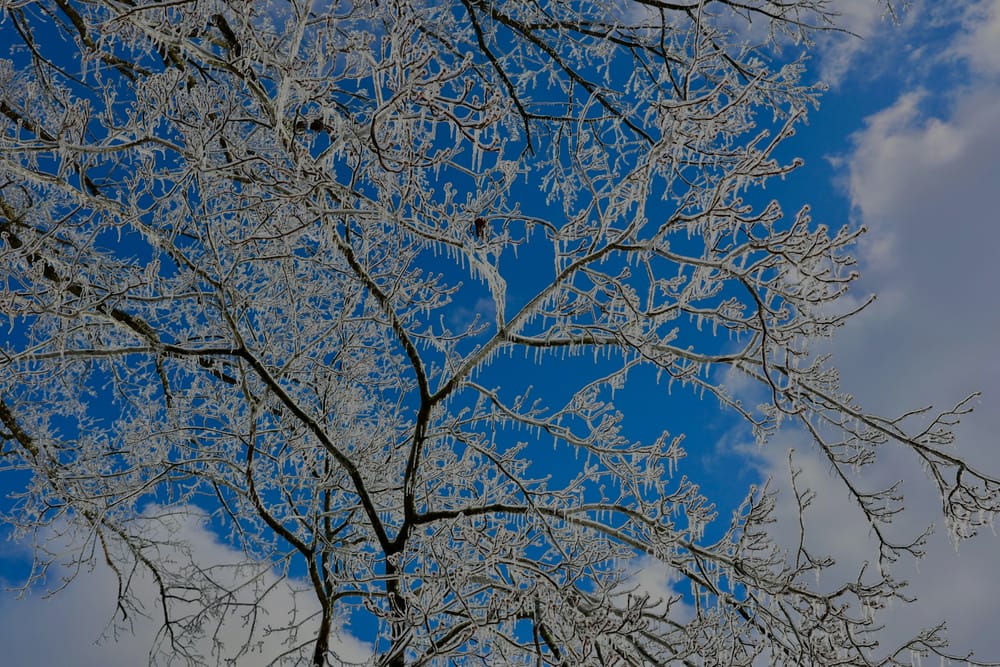
An ice storm in Wichita usually announces itself after dark. Freezing rain glazes every twig for hours, and then the cracking starts — a sharp report, a pause, and the rush of a limb coming down through the branches below it. By morning there are limbs across driveways, on cars and roofs, and tangled in the lines, and every tree crew in town has a waiting list.
Ice storm tree damage is the one kind of storm damage you can see coming weeks ahead, because the trees that fail under ice are mostly the ones that were already weak. This guide is for homeowners in Wichita and the surrounding towns heading into ice season: which trees break first, what is worth pruning or removing before winter, what to do and not do while the ice is on, and how to tell an ice-damaged tree that will recover from one that has to come down. It comes from the crew that does the cleanup — Kohnen’s Tree Service is based in Park City and runs 24/7 storm work across Sedgwick County and the communities around it.
The Short Answer
- Ice season is coming. Most ice storms hit between December and March, most often in January. October through early December is the time to get trees ready.
- The trees that break are mostly predictable. Siberian elm, silver maple, Bradford pear, hackberry, cottonwood and honeylocust top the list, along with any tree carrying dead wood, tight V-shaped forks, or regrowth from past topping.
- Before winter: get dead wood and hanging limbs out, deal with weak limbs over the house, and take down trees that are already dying.
- During the storm: don’t knock ice off branches, don’t prop limbs up, stay out from under loaded trees, and treat every downed line as live.
- After the ice melts: photograph the damage, handle real hazards first, and don’t rush to cut down a tree that isn’t one. A healthy tree that kept at least half its crown usually recovers.
- Never top a damaged tree, and don’t hire whoever knocks on your door with a chainsaw.
How Often Ice Storms Hit the Wichita Area
Ice isn’t a once-a-generation event here. The National Weather Service office in Wichita has documented several that hit the area hard:
- January 3–4, 2005. A quarter to half an inch of ice coated most of south-central Kansas. More than 50,000 people in Sedgwick County lost power at one point, and the damage to trees, lines and poles left many areas without power for one to two weeks.
- December 10–11, 2007. One to two inches of ice across the region, about 260,000 people without power, and $136.2 million in damage to the power system alone. The Weather Service described the damage to trees as severe and called it the costliest ice storm in Kansas history.
- January 13–15, 2017. A reminder of how local ice is: north Wichita reported about an eighth of an inch on its trees, while Great Bend picked up as much as three-quarters of an inch.
Researchers who study ice and trees put the national pattern plainly: about 90 percent of ice storms fall between December and March, and most of them in January. So the useful question for a Wichita homeowner isn’t whether ice will come, but what shape your trees are in when it does.
Why Ice Breaks Trees
Freezing rain falls as liquid and freezes on contact with anything at or below 32°F. The Weather Service counts it as an ice storm once a quarter inch or more has built up on exposed surfaces — and unlike snow, it coats the underside of every branch and doesn’t slide off.
- The weight is enormous. Richard Hauer and colleagues at the University of Wisconsin–Stevens Point and the University of Illinois estimate that ice can increase a branch’s weight by 10 to 100 times. All of that load ends up at the branch unions.
- Wind multiplies it. The Sperry-Piltz index that forecasters use to rate ice storms puts a quarter to half an inch of ice with 25 to 35 mph gusts in the range that does heavy damage to tree limbs. On the plains, ice rarely comes without wind.
- Leaves make it worse. A storm that arrives before the leaves drop is the worst case, because every leaf collects ice too. When a record-early ice storm hit Oklahoma on October 27, 2020, with trees still in leaf, it toppled thousands of trees and left about 300,000 customers without power.
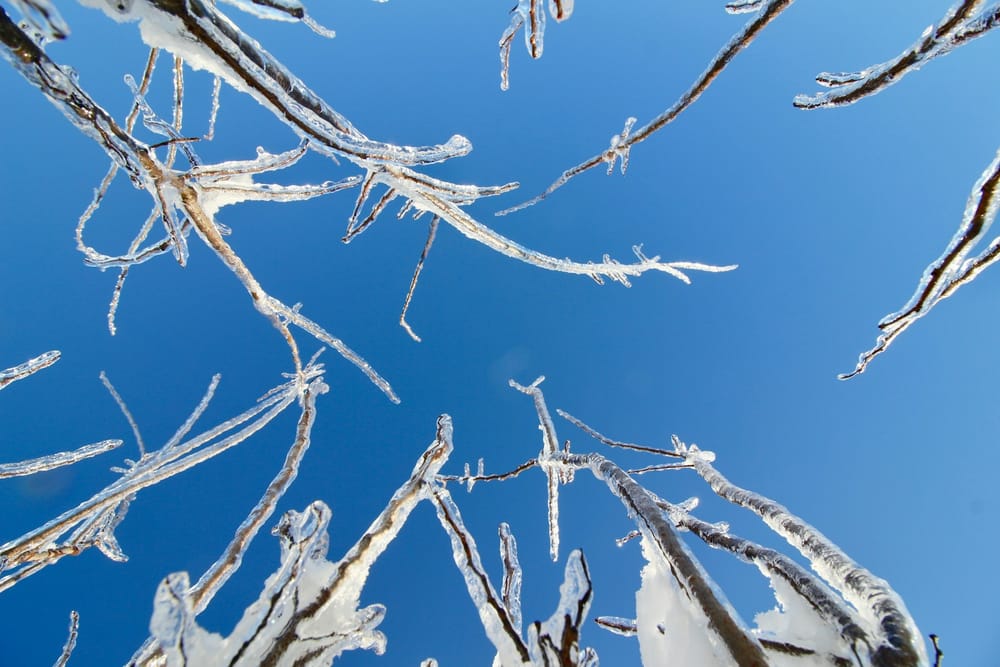
Where a tree fails matters more than you might expect. Hauer’s research found that the strength of sound wood counts for less than the tree’s weak points — and those are easy to spot:
- Tight V-shaped forks with bark pinched inside them (arborists call it included bark). The two stems are pressed together rather than grown together, and they pull apart under load.
- Dead and decaying branches, which are already brittle and snap first. Decay sitting right at a weak fork is the worst combination.
- Broad crowns full of fine twigs, which give ice the most surface to build on.
- Lopsided crowns, such as a tree that has grown one-sided toward the street or been cut back hard on one side for a line.
- Regrowth from topping. The clusters of sprouts that come back after a tree is topped are weakly attached, and ice strips them off.
Which Wichita Trees Take the Most Ice Storm Tree Damage
The most complete rating of tree species and ice comes from Hauer and his colleagues, who combined their own field studies with 42 published studies of ice storms. Here is how their ratings sort out for trees common in Wichita-area yards.
Most likely to break
- Siberian elm — the volunteer elm in many Wichita fence lines and alleys. Brittle wood in a broad, twiggy crown.
- Silver maple — fast-growing, big and brittle, with long limbs that act as levers. Our guide to managing aging silver maples covers what can be done short of removal.
- Bradford (Callery) pear — the textbook case of included bark. The original ‘Bradford’ is named in the research specifically for breaking at its forks. More in our article on why Bradford pears split.
- Hackberry — handles wind well, but its broad, fine-branched crown collects a lot of ice.
- Eastern cottonwood — soft wood and a great deal of mass, usually high over something you care about.
- Honeylocust — a common street and yard tree here, with the broad, open crown the research links to ice damage.
- Also rated susceptible: American elm, black locust, willows and river birch.
In the middle
- Pin oak, green ash, red maple, sycamore, sugar maple and boxelder. One caution on ash: that rating is for a healthy tree. An ash weakened or killed by emerald ash borer turns brittle fast and belongs at the top of the list.
Usually hold up
- Bur oak, Kentucky coffeetree, eastern redcedar, crabapple, catalpa, black walnut, ginkgo, sweetgum, littleleaf linden, white and swamp white oak, and Colorado blue spruce. Coarse branching, a conical shape and strong unions are what these have in common.
“Resistant” doesn’t mean ice-proof. A bur oak with a dead limb will still drop the dead limb, and at an inch of ice almost everything breaks somewhere. But the list holds up locally. When ice hit Wichita in January 2017, Botanica’s landscape supervisor told KWCH that the faster-growing, weaker trees — silver maples and elms — “will take a beating,” and that Callery pears have “a bad habit of splitting.” Those are the same trees we’re called to cut off roofs and driveways after ice.
Before Winter: How to Get Your Trees Ready for Ice
Fall is the cheapest and easiest time to prevent ice storm tree damage. The leaves are coming down, so the structure of the tree is easy to see. Crews have openings that disappear after the first big storm. And you have time to make decisions instead of reacting to them.
- Walk the yard and look up. Make a note of dead branches, broken limbs still lodged in the canopy from summer storms (they come down first when ice adds weight), cracks in the trunk or major limbs, and tight V-shaped forks. Pay most attention to anything that hangs over the roof, the driveway, a play area, or the line running to the house. Our storm preparation guide goes through the inspection in more detail.
- Get the dead wood and hanging limbs out now. Dead wood is the first thing ice takes down, and in most cases it can come out in any season.
- Reduce the worst risks over the house. A long, heavy limb reaching over the roof can be shortened back to a side branch so it carries less weight and leverage. A weak fork may be reduced or cabled. That is structural tree pruning done to a plan, not hacking branches back to make the tree smaller.
- Mind the timing on oaks and elms. Late fall works for structural pruning on most shade trees, but our Kansas pruning calendar holds oaks and elms for deep dormancy in January and February. If the risky limb is on an oak or elm over the house, ask us about timing at the estimate.
- Don’t top anything. Topping leaves stubs that sprout dense clusters of weakly attached shoots — exactly what ice strips off a few years later. Our article on tree topping explains why it backfires.
- Take down trees that are already failing. A dead or dying tree, an ash killed by emerald ash borer, a pine killed by pine wilt, or a Bradford pear that has already split won’t survive a real ice load. Winter is also the best time of year for most removals.
- Leave the line to the house alone. If branches are touching or crowding the service line between the pole and your house, don’t trim near it yourself, and don’t let anyone else until Evergy has been involved. That line is live.
- When an ice storm warning goes out, move vehicles out from under big limbs, keep kids and pets away from trees, charge your phones, and save our number: (316) 207-4740.
During the Ice Storm: What Not to Do
- Don’t knock or shake ice off branches. Frozen wood is brittle, and extension foresters consistently warn that striking or shaking ice-coated branches breaks more than it saves.
- Don’t prop up sagging limbs. Moving an ice-laden branch is a good way to snap it. Bent young trees often straighten on their own over the following months.
- Stay out from under loaded trees, and don’t park under them. Limbs fail without warning, and broken pieces can hang up in the canopy and drop hours later.
- Treat every downed line as live. That includes cable and phone lines, and even fence wire, which can carry current if it’s touching a broken power line. Call 911 for a line that is down or sparking, and report outages to Evergy at 800-LIGHT-KS (800-544-4857) or through the Evergy app.
- Leave the chainsaw in the garage. Ice underfoot, ice on the wood, and limbs still under load are a bad combination for anyone, professionals included.
After the Ice: What to Do, in Order
- Wait for the melt before working under trees. As Botanica’s Pat McKernan put it after the 2017 storm, “You should wait until the ice is totally gone before doing anything to the tree.” The exception is a genuine emergency, which is a call for a crew, not a ladder.
- Look up before you walk in. Check every tree for hangers — broken limbs caught in the canopy — and for limbs resting on lines. Stay out of the area they could fall into.
- Photograph everything before anything moves. Wide shots of the tree and the property, then close-ups of damage to the roof, gutters, fence or vehicles. Those photos carry your insurance claim.
- Sort by urgency. A limb on the house, a car or a line; a hanger over a door, driveway or sidewalk; a fresh split in the trunk; a tree leaning more than it did yesterday; or a tree blocking your only way out — those are calls to our 24/7 emergency tree service. Broken limbs on the lawn can wait for a scheduled visit. Our guide to when a storm-damaged tree is an emergency has the full checklist.
- Call your insurance company if anything covered was hit. If a tree is on the house, start with our guide to the first hour after a tree falls on your house.
- Hire carefully. University of Missouri Extension warns against being pressured by people with chainsaws who knock on doors after storms; many have little or no training. Ask for a certificate of insurance and a written scope before work starts. Our checklist for choosing a tree service in Wichita covers the rest.
Can an Ice-Damaged Tree Be Saved?
Often, yes — and the most common mistake after an ice storm is taking down trees that would have recovered. University of Missouri Extension’s advice is to be patient: if a damaged tree isn’t a hazard and you’re not sure about it, keep it for now. Their assessment comes down to a handful of questions:
- Was the tree healthy before the storm? A vigorous tree has the reserves to regrow. One already in decline usually doesn’t.
- Is at least half the crown still there? That is the extension service’s rule of thumb. With less than half its branches, a tree may not grow enough leaves to feed itself through the next season.
- Is the leader intact? A tree can live without its main upward stem, but it usually ends up stunted or misshapen.
- How big are the wounds? The smaller the wound compared with the limb it’s on, the better. Missouri’s example: a 2- to 3-inch wound on a 12-inch limb seals over within a couple of years.
- Is it the right tree for that spot? A badly damaged silver maple under a power line or over a bedroom may be the moment to make a change.
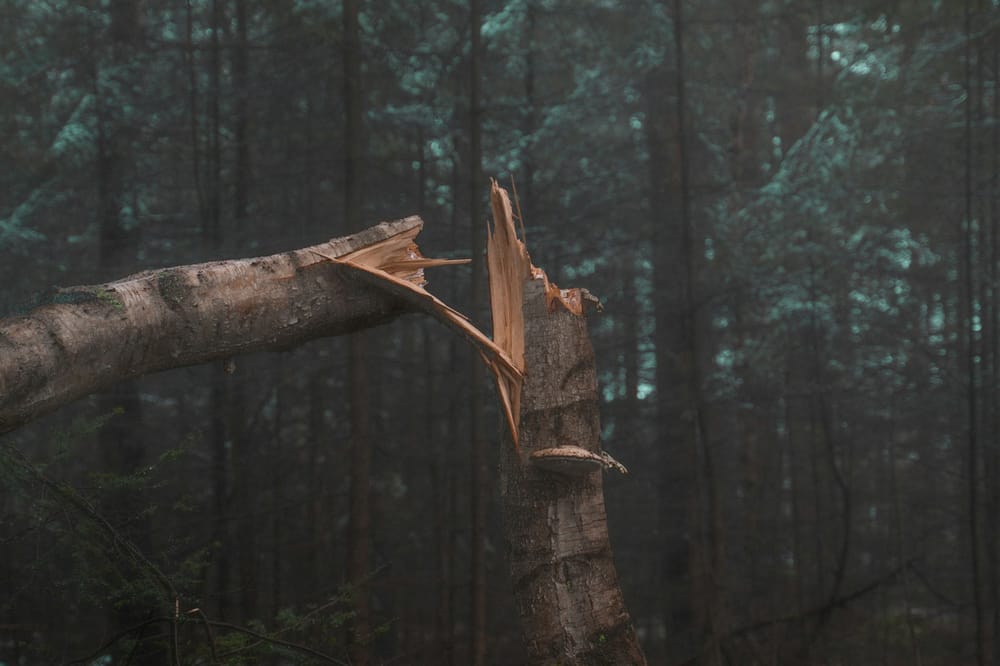
Most trees end up in one of three places:
- Keep it and prune it. Light damage: clean up the broken branches and let the tree close the wounds. A mature shade tree can usually survive losing one major limb.
- Prune and wait. Borderline damage on a tree that isn’t a hazard: remove the broken parts now and decide after it leafs out next spring. How it grows tells you more than how it looks in January.
- Take it down. Missouri’s line is a split trunk, more than half the crown gone, or a tree already weakened by disease or decay. We’d add one local note: when a silver maple, Siberian elm or Bradford pear loses most of its structure, what grows back is a mass of weakly attached sprouts — the same thing ice broke in the first place.
When it’s a close call, it’s worth having someone qualified look at it in person. Joe Kohnen is an ISA Certified Arborist, and a save-or-remove assessment is part of every free estimate. Our article on trimming vs. removal walks through how we make that call.
What Repair Pruning After an Ice Storm Looks Like
Storm breaks are ragged, and a ragged break heals poorly. Repair pruning turns them into clean wounds the tree can close:
- Broken branches come back to the trunk or a main limb, cut just outside the branch collar — the slightly swollen ring where a branch joins the stem. No stubs, and no flush cuts into the trunk.
- Heavy limbs come off in three cuts, so their weight doesn’t peel a strip of bark down the trunk as they fall.
- A broken top is cut back just above a live branch big enough to take over as the new top.
- Torn bark is trimmed back to clean, firmly attached edges.
- No wound paint. Extension guidance is consistent that trees seal wounds on their own and dressings don’t help.
- No more than necessary. The tree needs every remaining leaf next season to rebuild, so repair pruning removes the damage and stops there. Shaping waits for follow-up visits over the next few years.
And no topping. Missouri Extension is blunt about it: “A topped tree that has already sustained major storm damage is more likely to die than repair itself.” If someone offers to “cut it back so it won’t break again,” that is the offer to turn down.
Cleanup, Debris Hauling, and Insurance
Wind tends to take out a few trees on a block. Ice breaks branches on nearly every tree at once, so the brush piles after an ice storm are enormous. Plan for how that debris will leave the property:
- The City won’t take it from your yard. After past storms, the City of Wichita has said its crews don’t collect debris on private property; residents haul it to Brooks Landfill themselves or hire a tree service. Check the City’s announcements after any major storm.
- Trees between the sidewalk and the street are generally the City’s. Report a broken right-of-way tree through the City’s Report an Issue page rather than paying to have it cut.
- A neighbor’s tree that came down on your side raises its own questions. Our guide to neighbor tree laws in Kansas covers who usually pays.
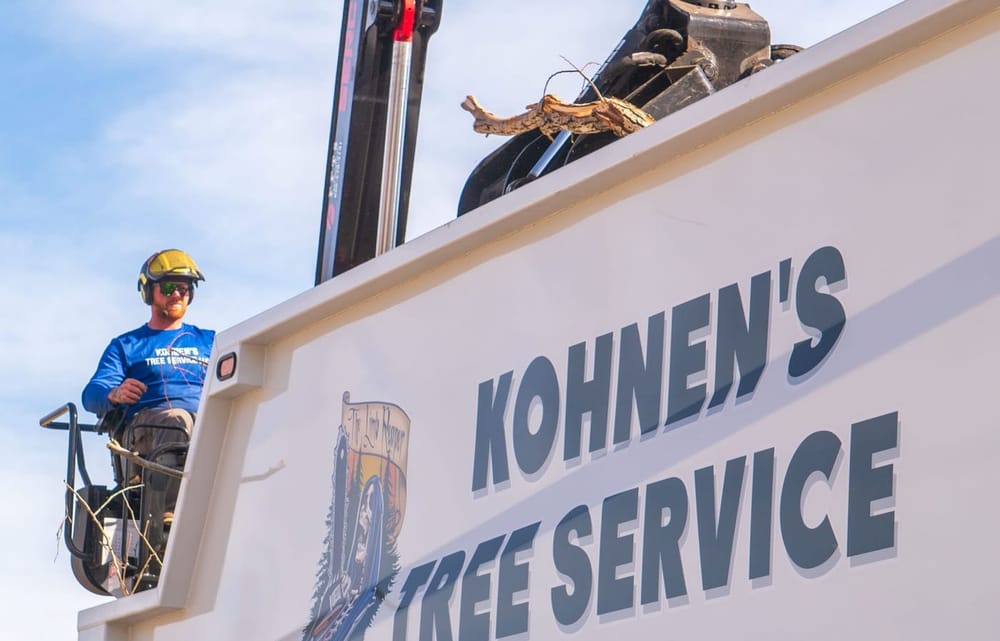
Our grapple truck picks up trunk sections and brush that are too big to drag to the curb, and it is a standard part of our storm damage cleanup. We can haul debris you have already piled or clear the whole yard.
On insurance: a standard homeowners policy typically covers tree removal when a tree damages a covered structure, such as the house, an attached garage or a fence, minus your deductible. A tree or limb that falls in the yard without hitting anything is often not covered, or only up to a small limit. Kohnen’s offers insurance direct billing for covered storm work — we document the job with photos and detailed invoices and work with your adjuster. Our storm damage insurance guide has the details.
On cost: storm work is priced by the job like any other tree work — size, access and what’s underneath it set the number. A middle-of-the-night callout can add a premium that a daylight visit doesn’t. Our breakdown of after-hours emergency tree removal cost explains when that’s worth paying and when it’s safe to wait for morning.
What You Can Do Yourself — and What Needs a Pro
Reasonable to do yourself, after the ice has melted:
- Walking the yard, photographing damage, and calling your insurer.
- Picking up small branches that are already on the ground.
- Clipping small broken twigs you can reach with hand pruners, both feet on the ground.
- Watering stressed trees through a dry winter or spring.
Not a DIY job:
- Cutting bent or twisted wood. Storm-bent trunks and limbs hold tension you can’t see, and they can spring or roll when cut. Missouri Extension advises leaving bent trees and branches over 6 inches in diameter to someone with more experience. Our case against DIY tree removal covers what goes wrong.
- Hangers, or anything that needs a ladder and a saw at the same time.
- Anything touching or near a power line, including the line to the house.
- A tree or large limb resting on a structure, where a wrong cut can drop the load through the roof. That is hazardous tree removal work, done with rigging.
Frequently Asked Questions
Should I knock the ice off my tree branches? No. Ice-coated wood is brittle, and knocking or shaking the branches usually breaks more of them than the ice would have. Let the ice melt on its own, and keep people and cars out from under the tree until it does.
How much ice does it take to break tree branches? The National Weather Service treats a quarter inch of ice as an ice storm. At that level, dead wood and weak branches on susceptible trees start to fail, especially with wind. A half inch or more breaks sound limbs on stronger trees too, and wind makes every amount worse.
Which trees are most likely to break in an ice storm? In the Wichita area, Siberian elm, silver maple, Bradford pear, hackberry, cottonwood and honeylocust are rated among the most susceptible. Bur oak, Kentucky coffeetree, eastern redcedar, ginkgo and catalpa are among the most resistant. Any tree with dead wood or tight V-shaped forks is at risk regardless of species.
Will my tree recover from ice storm damage? Usually, if it was healthy before the storm, kept at least half of its crown, and the trunk isn’t split. Prune the broken branches cleanly, don’t top it, and judge it again after it leafs out in spring.
When should an ice-damaged tree be removed? Right away if it threatens a house, a driveway or a line. Otherwise, take it down when the trunk is split, more than half the crown is gone, or the tree was already declining. If you’re unsure and it isn’t a hazard, prune the damage and decide in the spring.
Does homeowners insurance cover ice storm tree damage? Typically, when the tree damages a covered structure such as the house, an attached garage or a fence, minus your deductible. A tree that falls in the yard without hitting anything often isn’t covered, or only up to a small limit. Kohnen’s offers insurance direct billing for covered storm work.
Who removes a tree limb that’s on a power line? Not you. Call 911 if the line is down or sparking, and report it to Evergy at 800-LIGHT-KS (800-544-4857). Once the utility has made the line safe, we can remove the tree and clean up the debris.
Does the City of Wichita pick up branches after an ice storm? After past storms, the City has said its crews don’t collect debris from private property. Homeowners haul it to Brooks Landfill or hire a tree service to remove it. Trees in the strip between the sidewalk and the street are generally the City’s responsibility.
Get Your Trees Checked Before Ice Season
The trees that come down in an ice storm usually show their weak spots months earlier. A fall walk-through costs nothing and turns most of that winter damage into a short, scheduled pruning job instead of a 2 a.m. emergency. Joe Kohnen is an ISA Certified Arborist and looks at every tree in person before we quote it. Kohnen’s Tree Service is family-owned, fully insured, and rated 4.9 from 130+ Google reviews.
We work across Wichita and the surrounding communities from our Park City base, including Bel Aire, Valley Center, Maize, Andover, Derby and Goddard. And when ice does hit, we run 24/7.
Request a free in-person estimate, or call (316) 207-4740. We respond the same day.