
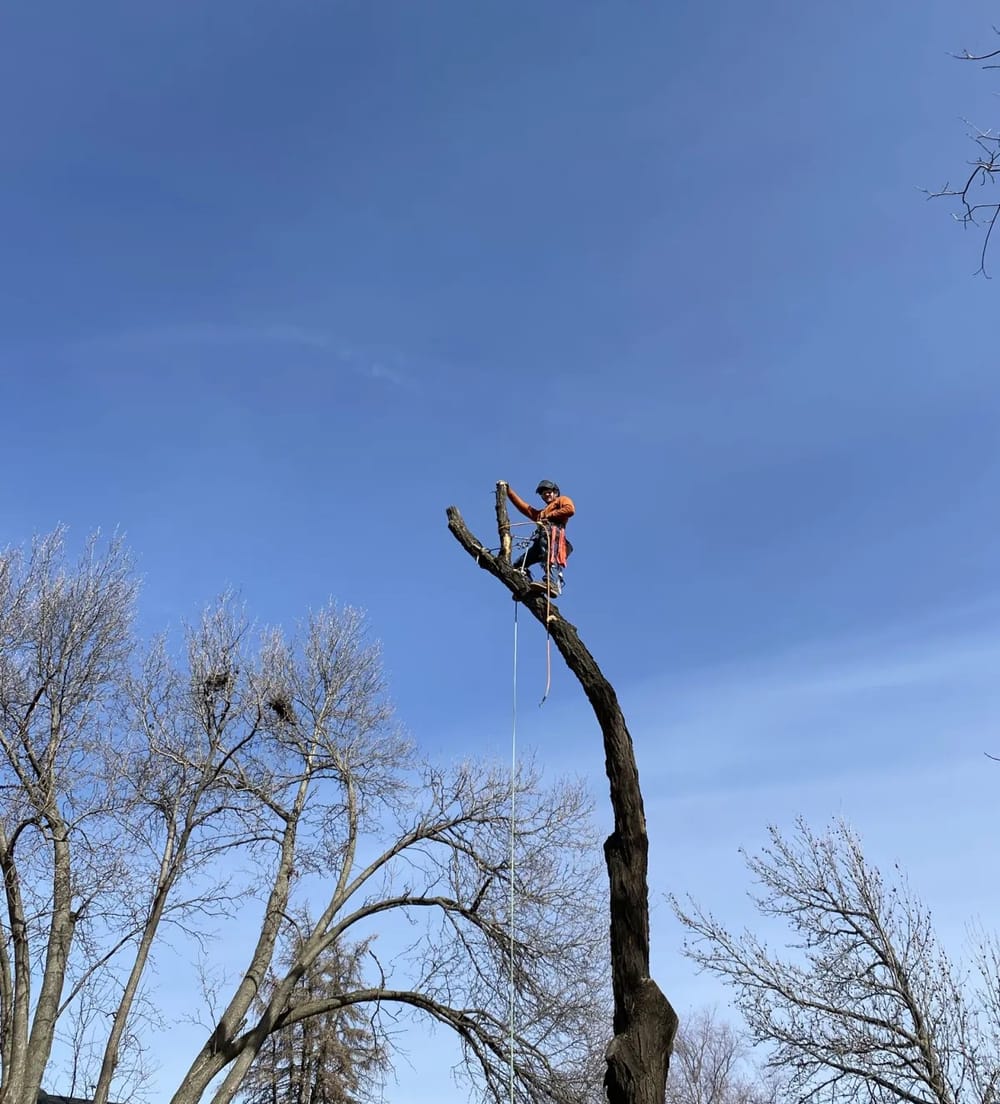
Once the leaves start coming down, we hear some version of the same question again and again: “That tree has to go eventually — should we do it now or wait until spring?” If the tree isn’t a hazard yet, the answer for most Wichita yards is the same. Get the estimate now, and schedule the removal for late fall or winter.
Below is why the dormant season usually works best, which trees run on a deadline, the warning signs that mean a tree shouldn’t wait for any season, and what timing does and doesn’t change about the price.
The Short Answer
- For a tree that isn’t a hazard, late fall through winter is usually the best time. The branches are bare, the ground is firmer, and birds aren’t nesting.
- A tree that is dead, cracked, or leaning over a house should not wait for a season. Those go on the calendar now.
- Some trees run on a deadline. K-State’s guidance is to take pines killed by pine wilt down by April 1, and ash killed by emerald ash borer turns brittle within a year or two.
- The season isn’t the main price lever. Height, access, and what’s under the tree decide most of the cost.
- Getting the estimate is free and doesn’t lock you into a date. You can book the work for whenever it makes sense.
Why Late Fall and Winter Usually Work Best
Bare branches show the tree’s structure
With the leaves off, we can see every union, crack, and dead limb from the ground and from the bucket. That matters most on big, compromised trees — silver maples and cottonwoods that have hollowed out, or a tree with an old split — because the rigging plan depends on knowing which wood will hold a rope and which won’t. Better sightlines make for a safer, more predictable takedown.
Less weight in the canopy
A full summer canopy adds a lot of weight and wind resistance to every limb we lower. A bare crown is lighter to rig and simpler to control around a roof or fence, and there’s less leafy brush to haul off at the end.
Firmer ground is easier on the lawn
Removals bring heavy equipment into the yard: bucket trucks, lifts, and the grapple truck that hauls the wood. When the ground is dry and firm, or frozen, those machines leave far less of a mark than they do on soft spring soil after a week of rain. Dormant grass also recovers on its own once it greens up.
Dormant plants underneath take the work better
Perennials, shrubs, and beds under the drip line are cut back or dormant in winter, so the drop zone and walk paths do less damage than they would in June.
No nesting season to work around
Spring and early summer are nesting season, and federal law protects the active nests of most native birds. A winter removal sidesteps that entirely — no nests to find in the crown, and no delays while a brood fledges.
It gets the tree out before storm season
Wichita’s spring straight-line winds are what turn a weak tree into a roof claim. Taking a tree you already know is failing down in winter means it isn’t standing when the first big cell comes through. Our guide to preparing trees for storm season covers what to check on the trees you’re keeping.
Trees That Run on a Deadline
- Pines killed by pine wilt. The beetles that spread the disease spend the winter inside the dead tree and start emerging around May 1. K-State’s guidance is to take the tree down by April 1, cut it to the ground, and chip or burn the wood. More in pine wilt in Kansas.
- Ash killed by emerald ash borer. Once an infested ash dies, the wood dries out and turns brittle within one to two years — and a brittle ash is a harder, more expensive removal. See emerald ash borer in Wichita.
- Work near oaks you’re keeping. Fresh wounds on an oak between April and July can let in oak wilt. If a removal means cutting back or brushing against neighboring oaks, the dormant season avoids that window entirely.
When a Tree Shouldn’t Wait for Winter
Everything above assumes the tree is stable. Some trees aren’t, and the right time to remove them is as soon as the crew can get there. Call now if you see:
- A dead tree, or a tree with a mostly dead crown, standing over the house, garage, driveway, or a neighbor’s yard
- A fresh crack or split in the trunk, or a split at a major union
- A lean that is getting worse, especially with soil lifting on the far side
- A broken limb hanging in the canopy over a door, walkway, or driveway
Those are hazardous tree removals, and they get scheduled on their own urgency. If a tree or limb is touching a power line, stay at least 35 feet back and call 911 and Evergy first. If a tree is already on the house, that’s our 24/7 emergency service — and our guide to telling a true emergency from damage that can wait helps sort the rest.
What Timing Doesn’t Change
The season isn’t what sets the price. The tree is. As general ranges for the Wichita area, small trees under 30 feet usually run $200–$500, medium trees $500–$1,500, and large trees over a house or fence $1,500–$3,000 or more. Height, access, the condition of the wood, and what’s underneath move the number far more than the month does. Our tree removal cost guide breaks it down.
What does save money is bundling. Removing several trees in one visit, and grinding the stumps in the same trip, cuts the cost of mobilizing the crew more than once — see honest ways to lower the cost of tree removal. If you plan to replant, a winter removal leaves the spot ready for spring or fall planting; our guide to planting where the stump was ground walks through it.
Common Questions
Can trees be removed in winter in Kansas? Yes. Winter is one of the best times to remove a tree that isn’t an emergency. Ice on the branches and high winds are the main reasons to hold off on a given day, and a careful crew waits those out.
Is tree removal cheaper in winter? Not automatically. Price comes from the tree’s size, condition, and access. The savings in a dormant-season removal show up as less lawn and bed damage, and in getting a failing tree down before it becomes an emergency job.
Should I wait until spring to remove a dead tree? Usually not. A dead tree gets more brittle every month it stands, which makes it harder and costlier to rig, and spring storms are when weak trees fail. If it can reach the house or a neighbor’s property, schedule it now.
Do I need permission to remove a tree in Wichita? Trees in the public right-of-way — usually the strip between the sidewalk and the street — are the City of Wichita’s to maintain, and altering them generally needs the City’s consent. Some HOAs also require approval before a removal. Our guide to Kansas and Wichita tree rules has the details, and we’ll flag anything like this at the estimate.
Get the Estimate Now, Book the Work for the Dormant Season
Owner Joe Kohnen is an ISA Certified Arborist and looks at every tree in person. He’ll tell you whether yours can wait for winter, whether it should come down sooner, or whether pruning could save it. Pricing is in writing before anything is scheduled. See how a tree removal works from start to finish.
We work across Wichita and the surrounding communities from our Park City base, including Derby, Andover, Goddard, and Maize. Request a free in-person estimate, or call (316) 207-4740. We respond the same day.