
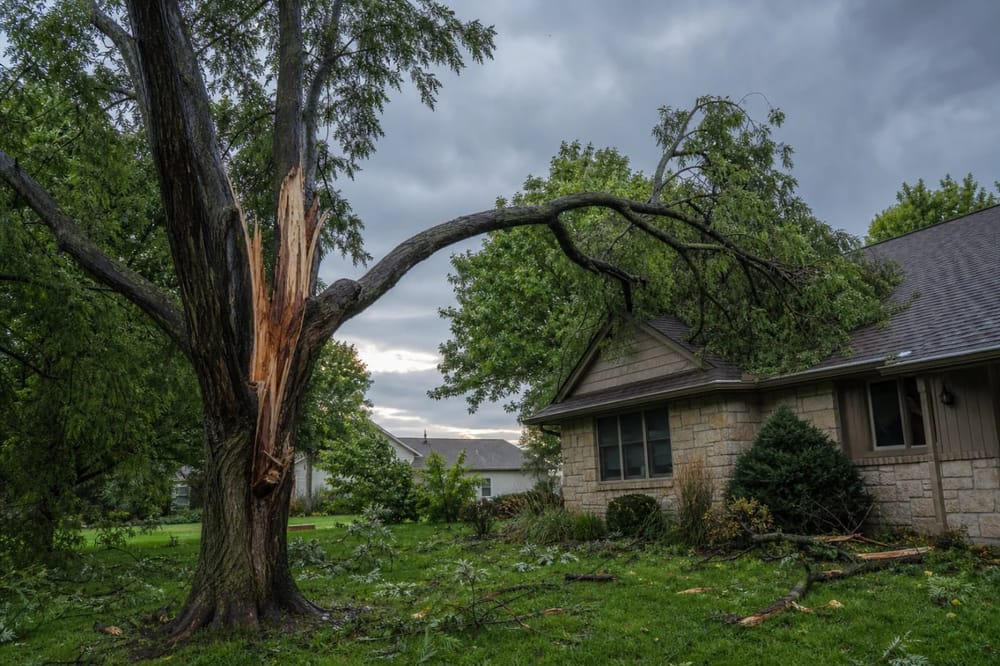
The morning after a Kansas storm, half of Wichita walks outside to find a tree that does not look quite right. A limb is hanging. The trunk has a fresh crack. The whole tree is leaning a little more than it did yesterday, and the ground around the base looks disturbed. The question almost every homeowner asks next is the same: do I need to call someone right now, or can this wait until the weekend?
That is the right question, and the answer genuinely matters — both for your safety and your wallet. A true emergency left alone can become a tree through your roof. A non-emergency treated as a 2 a.m. crisis means paying for urgency you did not need. After years of taking the storm calls across the Wichita metro, I can tell you the difference usually comes down to a handful of clear signals. This guide walks you through how to read them, so you can decide with confidence whether to call emergency tree service in Wichita immediately or schedule a calmer assessment. (If a tree has already come down on your house, skip the triage — go straight to our guide on the first 60 minutes after a tree falls on your home.)
The 30-Second Emergency Test
Before you study the tree, stand back and ask three fast questions. If the answer to any of them is yes, treat it as an emergency and call a professional now — do not wait for daylight, do not wait for a free Saturday.
- Is anything load-bearing or live involved? Is the tree (or a broken limb) touching your house, garage, fence, vehicle, or — most critically — a power line?
- Could it hurt someone right now? Is there a hanging or partially detached limb above a driveway, sidewalk, porch, play area, or anywhere people walk?
- Is it actively moving? Is the tree leaning more than before, shifting in light wind, or is the soil heaving at the base?
Those three cover the vast majority of real emergencies. The rest of this guide explains what each one looks like in the yard, and which situations are genuinely urgent versus the ones that can safely wait a few days.
Call Now: The True Emergencies
These are the situations where the cost of waiting is measured in roofs, cars, and people. Every one of them warrants an immediate call to a 24/7 crew.
A tree or large limb is on a structure, vehicle, or power line
This is the clearest emergency there is. A tree resting on a roof is being held up by whatever framing caught it, and that support is rarely stable. It can shift hours after the storm. If the tree took down the service line from the pole to your house, assume there is a live wire in that mess. In the Wichita area, Evergy treats any downed line as energized until they verify otherwise — so should you. Stay back, keep kids and pets back, and call Evergy at 1-800-383-1183 before anyone goes near the tree. Then call a tree service. Never try to lift, cut, or pull a tree off a structure or line yourself.
A "widow-maker" limb is hanging overhead
The most underrated storm hazard in Wichita is the limb that broke but did not fall. It is hung up in the canopy, sometimes barely visible, often held by a strip of bark or a tangle of smaller branches. Arborists call these widow-makers for a reason: they come down without warning, frequently when someone is standing underneath wondering whether it is safe. If you can see a detached or dangling limb above any area where people pass — a driveway, the front walk, a patio — that is an emergency. Rope off the area, keep everyone out from under it, and get a crew out to bring it down under control.
The trunk has a fresh split or major crack
A vertical crack running down the trunk, a split where two main stems meet, or a visible seam that opens and closes as the tree moves — these mean the tree has lost structural integrity. A trunk that is cracked is no longer reliably holding its own weight, and the next gust, or even its own load on a still day, can finish the failure. Co-dominant stems (two trunks of similar size growing from one union) are especially prone to splitting in Kansas wind, and once one side tears, the whole tree is compromised. Cracked-trunk trees within reach of a house or driveway should be assessed the same day.
The tree is leaning more than it was — and the ground is lifting
A tree that has always leaned is usually fine; it grew that way and adapted. The dangerous version is the new lean — a tree that stood straight last week and is now tilting. The tell is at the base: if you see the soil mounded, cracked, or lifting on the side opposite the lean, the root plate is failing. That tree is in the slow process of uprooting, and saturated Kansas clay after a heavy rain makes it far more likely to let go entirely. A freshly leaning tree near anything you care about is an emergency, full stop.
A fallen tree is blocking your only way out
Even if nothing is damaged, a tree across your driveway, your front steps, or the only road off your property is an emergency in a practical sense — it blocks emergency vehicles, traps cars, and can hide a downed line underneath. This is exactly the kind of fast, safe clearing our grapple truck is built for.
Within 24 to 48 Hours: Urgent, But Not a Crisis
Some storm damage is serious without being life-threatening. These situations should be handled soon — before the next cell rolls through — but they do not require waking anyone up.
- A large limb broke cleanly and fell away from everything. No structure, no walkway, no line involved. The tree has lost a major branch and now has a wound and an unbalanced canopy, but nothing is in immediate danger. Get it looked at within a day or two, both to clean the cut properly and to check whether the remaining canopy is now lopsided enough to fail.
- The tree is partially uprooted but leaning away from your house. Some root lift, a modest new lean, but the fall zone is open lawn. Still failing, still needs to come down or be evaluated — just not with a roof underneath it. Keep people out of the lean direction until a crew arrives.
- You see torn bark, hanging strips, or split smaller branches up high. Minor hangers that are not over a walkway can wait a couple of days, but do not let them linger into the next storm.
The reason to act within a day or two rather than a week is simple: Wichita weather rarely sends just one storm. A tree weakened on Tuesday is the tree that fails on Thursday when the next front comes through. Closing out the damage while it is still a controlled job — on a clear day, on a normal schedule — is both safer and usually cheaper than waiting for it to become an after-hours takedown.
Can Wait for a Scheduled Visit
Plenty of post-storm damage looks alarming but is genuinely minor. You can fold these into a normal, free-estimate visit on your own timeline:
- A scatter of small twigs and leaves, or a few thin branches down in the yard.
- Minor deadwood that shook loose — small, dead, brittle branches that were already gone before the storm.
- Cosmetic canopy thinning or a slightly ragged outline, with no cracks, no hangers, and no lean.
- A small ornamental or young tree that bent but sprang back, with intact roots and no trunk damage.
For damage in this category, the smart move is prevention: have the tree professionally checked before the next round of weather, and consider structural pruning to remove weak branches on your terms instead of the storm's. Our guide on preparing your trees for storm season in Wichita covers exactly what to look for ahead of time.
Wichita-Specific Factors That Raise the Stakes
Two trees with the same visible damage are not always equally risky — species and soil change the math, and around here both work against you.
Some local species fail more than others. Fast-growing, brittle trees are overrepresented in every storm-call we run. Cottonwood, silver maple, Bradford pear, and Austrian pine top the list — they grow quickly, hold a lot of canopy, and snap or split under load far more readily than slow, dense hardwoods. If a tree with fresh damage is one of those species and stands within striking distance of your home, lean toward treating it as urgent rather than waiting. Cottonwood in particular — the Kansas state tree and a familiar giant on many older properties — is notorious for dropping large limbs, which is why we wrote a whole guide on cottonwoods and when removal is the right call.
Saturated clay soil makes uprooting easier. Much of the Wichita metro sits on heavy clay that holds water. After a soaking rain, the ground loses its grip on root plates, and a tree that would have ridden out the wind on dry ground tips over instead. That is why the most dangerous time for a leaning tree is the 24 to 48 hours after a heavy storm, not during it. If you have a new lean and the ground is still soft, do not wait for it to dry out and hope.
What a Real Emergency Crew Actually Does When We Arrive
Knowing what happens on an emergency call makes it easier to pull the trigger on one. When we roll up to a storm job, the first thing we do is not start cutting — it is assess. We identify what is holding the tree up, where the tension and compression are, and whether there is a line involved. A storm-damaged tree is under loads that a healthy standing tree is not, and cutting in the wrong order can release that energy violently. This is precisely why storm cleanup is the worst possible time to DIY a chainsaw.
From there we rig and lower the hazard under control, clear the debris — our grapple truck makes short work of even a large tree across a driveway — and, where storm damage hit a covered structure, we handle the documentation and insurance direct billing so you are not floating the cost. Owner Joe Kohnen personally climbs and works these jobs, and our crew is fully insured and licensed for all tree work in Kansas. We answer the phone 24/7 across Wichita, Park City, Derby, and Bel Aire, and we do not add an after-hours surcharge for taking the call at midnight.
While You Wait: Do Not Make It Worse
Once you have decided it is an emergency and the crew is on the way, your only job is to keep everyone safe. A few rules:
- Stay out from under it. Give any leaning tree or hanging limb a wide berth — at least the tree's full height as a buffer.
- Assume every downed wire is live. Do not approach, do not move branches near it, and keep the area clear until the utility verifies it is dead.
- Do not climb up to "just cut the hanger." More people are hurt in the cleanup than in the storm.
- Photograph everything from a safe distance before anything is moved, especially if a structure was hit — it matters for your insurance claim.
For the full playbook on documentation, downed lines, and claims after a tree comes down, see how to handle fallen trees on your property.
Frequently Asked Questions
Is a leaning tree always an emergency? No — a tree that has leaned the same way for years has usually adapted and is often stable. The emergency is a new lean, especially with lifted or cracked soil at the base, because that means the root plate is actively failing.
The storm is over and the tree looks fine — am I in the clear? Not necessarily. Cracks, partial root failures, and hung-up limbs are often invisible from the ground or only show up days later. If a tree took a hard hit, a quick professional look is cheap insurance — and our estimates are free.
Will my homeowner's insurance cover emergency tree removal? Routine removal of a healthy tree is your expense. But when a storm-damaged tree hits a covered structure, removal is often part of that claim. We bill insurance directly for covered storm-damage work — the details are in our Kansas storm-damage insurance guide.
Do you charge extra for nights and weekends? No. We run 24/7 emergency tree service across the Wichita metro with no after-hours surcharge — the price is the same whether you call at noon or 2 a.m.
What if I am in Derby or one of the outlying towns? We respond the same across the metro. If you are south of the city, our Derby tree service page has the local details, but the emergency line is the same number for everyone.
When in Doubt, Make the Call
If you have read this far and still are not sure which category your tree falls into, that uncertainty is itself a reason to call. A two-minute conversation — or a free, no-obligation look from someone who reads storm-damaged trees for a living — costs you nothing and can be the difference between a controlled removal and a tree through your roof. We would always rather drive out and tell you it is fine than get the second call after it failed.
If a storm has left you staring at a tree you are not sure about anywhere in Wichita, Park City, Derby, or Bel Aire, call us any hour at (316) 207-4740 or request a free estimate online. Owner-operated, fully insured, 24/7 — no surcharge for the late-night call.