
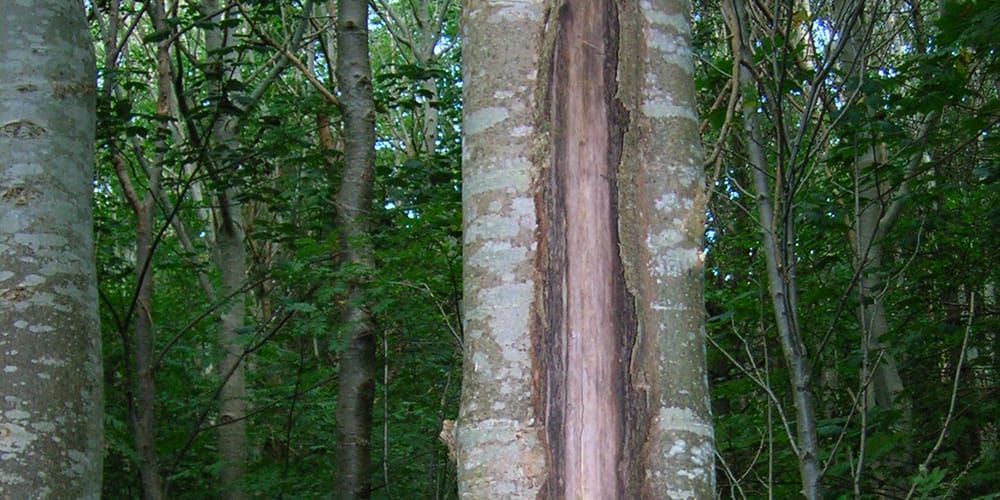
You walk past the big maple on a cold morning and there it is: a long vertical crack in the trunk that you would swear wasn't there last week. Maybe you even heard it go. Most of the time a crack like that is a frost crack, and a healthy tree can usually live with one. Some of the time it is the first visible sign that the trunk is coming apart.
The short answer: a single narrow crack on the south or southwest side of a sound trunk, showing up after a hard cold snap, is probably a frost crack. Watch it. A crack that runs through the trunk, starts at a fork, touches decay, moves in the wind, or is one of several in the same area is a structural problem, no matter what started it. If that tree can reach your house, your driveway, or a power line, get it looked at before winter wind and ice load it.
This guide walks through how to read the crack in front of you, what each answer means, and whether to monitor it, have an arborist assess it, or plan a removal.
What a Frost Crack Is
A frost crack is a vertical split in the bark and wood caused by a fast drop in temperature. A sunny winter day warms the trunk, the sun goes down, and the outer layers cool and shrink faster than the warmer wood at the center. The Kansas Forest Service adds that moisture freezing inside the tree builds pressure too. When that stress lets go, Purdue Extension says the split can be sharp enough to make a rifle-like noise, which is where the "exploding tree" stories come from during hard cold snaps. The tree doesn't explode. It splits.
A few things make a frost crack recognizable:
- Which side it's on. Usually the south or southwest face of the trunk, where the sun swings the temperature hardest.
- Its shape. A fairly straight vertical line that follows the grain, often starting at an old wound or a leftover branch stub.
- When it showed up. During or right after a sharp cold spell. After the February 2021 cold snap, K-State Research and Extension's horticulture agent in Harvey County reported frost cracks on trunks in the area.
- The species. The Kansas Forest Service lists maple, boxelder, linden, sycamore, cottonwood, and many fruit trees as especially vulnerable, which covers a lot of yards around Wichita. Young trees and thin bark raise the odds.
- How it behaves. Iowa State Extension notes frost cracks usually close during the growing season and often reopen, sometimes every year. Repeated rounds of damage and repair can leave a raised ridge along the crack, called a frost rib.
That last point matters if you only just noticed yours. A crack you're seeing for the first time this November may be an old one reopening, not a new injury. Rounded, rolled edges of new wood mean the tree has been working on it for a while. Sharp edges and bright, clean wood mean it's fresh.
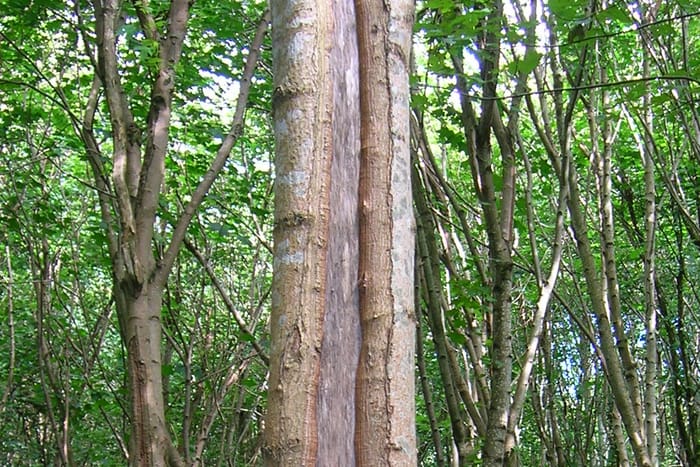
One caution before you relax: "frost crack" is an explanation, not a clean bill of health. Montana State University Extension notes these cracks can reopen, enlarge, and reach the center of the tree, and K-State notes that decay organisms can get in while a crack stays open. So the question isn't only what caused it. It's what condition the crack and the wood around it are in now.
Five Things to Check on the Crack
Do this from the ground on a calm day. If the crack looks large and fresh and the tree is over a house, a driveway, or anywhere people spend time, skip the close look, stay out from under it, and go straight to the action section below.
1. Where is it?
A crack in the middle of the trunk on the south or southwest side is the classic frost crack location. Be more concerned when a crack runs down into the root flare, where the trunk widens into the ground, or up into a main fork. Those are the spots carrying the most load.
2. How deep does it go?
Walk all the way around the trunk. A matching crack on the opposite side can mean the split goes clear through. A flashlight helps you see whether you're looking at a shallow bark split or a dark gap running deep into the wood. Don't pry at it or wedge anything in. Hazard-tree guides are blunt on this point: a crack that goes deep into or completely through the stem means act now, whatever started it.
3. Does it move with the temperature, or with the wind?
Take a photo with a coin or a ruler in the frame on a cold morning, then again from the same spot on a mild afternoon. A frost crack tends to gap in the cold and tighten as things warm up. A crack that flexes as the tree sways is a different animal. That means the two sides of the trunk are moving independently, and the tree has lost part of its strength. If you can see it working in the wind, step back and call.
4. Is there decay nearby?
Look for mushrooms or shelf-shaped conks on the trunk or at the base, soft or crumbling wood inside the crack, an open cavity, or a wound that has never closed. Penn State's hazard-tree field guide treats decay in contact with a crack as a high risk of failure, even when neither one would be alarming alone. A crack plus rot is worse than either by itself.
5. Does it start at a fork?
Co-dominant stems are two main trunks of about the same size growing from one point. Where they press together, bark gets trapped inside the joint instead of solid wood knitting across it. That trapped bark is called included bark, and it doesn't have the strength of wood. A dark seam or crack running down from a tight V-shaped fork is not a frost crack. It's the weak joint starting to open, and it's the classic reason Bradford pears split in half. Silver maples and cottonwoods do it too.
The Question That Sets the Urgency: What Can It Hit?
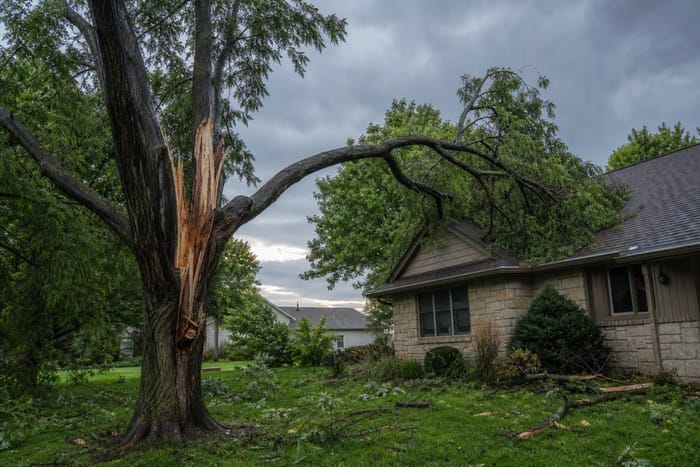
A defect only makes a tree hazardous if there's something within striking distance. The same crack means something very different on a cottonwood at the back of a pasture than on a maple leaning over a bedroom. Stand back and picture the tree falling, or the cracked side falling, in any direction. A tree can reach about as far as it is tall. If that circle includes your house, a neighbor's house, the driveway, a play area, the street, or a power line, move up one level on the list below.
Cracks That Aren't Frost Cracks
Not everything that looks like a crack is one, and not every crack comes from the cold:
- Normal bark furrows. Mature cottonwoods, oaks, and many other trees have deep ridges in their bark. If you see no bare wood and the pattern runs around the whole trunk, that's just bark.
- Winter sunscald. Young, thin-barked trees can get dead, cracked bark on the south or southwest side from winter sun waking the tissue on warm days. It tends to look like a sunken, dying patch of bark rather than one clean line.
- Lightning scars. Usually a long strip of bark blown off, often starting high in the tree. It follows a thunderstorm, not a cold snap, and the tree needs a real assessment.
- Emerald ash borer. On an ash, vertical bark splits along with thinning at the top and D-shaped exit holes point to emerald ash borer, and that's a different decision entirely.
- Drought-to-rain splits. K-State notes a dry spell followed by a sudden return of moisture can push a growth surge that splits bark. These are usually shallow.
- Storm cracks. A fresh crack after high wind or ice isn't a frost crack, even in January. Treat it as structural.
Monitor, Schedule an Arborist, or Clear the Area
Here's how the answers above sort out. Go with the most serious list that fits your tree.
Monitor it if all of these are true:
- It's one narrow crack on the south or southwest side.
- It appeared after a cold snap, or it has old, rounded edges.
- There's no matching crack on the other side, no decay, and no fork involved.
- The canopy looked normal last growing season.
Take a dated photo once a month through winter and again when the leaves come out. Call if the crack gets longer, stays open through warm weather, or picks up company.
Have an arborist look this season if any of these are true:
- The crack is long and the tree could reach something you care about.
- You can't tell how deep it goes.
- It has reopened for years, or the frost rib has soft wood along it.
- A limb larger than about 4 inches across is cracked.
- The tree has been losing limbs or thinning out.
This is exactly what a tree risk assessment is for, and it's part of our free in-person estimate. Book it before the next ice or high-wind forecast, not after.
Clear the area and call now if any of these are true:
- The crack goes through the trunk or shows on both sides.
- Two or more cracks sit in the same general area of the trunk.
- The crack touches decay, a cavity, or a fork with included bark.
- The two sides move when the tree sways.
- The tree has a new lean, or the soil at the base has lifted or cracked.
Move cars and keep kids and pets out of reach of the tree. If it touches or could reach a power line, stay at least 20 feet away, call Evergy, and don't try to handle any of it yourself. Then call us at (316) 207-4740. Our emergency tree service runs 24/7.
Some of these trees can be helped with reduction pruning or cabling, if there's enough sound wood left to work with. Others need to come down, and it's better to do that on a calm day than after the tree picks its own moment. When tree removal is the right call we'll say so, and if the tree is also dying, the risk climbs fast. Our guide to dead tree removal in Wichita covers why.
Why a Cracked Tree Shouldn't Wait Out the Winter
Kansas winters put two big loads on a tree that may already be weak. The first is ice. Ice can add 30 times or more to the weight of a branch, and that extra weight hangs on the same forks and cracked trunks you were looking at in the sunshine. The second is wind, which keeps working a loaded tree back and forth. A crack that stood fine all summer gets its hardest test between now and March.
November is also a good time to look. The leaves are off, so forks, seams, and deadwood are easy to see from the ground, and the work can be planned on a calm day. Once an ice storm hits, you're choosing from fewer options on a worse schedule. If you're already walking the yard, our guide to preparing your trees for storm season covers what else to check.
What Not to Do, and What You Can Do
Leave these alone:
- Don't fill or seal it. Caulk, spray foam, tar, and wound paint don't help. A healthy tree seals off damage on its own by growing callus, the new wood and bark that rolls in from the edges.
- Don't bolt, screw, or strap it. Hardware in a cracked trunk is structural work, and done wrong it adds wounds without adding strength.
- Don't climb it, lean a ladder on it, or cut it. Cracked trees don't behave predictably under a saw. Large limbs and removal are never DIY jobs.
- Don't top it to lighten it. Topping leaves big wounds and weak regrowth, and we won't do it.
These are fair game for a homeowner:
- Water during dry spells, especially in fall. Stressed trees crack more easily, and Kansas falls can run dry.
- Keep mowers and string trimmers off the trunk. Those small wounds are where cracks like to start.
- Handle small pruning you can reach from the ground. Clean cuts on small dead twigs are fine. Don't leave stubs.
- Wrap young, thin-barked trees. K-State recommends this to protect them from winter sunscald. Take the wrap off in spring. It won't do anything for a mature tree, and Iowa State says there's no proven way to prevent frost cracks themselves.
Frequently Asked Questions
Is a crack in a tree trunk dangerous?
It depends on the crack. A single narrow frost crack on an otherwise sound trunk is usually not an immediate danger, and healthy trees live with them. A crack that goes through the trunk, is one of several in the same area, touches decay, starts at a fork, or moves in the wind means the tree may be failing. How much that matters depends on what the tree could hit.
Will a frost crack heal on its own?
Not the way a cut on your hand does. A healthy tree seals off the damage by growing callus, new wood and bark, along the edges. The crack usually closes during the growing season but often reopens in later winters, which is how the raised ridge called a frost rib forms.
Should I fill or seal a crack in a tree trunk?
No. Caulk, foam, tar, and wound paint do not stop decay or close the crack. Leave it open, keep the tree watered in dry spells, and watch for changes. Bolting or cabling is structural work for an arborist, not a homeowner.
Can a split tree trunk be saved?
Sometimes. A sound tree with a limited defect may be helped by reduction pruning or cabling, as long as there is enough good wood to work with. A split through the main trunk, or a failing fork with decay over a house, usually means removal. That call takes an in-person look.
How fast should I act on a cracked tree near my house?
If the crack goes through the trunk, touches decay, starts at a fork, or moves in the wind, keep people and cars out of reach and call right away. If you simply aren't sure, have it assessed before the next ice or high-wind forecast. Assessments are part of our free, in-person estimates.
Get a Straight Read on the Crack
Kohnen's Tree Service is family-owned, fully insured, and based right here in the Wichita area. Owner Joe Kohnen is an ISA Certified Arborist (credential MW-389993A), and he climbs and works every job himself, so the person reading your crack is the same person who would plan the work. If it's a frost crack, we'll tell you to watch it and leave it alone. If it's dangerous, we'll tell you that too, and we take the hard removals other companies pass on. We work across Wichita, Park City, Derby, and the surrounding towns.
Request a free in-person estimate online, or call (316) 207-4740. If the tree is actively splitting, call any time, day or night.