
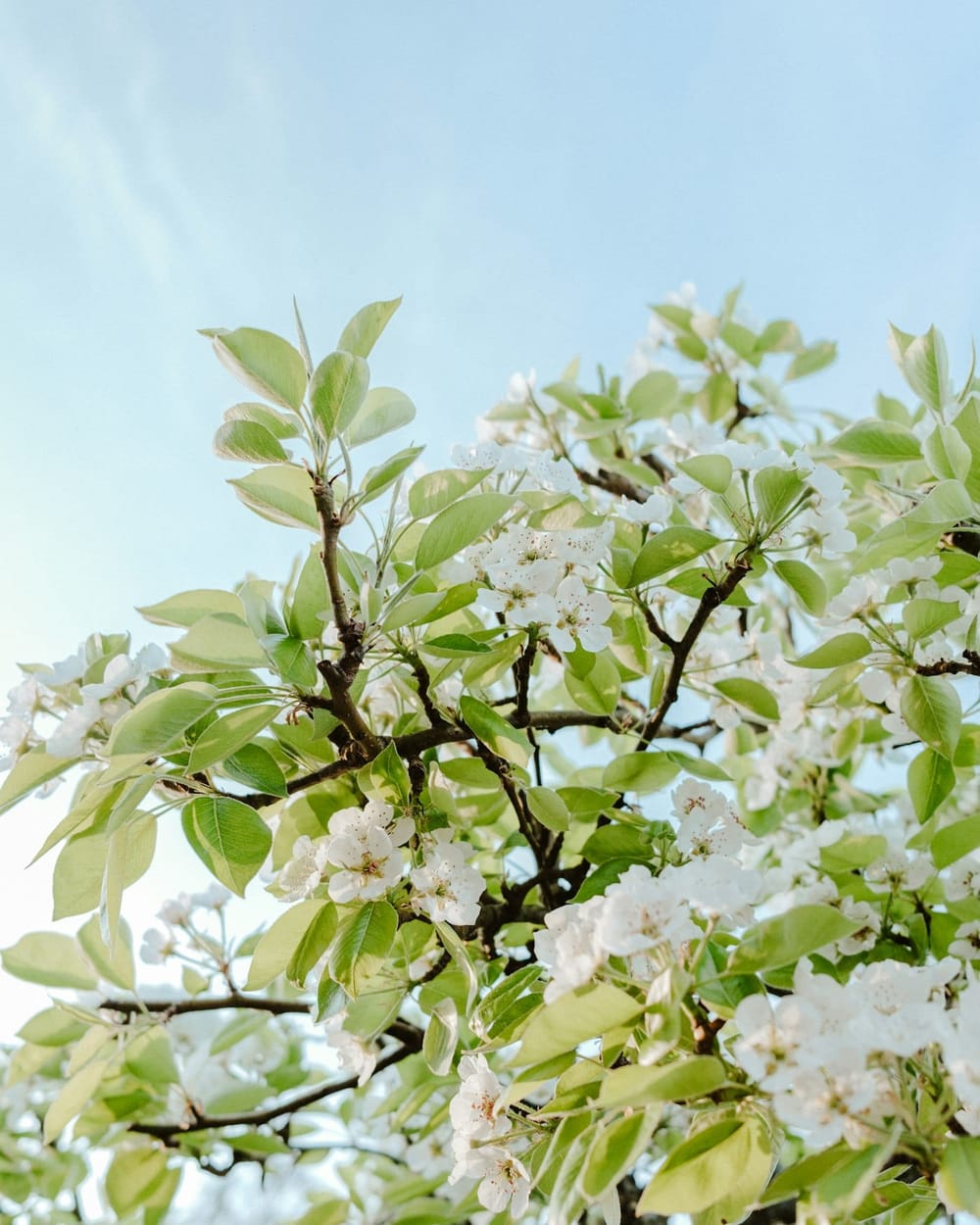
If you have a tree in your yard that erupts into a cloud of white flowers every spring, throws off a faintly unpleasant smell, and has a tidy lollipop shape, there is a good chance it is a Bradford pear. They are one of the most heavily planted ornamental trees in the Wichita metro, and they are also one of the trees we are called to take down most often. Bradford pear tree removal has become a regular part of our week across Wichita, Park City, Derby, and the surrounding Kansas suburbs — because these trees almost always reach a point where they split apart, and once that happens there is no putting them back together. This guide explains why Bradford pears fail, why Kansas is actively phasing them out, how to know when yours needs to come down, and what to plant in its place.
What Is a Bradford Pear — and Why "Callery Pear" Matters
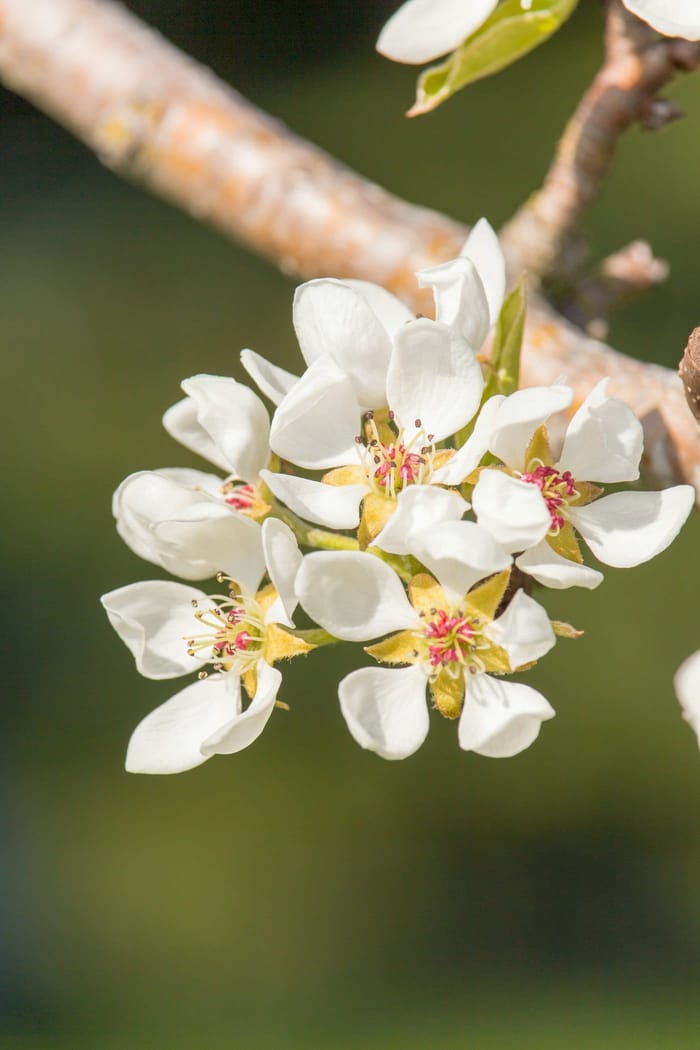
The Bradford pear is a cultivated variety of the Callery pear (Pyrus calleryana), a species originally brought to the United States from Asia. The "Bradford" cultivar was introduced in the 1960s and marketed as the perfect suburban street tree: fast-growing, uniform, covered in white blossoms in spring, with glossy leaves that turn red-purple in fall. It tolerated poor soil, shrugged off pollution, and grew almost anywhere. For decades it was planted by the millions, and Wichita-area developers embraced it as enthusiastically as anyone.
There was one catch the marketing left out. Bradford pears were sold as sterile — they were not supposed to produce viable fruit or spread. But once nurseries introduced other Callery pear cultivars (Cleveland Select, Aristocrat, Autumn Blaze and others), the different varieties began cross-pollinating. The result is fertile fruit, eaten by birds and dropped across the landscape, which sprouts into wild Callery pears. Those wild offspring are thorny, dense, and aggressive, and they are now spreading along Kansas roadsides, fence lines, and untended fields. So while your front-yard tree may be a well-behaved "Bradford," the species as a whole has become a genuine invasive problem — which is why you will hear arborists and the state use the broader name Callery pear.
Why Bradford Pears Are So Common in Wichita Neighborhoods
Drive through almost any Wichita-area subdivision built between the mid-1980s and the late 2000s — Maize, Goddard, Andover, Derby, Bel Aire, Park City — and you will see Bradford pears everywhere. They line entry boulevards, anchor front yards, and frame cul-de-sacs in matched pairs. Builders liked them because they were cheap, transplanted easily, and gave a brand-new development instant curb appeal. A street of young Bradford pears in full white bloom looks impressive in a way that takes most shade trees twenty years to achieve.
That same uniformity is exactly the problem. A neighborhood planted almost entirely in one short-lived species hits its structural problems all at once, on roughly the same timeline. The Bradford pears planted across the Wichita metro in the 1990s and early 2000s are now fifteen to thirty years old — precisely the age at which these trees start coming apart. For a broader look at which species do and do not hold up here, our guide to common tree species in Wichita puts the Bradford pear in context with the oaks, ashes, and cottonwoods around it.
The Real Problem: Bradford Pears Split in Kansas Storms
The single biggest reason we remove Bradford pears is structural failure. The problem is built into the tree from the day it is planted. A Bradford pear grows many upright limbs that all originate from nearly the same point on the trunk, crowded together at narrow, steep angles. Where two limbs press against each other, the tree cannot lay down solid connecting wood — instead it traps bark inside the joint. Arborists call this included bark, and it creates a weak seam exactly where the tree carries the most stress.
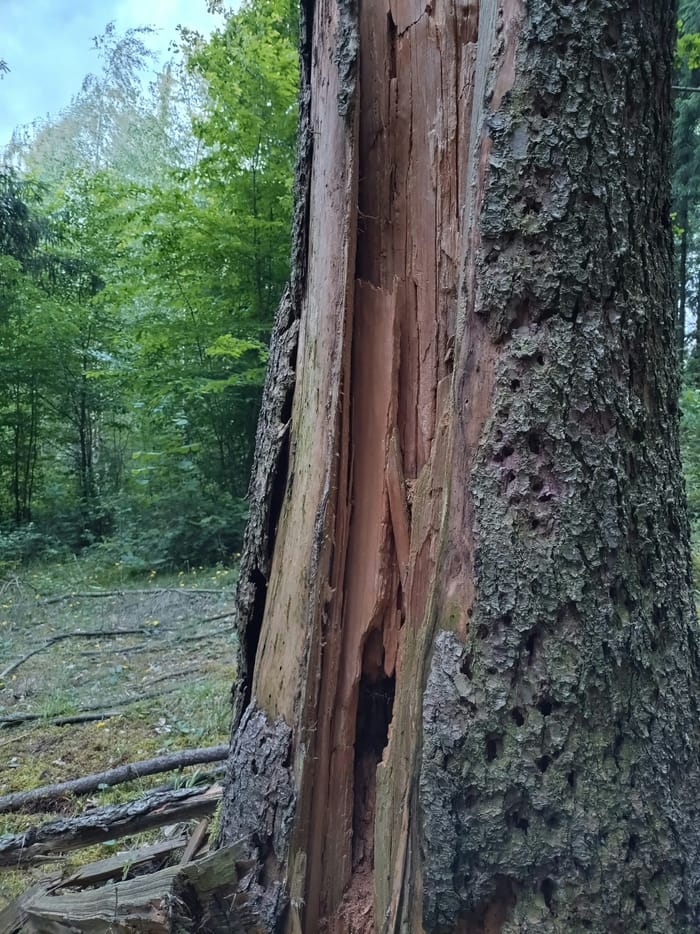
For the first ten or fifteen years, the tree usually holds together. But as the canopy gets taller and heavier, those crowded, bark-included unions become a liability. Kansas does the rest. A summer thunderstorm with 60-mph downbursts, a heavy wet snow, or one of the ice storms that periodically coat the region in glaze is all it takes. The tree splits — often straight down the middle — and you lose half of it or more in a single event. It is one of the most common storm-damage calls we get, and the failure is almost always catastrophic rather than a single broken branch. A mature oak that loses a limb still has a tree left. A Bradford pear that splits is usually finished.
If you want to get ahead of this on the trees you still have, our guide on preparing your trees for storm season in Wichita walks through what is worth doing before the weather turns. And if a pear has already come down or split in a storm, that is exactly what our storm-damage tree removal crews handle every week.
Three More Reasons Homeowners Want Them Gone
Structural failure is the headline, but it is rarely the only complaint. When a homeowner calls us about a Bradford pear, two or three of these usually come up in the same conversation.
The smell. Bradford pear blossoms look beautiful from a distance, but up close the scent is famously unpleasant — most people describe it as rotting fish or a dirty gym sock. For two or three weeks every spring, a yard with a few mature pears can be genuinely hard to enjoy. It is the most common reason people first ask us about removing a tree that is otherwise still standing.
The invasive spread. As noted above, today's Callery pears are no longer reliably sterile. Birds eat the small fruit and scatter the seed, and the wild seedlings that result are thorny, fast, and able to crowd out native Kansas plants along roadsides and in unmanaged ground. Removing a mature pear from your property is one small way to slow that spread — every flowering tree you take out is one fewer source of seed.
Short life and constant mess. Even setting aside storms, Bradford pears are simply not long-lived trees. Most decline noticeably after about twenty years, dropping fruit, twigs, and limbs as they go. Compared with a bur oak that will outlive the house, a Bradford pear is a tree on a stopwatch. If yours is already shedding deadwood and showing thin spots in the canopy, our article on the signs a tree needs to be removed lays out the criteria we use to make the call.
Kansas Is Phasing Out the Callery Pear
This is not just an arborist's opinion — the state of Kansas has formally moved against the Callery pear. Under a Kansas Department of Agriculture rule, the Callery pear (including the Bradford and every other cultivar) can no longer be sold or planted anywhere in the state as of January 1, 2027. After that date, new plantings are prohibited. The species has been recognized as invasive enough that the state is closing the door on it entirely.
At the same time, K-State's Kansas Forest Service has run Callery Pear Buyback events — including one in Wichita in the spring of 2026 — where homeowners who remove a Callery pear can claim a free native replacement tree (options have included bur oak, Kentucky coffee tree, eastern redbud, serviceberry, and Sargent crabapple), generally one per household and on a first-come, first-served basis with proof of removal. It is worth knowing two things about these programs: they hand out a replacement tree, not free removal, and Sedgwick County does not currently run a standing incentive of its own. In other words, the buyback is a nice bonus when the timing lines up, but the removal itself is still a job for a professional crew. If you are weighing the decision, the direction of state policy is a clear signal: this is a tree Kansas wants gone.
Should You Remove Your Bradford Pear?
Not every Bradford pear needs to come down tomorrow. Here is the framework we use when we assess one during a free estimate.
Strong reasons to remove it now
- It is fifteen years old or older with a classic crowded crown. Multiple upright limbs leaving the trunk at the same height, pressed tightly together, is the signature failure pattern. The bigger and older the tree, the higher the odds it splits in the next big storm.
- You can see included bark or a vertical seam where two main limbs meet. That dark, in-rolled line is a crack waiting to open.
- It has already lost a limb or partially split. Once a pear starts coming apart, the remaining structure is compromised. Patching it rarely buys much time.
- It is close to the house, driveway, fence, or a power line. A pear that splits over your roof or car turns a cosmetic problem into an expensive one. Location raises the stakes on every other risk factor.
When a younger tree might be worth pruning first
If your pear is still young — under about ten years and not yet showing tight, bark-included unions — structural pruning can sometimes reduce the worst of the crowding and buy you a few more good years. We will tell you honestly when that is a reasonable option. But it is a delay, not a cure: the underlying form of the tree is the problem, and most mature Bradford pears in Wichita are past the point where pruning changes the outcome. For the trees that are clearly finished, removal is the straightforward answer.
Why You Shouldn't Cut a Split Bradford Pear Yourself
When a pear splits, the temptation is to grab a chainsaw and clean it up over the weekend. Please don't. A split or leaning pear is loaded with stored tension — the wood fibers in a partially failed limb are under enormous spring-loaded pressure, and a single wrong cut can release that energy violently, snapping the limb back toward whoever is holding the saw. Add a ladder, a fence, or a nearby power line and the margin for error disappears. Bradford pears also tend to fail in big, awkward sections that are heavy and badly balanced, which is exactly the kind of load that injures homeowners.
This is the work our crews are trained and equipped for. Owner Joe Kohnen personally climbs and handles the high-risk removals, and the company is fully insured and licensed for tree work in Kansas. If your pear comes down at midnight in a storm, our 24/7 emergency tree service can get it stabilized and cleared. For the full rundown of what can go wrong, our article on why you should never DIY tree removal covers the specific dangers in detail.
Bradford Pear Tree Removal Cost in Wichita
The good news on cost is that Bradford pears are mid-sized trees, not towering hardwoods, so removal is usually toward the affordable end of the range. Based on what we see across the Wichita metro:
- Smaller pear, under about 25 feet: generally $250 to $500. Many younger ornamental pears fall here.
- Typical mature pear, 25 to 45 feet: generally $500 to $1,200. This covers the bulk of established neighborhood Bradford pears.
- Large or hazardous pear over a structure or power line: $1,200 and up, especially when a split has already happened and the wood has to be rigged down in controlled sections.
A pear that has already failed often prices a little higher than a clean, standing tree, because the spring-loaded wood has to be handled carefully. Two services almost always come up at the same time. Most homeowners want the stump ground out so they can replant in the same spot, and grinding is far cheaper to add to the same visit than to schedule separately. And because a removed pear produces a surprising volume of brushy wood, we bring our grapple truck to clear the debris efficiently and keep the final invoice down. For a full breakdown of what drives pricing, see our guide on how much tree removal costs in Wichita.
What to Plant Instead of a Bradford Pear
Once the pear is gone, resist the urge to replace it with another fast ornamental that will repeat the same story. The smarter move is a tougher, longer-lived tree — and conveniently, the species Kansas hands out through its Callery pear buyback are a great shortlist for our soils and climate:
- Eastern redbud. A native small tree with a burst of pink-purple spring flower, well-suited to a front yard where you want the same ornamental scale as a pear without the weak wood or the smell.
- Serviceberry. White spring bloom, edible berries the birds love, and good fall color — a genuinely better-behaved replacement for the look people liked about Bradford pears.
- Bur oak. Native, drought-tough, and effectively permanent. Slower to establish, but it builds a canopy that will outlast the house.
- Kentucky coffee tree. An underused, pest-resistant native with a bold form and strong wood — exactly the structural opposite of a Callery pear.
- Sargent crabapple. A compact flowering option that gives you the spring show without the invasive baggage.
Whatever you choose, the principle is diversity: a yard and a neighborhood built on a mix of strong species is far more resilient than a street of identical pears all failing in the same storm.
Why Wichita Homeowners Call Kohnen's for Bradford Pear Removal
Kohnen's Tree Service is family-owned and locally operated, and owner Joe Kohnen is on the job personally — he climbs, he rigs, and he handles the awkward, spring-loaded removals that split pears so often turn into. We are fully insured and licensed for all tree work in Kansas, carrying both liability insurance and workers' compensation, which protects you in a way a cash-only weekend crew never will. With over 120 five-star Google reviews, our track record on exactly this kind of residential removal is on the record.
We serve Wichita and the surrounding communities within about a 40-mile radius — Park City, Derby, Andover, Goddard, Maize, Bel Aire, Valley Center, Newton, El Dorado, Augusta, Rose Hill, and the smaller towns in between. Those are the same subdivisions where Bradford pears were planted by the hundreds, so this is a tree we know well.
"A split pear is one of the most deceptively dangerous trees a homeowner can take on. The wood is under load, it lets go without warning, and it does not behave the way people expect. That is exactly why we do this work ourselves. If your Bradford pear is getting big or starting to come apart, call me and I'll come look at it — no pressure, no obligation, no charge."
— Joe Kohnen, Owner, Kohnen's Tree Service
If you are not sure whether your Bradford pear is worth keeping another season or whether it is time to take it down, the next step is a free in-person assessment. We will look at the structure, check for included bark and prior failures, weigh its position relative to your house, and give you an honest recommendation. If it has good years left, we will tell you that too.
Request your free Bradford pear removal estimate online, or call (316) 207-4740 any time. We respond the same day.