

Every year between April and August, Wichita and the surrounding communities sit squarely in the path of some of the most severe weather in the country. Straight-line winds, hail, tornadoes, and intense thunderstorms are not hypothetical risks here — they are seasonal certainties. And the trees on your property are both valuable assets and potential liabilities depending on how well they are prepared before that first major storm rolls through. Preparing your trees for storm season in Wichita is not about eliminating risk entirely. That is not possible in south-central Kansas. It is about reducing the chances that a tree — or a piece of one — ends up on your roof, across your driveway, or tangled in power lines. This guide covers what Wichita homeowners should do before storm season, what to look for when inspecting your trees, and when to call a professional for help. Winter brings a different kind of load; our guide to ice storm tree damage in Wichita covers getting trees ready for ice.
Why Storm Preparation Matters in the Wichita Area
Kansas ranks among the top states in the country for severe thunderstorm activity. The Wichita metro area averages over 50 days per year with thunderstorms, and the region regularly experiences wind gusts exceeding 60 mph during spring and summer storms. Those gusts do not need to be tornadic to cause serious tree damage — straight-line winds from a fast-moving thunderstorm are responsible for the majority of storm-related tree failures in the area.
The trees most likely to fail during a storm are not random. They are trees with structural weaknesses that were visible before the storm hit — dead branches, split crotches, root damage, interior decay, and excessive canopy weight that acts like a sail in high winds. The homeowners who deal with the worst storm damage are almost always the ones who did not address those problems when they had the chance.
Storm preparation is also a financial decision. The cost of proactive tree pruning is a fraction of what you will pay for emergency tree removal after a storm drops a tree on your house. And while homeowner's insurance often covers storm damage tree removal, the deductible, the disruption, and the damage to your property are all avoidable in many cases.
Step 1: Inspect Your Trees Before Storm Season
The single most important thing you can do to prepare your trees for storm season is walk your property and look at every tree with a critical eye. You do not need to be an arborist to spot the most common warning signs. Here is what to look for:
Dead or hanging branches. Dead wood is brittle and will snap in moderate wind that a healthy branch would flex through. Look for branches with no leaves (during the growing season), peeling bark, or a grayish color that differs from the rest of the tree. Hanging branches — sometimes called "widow-makers" — are branches that have already partially broken but are caught in the canopy. These are the highest-priority hazards because they can fall at any time, storm or no storm.
Cracks and splits in the trunk or major limbs. A crack running vertically along the trunk or through a major branch union is a structural failure waiting to happen. Deep cracks indicate that internal wood fibers have already separated, and high winds can complete the split. Pay special attention to V-shaped branch unions where two main leaders grow tightly together — these are inherently weaker than U-shaped unions and are common failure points during storms.
Leaning trees. A tree that has always grown at a slight angle is not necessarily a problem — some trees lean naturally. But a tree that has recently started leaning, or one where you can see soil heaving or exposed roots on the side opposite the lean, is a tree whose root system may be failing. A compromised root system combined with high winds is how trees uproot entirely. If you are not sure whether a lean is new, our guide on signs a tree needs to be removed can help you evaluate it.
Fungal growth and decay. Mushrooms or conks (shelf-like fungal growths) on the trunk or at the base of a tree indicate internal decay. By the time fungal fruiting bodies are visible on the outside, the decay inside is usually extensive. A tree that looks solid from the outside can be hollow or structurally compromised internally. These trees are unpredictable in storms because the trunk or major limbs can snap without warning.
Root zone problems. Look at the ground around the base of the tree. Soil that is cracked, heaved, or pulling away from the trunk suggests root movement. Construction damage, grade changes, or soil compaction from vehicles or heavy equipment can weaken root systems over time. Trees near recent construction — a new driveway, patio, or utility trench — are especially vulnerable because their root zones may have been cut or compacted.
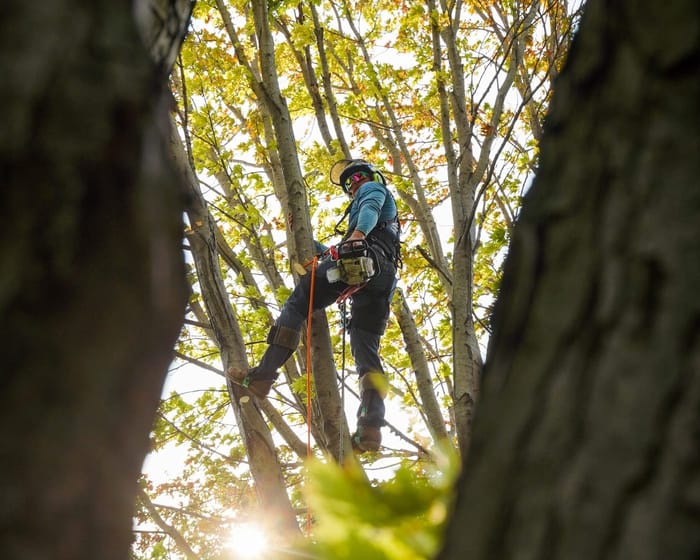
Step 2: Prune for Wind Resistance
Proper pruning is the most effective storm preparation you can do for your trees. The goal is not to remove as much of the tree as possible — it is to reduce the specific structural risks that cause failures in high wind. There is a difference, and it matters.
Remove dead and damaged branches. This is the baseline. Every dead branch is a projectile waiting for enough wind to send it flying. Removing deadwood from the canopy eliminates the most obvious storm hazard and is something that should be done annually on mature trees in the Wichita area. If the whole tree is dead, pruning won’t fix it — that’s a job for dead and hazardous tree removal.
Thin the canopy selectively. A dense, full canopy catches wind like a sail. Selective thinning — removing some interior branches to allow wind to pass through the canopy rather than push against it — dramatically reduces the wind load on the trunk and root system. This does not mean stripping the interior of the tree bare. Proper thinning removes no more than 15 to 20 percent of the live canopy and maintains the tree's natural shape. Over-thinning, or "lion-tailing" where all interior branches are removed and foliage is left only at branch tips, actually makes trees more vulnerable to wind damage, not less.
Reduce end-weight on long limbs. Branches that extend far from the trunk with heavy foliage at the tips act as levers in the wind. The longer and heavier the branch tip, the more force it exerts on the branch union where it connects to the trunk. Reducing the length and weight at the tips of overextended limbs — a technique called crown reduction — lowers the forces that cause branch failures without drastically changing the tree's appearance.
Address co-dominant stems. Trees with two main trunks that split from a single point (co-dominant stems) are the most common large-scale storm failure we see in Wichita. The tight V-shaped union between co-dominant stems often includes bark that is trapped between the two stems rather than proper wood fibers connecting them. Under wind load, these stems split apart. A professional arborist can install cable or brace hardware to support co-dominant stems, or in some cases, reduce one stem to subordinate it to the other.
The best time to prune most Kansas trees is during dormancy in late winter, but storm prep pruning — especially deadwood removal — can and should be done any time the hazard is identified. Do not wait until November to remove a dead branch hanging over your bedroom in April.
Step 3: Deal with Hazard Trees Before the Storm Does
Some trees cannot be made safe through pruning alone. If a tree is dead, severely decayed, structurally compromised, or leaning toward a structure, the responsible decision is to have it removed before a storm makes the situation worse — and more expensive.
We understand that removing a tree is not a decision homeowners take lightly, especially if the tree has been on the property for decades. But a dead 60-foot cottonwood leaning toward your house is not going to improve with time. Every storm season it survives is a storm season you got lucky. The cost of planned tree removal is significantly less than the cost of emergency removal after the tree has fallen on a structure — and that does not account for the structural damage to your home that insurance may not fully cover.
If you have a tree you are unsure about, a professional assessment is the best investment you can make before storm season. At Kohnen's, we provide free, in-person evaluations and will give you an honest recommendation. If pruning can make the tree safe, we will tell you that. If the tree needs to come down, we will explain why and provide a written estimate. There is no pressure to commit on the spot.
Step 4: Clear Deadfall and Debris from Your Yard
Storm preparation is not just about the trees themselves. Loose branches, brush piles, and yard debris become airborne hazards in high winds. A stack of cut branches next to your garage is harmless on a calm day. At 70 mph, those same branches are projectiles that can break windows, dent siding, and damage vehicles.
Before storm season, clear any accumulated deadfall, brush, and cut wood from your property. If you have a significant amount of debris — from a previous storm, a pruning job, or general yard maintenance — our grapple truck service can clear it quickly and efficiently. The grapple truck picks up and loads loose branches, logs, and brush mechanically, which means a job that would take hours of manual loading can be completed in a single pass.
Step 5: Know Your Trees and Their Vulnerabilities
Not all tree species handle Kansas storms equally. Understanding which trees on your property are more vulnerable to storm damage helps you prioritize your preparation efforts.
Silver maple. Arguably the most storm-prone tree in the Wichita area. Silver maples grow fast, develop weak branch attachments, and produce brittle wood. They are beautiful trees, but they shed limbs in every significant windstorm. If you have a large silver maple near a structure, annual pruning is not optional — it is essential.
Bradford pear (Callery pear). The Bradford pear's tight branching structure and multiple co-dominant stems make it one of the most likely trees in any neighborhood to split apart in a storm. Many Wichita homeowners have already learned this lesson the hard way. These trees are structurally flawed by design and typically start failing within 15 to 20 years.
Cottonwood. Cottonwoods grow enormous quickly, and their wood is relatively soft. Large cottonwoods near structures are among the highest-risk trees in the area simply because of the mass involved — when a large cottonwood limb fails, it causes serious damage regardless of what is underneath it.
Green ash and white ash. Ash trees in Kansas face the additional threat of emerald ash borer (EAB), which has been confirmed in the state. An ash tree weakened by EAB infestation is dramatically more likely to fail in a storm because the beetle kills the tree from the canopy down, creating dead wood throughout the crown.
Bur oak, red oak, and hackberry. These species are among the most wind-resistant trees in the Wichita area. They produce strong wood and develop sturdy branch attachments. That does not make them storm-proof — any tree can fail given enough wind — but healthy specimens of these species require less intervention than the species listed above. For more on the trees in your yard, see our guide to common tree species in Wichita.

What to Do When a Storm Watch or Warning Is Issued
When the National Weather Service issues a severe thunderstorm watch or tornado watch for the Wichita area, your tree preparation should already be done. But there are a few immediate steps that can reduce damage:
- Move vehicles away from large trees. If you park under a tree regularly, move your vehicle to open pavement or a garage before the storm arrives. Falling limbs are the most common cause of vehicle damage during storms.
- Secure loose items in the yard. Patio furniture, grills, trash cans, and garden decorations become projectiles in high wind. Bring what you can inside or secure it to a fixed structure.
- Stay away from windows on the side of your home facing large trees. If a major limb or tree fails during the storm, flying glass from a broken window is a serious injury risk.
- Do not attempt any tree work during or immediately before a storm. If you notice a hazard as a storm is approaching, it is too late to address it safely. Stay inside, stay safe, and deal with it after the storm passes.
After the Storm: What to Do Next
If a storm has already damaged trees on your property, your first priority is safety. Stay away from downed trees, especially any that are near or touching power lines. Assume any downed line is live. Do not attempt to clear storm-damaged trees yourself — DIY tree removal is dangerous under normal conditions and significantly more dangerous when trees are under tension from storm damage.
If a tree has fallen on your home or another structure, document the damage with photos before any cleanup begins. This documentation is critical for your insurance claim. Kohnen's Tree Service handles storm damage tree removal and offers insurance direct billing — we manage the documentation, communicate with your adjuster, and handle the removal so you can focus on getting your property back to normal.
For emergency storm damage, call us at (316) 207-4740. We respond 24/7 and prioritize situations where trees have damaged structures or are blocking access to your property.
Get Your Trees Storm-Ready with Kohnen's Tree Service
Kohnen's Tree Service is family-owned, fully insured, and based right here in Park City, Kansas. Joe Kohnen personally works every job — he is not dispatching crews from an office. That hands-on approach means every tree gets assessed by someone with real experience in the field, not just a sales estimate.
We serve Wichita and surrounding communities including Derby, Andover, Goddard, Newton, Maize, Valley Center, and the entire south-central Kansas area within a 40-mile radius of Park City. Whether you need a single dead branch removed or a full-property storm preparation assessment with pruning and removals, we will give you an honest evaluation and a fair price.
"The calls I hate getting are the ones at two in the morning after a storm, where a homeowner tells me they noticed the tree was dead last fall but figured it would be fine. It is always cheaper, safer, and easier to deal with these things before the storm. That is what storm prep is — handling it on your schedule instead of the weather's."
— Joe Kohnen, Owner, Kohnen's Tree Service
Do not wait for the first tornado watch of the season. Request your free storm preparation estimate online, or call (316) 207-4740 any time. We will walk your property, identify the risks, and give you a clear plan to protect your trees and your home before storm season arrives.