
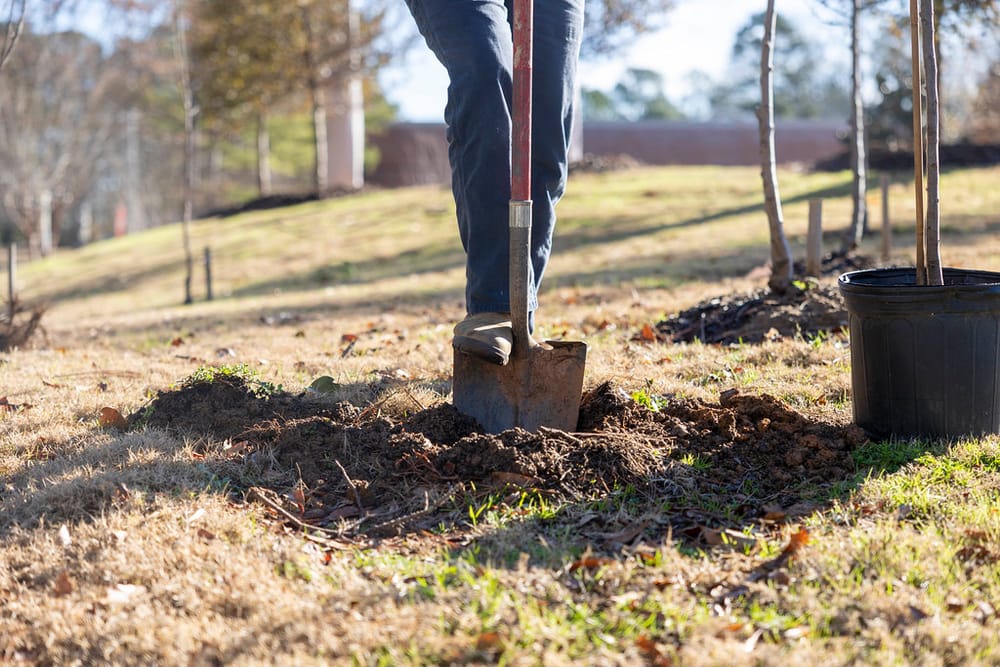
The grinder pulls out of the driveway and you're left looking at a mound of damp wood chips where a shade tree used to be. The next question is almost always the same, and it usually arrives by phone a day or two later: "Can I just plant a new one right there?"
Short answer: not in that hole, and not into those chips — but yes, in that area, and fall is the best time of year in south-central Kansas to do it. This guide walks through the whole job the way we'd talk a homeowner through it on site: what the grinder actually leaves behind, why the grindings are a poor place for a young tree, the two ways to handle the spot, and the step-by-step planting that decides whether the tree is still standing in ten years. If you're still choosing what to put back, our guide to native Kansas trees worth planting this fall covers species selection; this post is about the ground.
The Short Answer, Up Front
If you want the decision without the reasoning behind it, here it is:
- Don't plant into the grind hole or the grindings. Wood chips settle as they break down and temporarily pull nitrogen out of the soil right where the new roots need it.
- Pick one of two fixes. Either offset the new tree three to five feet from the old trunk, or dig the grindings out and backfill the area with soil.
- Tell the crew before they grind if you already know you're replanting. Standard residential grinding goes four to six inches below grade; ten to twelve inches gives you room to work.
- Plant between late September and mid-November and keep watering until the ground freezes.
The rest of this explains each of those, plus the planting steps themselves.
What the Grinder Actually Leaves Behind
Stump grinding isn't digging the stump out. A grinder is a spinning wheel with carbide teeth that chews the stump and the top of the root system into coarse chips, working from the top down. Three things are left when it stops:
- The grindings — a mound of chipped wood and soil. It always looks like more than came out, because chipped wood takes up roughly twice the volume of the solid stump it came from. Expect a pile.
- The hole. Standard residential grinding takes the stump about four to six inches below grade — below the mower blade, deep enough that grass will grow over it once the spot is filled and levelled.
- The root system. Everything past a few feet out is still in the ground. The root plate — the dense mass of structural roots directly under the trunk — is partly ground away; the long lateral roots radiating out from it are not. Those stay put and decay in place over five to ten years, depending on the species and how wet the soil stays.
That last point is the one most people don't picture. A mature shade tree's roots spread out well past where the branches ended, mostly in the top 12 to 18 inches of soil. Grinding a stump does not clear the ground for you; it clears the part you can see.
Why You Can't Just Plant Into the Grindings
Backfilling the hole with its own grindings is fine when you're putting grass back — we do it that way routinely. It is a bad start for a tree, for four reasons.
- Nitrogen tie-up. The soil microbes that break down wood chips need nitrogen to do it, and they pull that nitrogen out of the surrounding soil while they work. It comes back once decomposition finishes, but that can take a couple of years — exactly the window when a young tree is trying to establish. A tree planted in fresh grindings often looks pale and grows slowly, and the cause is invisible from above.
- Settling. As the chips decompose they lose a large share of their volume. Soil that was level in November can be a noticeable dish by the following summer, and a tree planted on top of it sinks with it — which buries the trunk deeper than it should be.
- Air pockets and drainage. Loose chips don't pack like soil. In Wichita's heavy clay, a chip-filled pit surrounded by clay behaves like a bucket: water runs in, sits, and doesn't drain. Young roots in standing water don't last.
- The old root mass. Whatever remains of the previous tree's structural roots is decaying wood directly in the path of the new roots. If the old tree came out because of a root or trunk disease, that decaying mass may also be where the problem still lives.
Two Good Options: Offset, or Excavate
Option 1: Offset the New Tree (usually the easier call)
Move the planting spot three to five feet away from the center of the old trunk and you sidestep most of the problem — no grindings to remove, no pit to rebuild, and the new roots grow into undisturbed soil instead of a decaying root plate. Rake or shovel the grindings out of the immediate planting area even so, and don't let them end up mixed into the backfill.
Before you settle on the offset direction, check what you're moving toward. Look up for overhead power lines; measure back toward the house, the driveway and the patio; and think about the canopy the tree will have at forty years old, not the six-foot whip on the trailer. Twenty feet from the foundation is a reasonable working minimum for a large shade tree. Under a primary power line, nothing that matures above roughly 25 feet belongs there at all.
Option 2: Excavate the Grindings and Backfill With Soil
Sometimes the spot is the spot — a narrow strip between the sidewalk and the curb, a courtyard, a small lot where nowhere else works, or a symmetrical pair of trees flanking a drive. In that case the grindings have to come out.
That means removing the chip-and-soil mix from the grind hole and the surrounding planting area, hauling it off, and backfilling with screened topsoil. Then water it in and let it settle for a week or two before planting so you aren't setting a tree on ground that's about to drop. Be realistic about the volume: a 30-inch stump can produce more debris than fits in a pickup bed, and the hole afterward wants more soil than most people expect. It's worth asking for deeper grinding and haul-off as part of the original job — our stump grinding service grinds four to six inches below grade as standard and can go to ten or twelve inches when you tell us you're replanting. That conversation is much cheaper before the crew arrives than after; our post on booking removal and stump grinding as one visit covers the other questions worth settling in advance.
Timing: Why Fall Is the Easier Window Here
Roughly late September through mid-November is the sweet spot in south-central Kansas. The air has cooled, so the tree isn't losing water through its leaves faster than it can pull it from the ground, but the soil is still warm enough that roots keep growing for weeks after the canopy shuts down for the year. A tree planted in October spends the entire dormant season quietly putting out roots. The same tree planted in late May spends its first summer just trying to survive.
Aim to get it in the ground about six weeks before the soil freezes hard, which in most Wichita-area years means finishing by mid-November. Later than that still works more often than not, but the margin gets thin. And fall planting does not excuse you from watering — a fall-planted tree needs water right up until the ground freezes.
One caveat: if the grindings were only just excavated and the backfill hasn't settled, it is better to wait and plant in early spring than to set a tree on ground that is going to drop three inches under it.
Before You Dig: Call 811
Kansas One Call is free, it's the law for anyone disturbing soil, and a planting hole is deep enough to matter. Call 811 or file online at least two working days ahead and they'll mark the public utilities on the property.
What 811 does not mark is anything private: irrigation lines, invisible pet fence, low-voltage landscape lighting, the gas line you ran to the grill, the electric out to the shed. You're on your own for those, so think back through what's buried out there before the shovel goes in.
Step by Step: Getting the New Tree In
- 1. Clear the area. Rake the grindings off the planting spot and set them aside. If you're excavating rather than offsetting, that soil work happens now and gets a week or two to settle.
- 2. Find the root flare before you dig. The root flare is where the trunk widens out into the first major roots. Nursery stock is very often potted or balled too deep, so scrape soil off the top of the root ball until you can see it. Measure the root ball height from the flare down — that number, not the height of the pot, is how deep your hole needs to be.
- 3. Dig wide and shallow. Two to three times the width of the root ball, and no deeper than the measurement you just took. In clay, scuff up the sides of the hole with the shovel rather than leaving them smooth and glazed, or roots will circle inside it like a pot.
- 4. Set the tree with the flare at or slightly above grade. Planting too deep is the single most common way a healthy young tree dies, and it kills slowly enough that nobody connects the cause to the effect five years later. Slightly high is much safer than slightly low, especially in clay.
- 5. Free the roots. On container stock, tease out or cut any roots circling the outside of the ball — left alone, they eventually strangle the trunk. On balled-and-burlapped stock, set it in the hole first, then cut away the twine and fold back or remove the top third of the wire basket and burlap.
- 6. Backfill with the soil that came out. Skip the peat, compost and bagged amendments. Amended backfill in a clay hole encourages roots to stay in the nice pocket instead of pushing out into native soil. Water as you fill to collapse air pockets rather than stomping it down.
- 7. Mulch in a wide ring, not a volcano. Two to three inches of wood mulch over a circle at least three feet across, pulled back a few inches so nothing touches the bark. Mulch piled against a trunk holds moisture against it and invites rot.
- 8. Stake only if you have to. Most trees establish faster unstaked, because a little movement builds trunk strength. If the site is windy or the root ball is loose, stake it loosely enough that the trunk can still flex, and pull the stakes after one growing season.
- 9. Skip the fertilizer. Nothing in year one. What a new tree needs is water and time, and fertilizer pushes top growth the roots can't yet support.
- 10. Water deeply and keep going. A rough rule is 10 to 15 gallons a week per inch of trunk caliper — the trunk diameter measured about six inches above the ground — delivered slowly, in one or two soakings rather than daily sprinkling. Continue until the ground freezes, then pick it back up in spring and hold that habit through the first two growing seasons. A Kansas August is hard on a two-year-old tree.
Leave the pruning shears in the garage. Beyond cutting off anything broken or dead at planting, a young tree needs every leaf it has. Structural pruning — picking a central leader, removing competing stems before they turn into weak forks — starts a few years in, and it is the cheapest tree work you will ever buy.
Choosing What Goes Back
Two rules specific to a replant spot, on top of the usual matching of species to site.
Don't replace like with like if disease took the old tree. If an ash came out because of emerald ash borer, another ash is a bad bet. If an elm went to Dutch elm disease or an oak to oak wilt, plant something in a different family. Root-decay fungi in particular persist in the old root mass for years, which is another argument for offsetting the new tree rather than planting straight into it.
Don't replace like with like if structure took it. A lot of the removals we do in Wichita are fast-growing, weak-wooded species that got tall quickly and then started dropping limbs — silver maple, Bradford pear, cottonwood near a house. Putting the same tree back in the same spot buys you the same problem on a thirty-year delay. If you're unsure what you had or what would suit the site, our guide to the common tree species in Wichita is a good place to start.
What to Do With the Leftover Grindings
You have three reasonable options, and one bad one.
- Use them as mulch on beds, fence lines or paths. Fresh grindings are coarse and will break down slowly, which is fine for that job. Keep them off the trunks of trees, including the new one.
- Leave them in the hole if the plan for that spot is lawn rather than a tree. Mound it slightly high, since it will settle, and top with soil for seed or sod.
- Have them hauled off. Worth doing when the tree was diseased or pest-infested, when the spot is being replanted or built on, or simply when you don't want the pile.
- Don't till them into garden soil. Same nitrogen problem as under a new tree, spread over a wider area.
What's Reasonable to Do Yourself — and What Isn't
Planting a container-grown tree is genuinely a homeowner job. A two-inch caliper tree in a pot, a spade, a wheelbarrow and an afternoon: that's a good Saturday and there's no reason to pay someone for it.
Where it stops being a homeowner job:
- Large balled-and-burlapped stock. A B&B root ball can weigh several hundred pounds. Moving one by hand is how people hurt their backs and damage the tree.
- Renting a stump grinder. A walk-behind grinder is a spinning carbide wheel at ankle height, it throws debris hard, and it takes real skill to control around a fence, a foundation or a gas line. The rental saves less than people expect once you add transport and a day of your time.
- Anything still standing that needs to come down. Felling, climbing, and cutting limbs overhead are not DIY work. Storm-damaged wood in particular holds stored tension that releases unpredictably when it's cut.
- Anything near a power line. Not a judgment call, not a "just be careful" situation. Keep yourself and your equipment well clear and let a utility or a qualified crew handle it. Downed lines are a 911 and Evergy call at 1-800-383-1183 first, before anything else.
"Half the replanting problems we get called out to look at started the day the stump came out. Somebody filled the hole with chips, put a tree on top of it, and watched it sulk for three years. Move over five feet, or take the chips out — either one, and the tree takes care of itself."
— Joe Kohnen, Owner, Kohnen's Tree Service
Frequently Asked Questions
Can you plant a tree where a stump was ground? Yes, with one adjustment. Either offset the new tree three to five feet from the old trunk, or dig out the grindings and backfill with soil before planting. Planting straight into fresh grindings means settling ground and a temporary nitrogen shortage exactly where the young roots are trying to establish.
How long after stump grinding can you plant a tree? If you're offsetting to undisturbed soil, right away — the same week is fine. If you excavated the grindings and backfilled with soil, water it in and give it a week or two to settle first. If you left the grindings in place and want to plant in that exact spot, you're waiting years, not weeks; excavate instead.
How deep should a stump be ground if I'm replanting? Ask for ten to twelve inches rather than the standard four to six. Standard depth is set by what a mower needs, not by what a root ball needs. Say so when you book, because it changes how the crew sets up.
How much should it cost to grind a tree stump? In the Wichita area, single stumps commonly land somewhere between about $100 and $400, driven mainly by diameter, root spread and how easily a machine can reach the spot. Those are general market estimates rather than posted rates — diameter and access can only really be judged in person, which is why our estimates are done on site and are free.
How much does it cost for a tree stump grinder? Renting a walk-behind grinder typically runs somewhere in the low hundreds for a day, before transport, fuel and the trailer to move it. For a single residential stump that is often close to what a crew charges to do it properly, with none of the risk.
Is it better to remove a tree stump or grind it? Grinding, for nearly every residential situation. Full excavation of the root ball is far more invasive and expensive and leaves a crater to fill. It is worth it mainly when you're building on the spot, regrading, or dealing with a soil-borne disease.
What is the fastest way to get rid of a tree stump? Mechanical grinding. It takes minutes to about an hour per stump depending on size and wood hardness. Chemical stump removers and burning are far slower — months to seasons — and they leave the root crown intact, which is the part that keeps sprouting.
Why shouldn't you leave a tree stump in the ground? It sprouts suckers for years in species like elm, cottonwood and silver maple; it draws termites, carpenter ants and wood-boring beetles close to the house; it can host root-decay fungi that reach nearby trees; the ground settles into voids as the roots break down; and it is a hazard to mowers and to anyone crossing the yard.
Will a tree grow back if I grind its stump? Not from the stump. Grinding removes the root crown and the stored energy that suckering depends on. An aggressive species may push the occasional sprout from a distant lateral root in the first season; those are isolated and die out on their own.
Do I need to remove the old roots before planting? No. The lateral roots left in the ground decay on their own over several years and don't need to come out. Just don't try to dig the new planting hole through one — move the hole rather than cutting your way through a major root.
When is the last day to plant a tree in Wichita in the fall? Plan on finishing by mid-November in a typical year, which gives roots about six weeks of warm soil before the ground freezes. Later plantings sometimes do fine, but the margin narrows, and the watering has to continue right up to the freeze either way.
Replanting a Spot in the Wichita Area?
If the tree is still standing and you're weighing whether it's worth keeping before you plan a replacement, that's a conversation worth having in person. Joe Kohnen is an ISA Certified Arborist and can tell you on site whether the existing tree has years left, how deep the stump should be ground for what you have in mind, and where the replacement should actually go. Kohnen's Tree Service is family-owned and owner-operated, fully insured, and rated 4.9 from 130+ Google reviews across the metro — you can see the full range of our Wichita tree service work, from removal through grinding and cleanup, on our home page.
We serve Wichita and communities within roughly 40 miles of our Park City base, including Derby, Bel Aire, Andover, Goddard, Maize, Newton, Valley Center and El Dorado.
Request a free in-person estimate, or call (316) 207-4740. We respond the same day.