
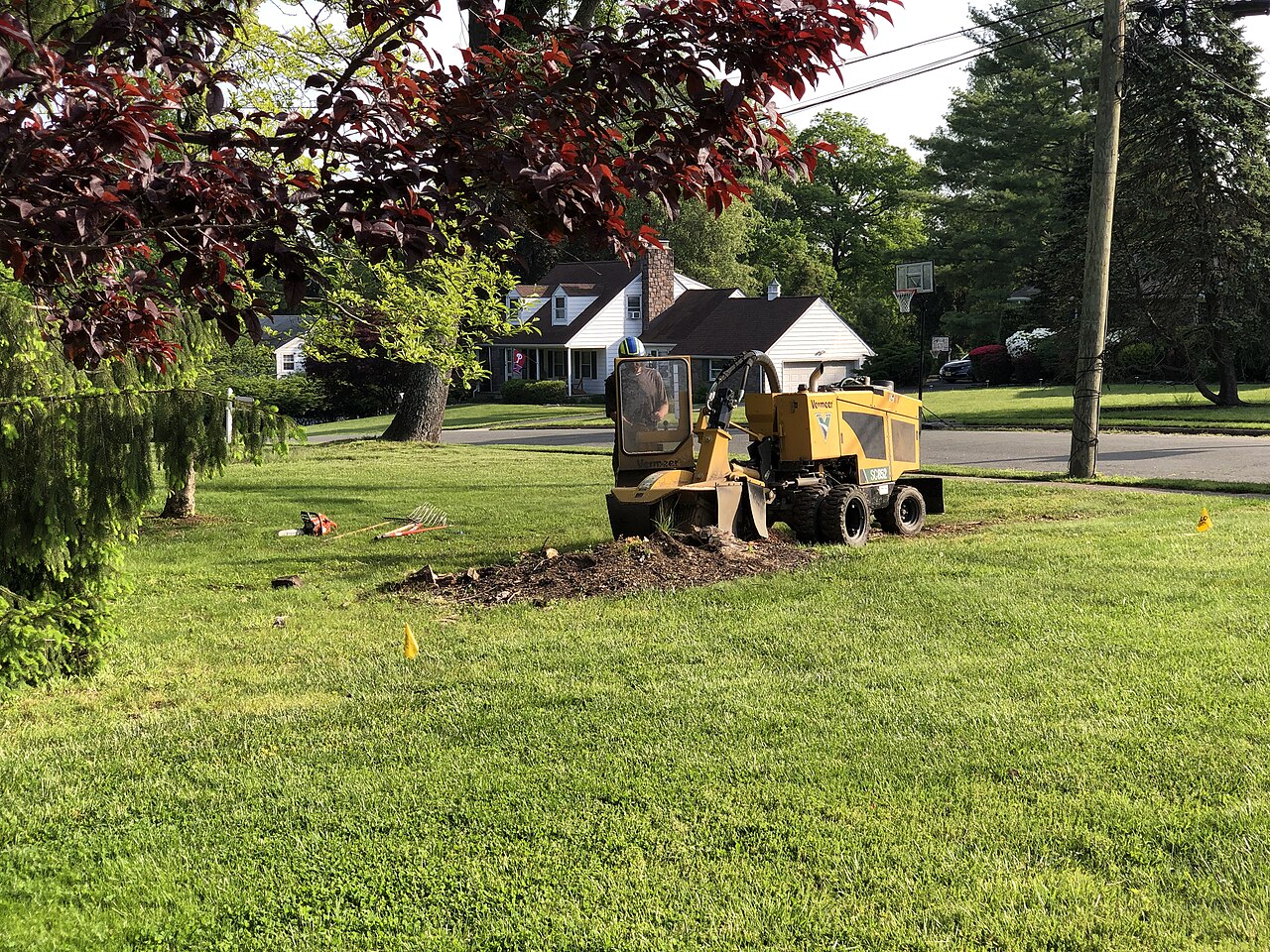
Most people book a tree removal, watch the crew leave, and only then start thinking about the stump. That's the expensive order to do it in. Getting the tree down and the stump ground on the same visit is usually cheaper, faster, and tidier — but only if a handful of details get settled before anyone shows up, because "we'll grind the stump too" can mean five different things depending on who you're talking to.
This is the short list of questions worth asking during the estimate. None of them are trick questions, and a good crew will have quick, specific answers to all nine. If you want the underlying mechanics — how the machine works, what the depression looks like, how to reseed the spot — our complete stump grinding guide covers that. This post is about the conversation you have before the work is scheduled.
First, Why Combine Them at All?
Two reasons, and both are practical rather than theoretical.
The first is mobilization. A big share of what you pay for any tree job is getting equipment, trucks, and a crew to your address and set up in your yard. Doing the removal and the grinding as one scheduled visit means paying that setup once instead of twice. It's the same logic behind grinding four stumps in one trip costing far less per stump than four separate calls.
The second is that the yard is already disturbed. The crew is already working around your fence, your sprinkler heads, and your driveway. Adding the grinder while the site is staged is a small marginal step; coming back in three weeks to a re-sodded, re-mulched, freshly landscaped yard is not.
What one visit does not mean, universally, is one machine or one moment. On many jobs the grinder rolls in the same afternoon the tree comes down. On others — a big removal that eats the whole day, a stump behind a gate the grinder can't clear until a panel comes off, wet ground after a storm week — the grinding lands a few days later on a scheduled return. That's normal. What matters is that you know which one you're getting, which is question one.
The Nine Questions
1. Is the stump getting ground the same day, or is that a second trip?
Ask it plainly and get a plain answer. Same-day grinding is common and it's what most people picture when they hear "we'll take care of the stump." But a return visit isn't a red flag on its own — it's often the right call for scheduling, ground conditions, or equipment routing. The problem is only ever the surprise. If it's a return trip, ask roughly when, and confirm it's part of the same quoted job rather than something you'll be re-quoted for later.
2. How deep will you grind — and does that change if I'm replanting or building?
Standard residential grinding takes the stump to roughly four to six inches below grade. That's deep enough to stop the stump sprouting, deep enough to disappear under topsoil, and deep enough to mow over without ever knowing it was there. It is not deep enough for everything.
If you're planning to put a deck footing, a patio, a shed pad, or a new tree in that exact spot, say so during the estimate, not after. (Replanting has a few more wrinkles than depth alone — our how-to on planting a new shade tree where the stump was ground covers them.) Deeper grinding — commonly ten to twelve inches — is available and usually costs more, because it's more machine time and more material. Deciding this before the grinder is staged costs you a sentence. Deciding it afterward costs you a second visit.
3. What happens to the grindings?
This is the question most people forget, and it's the one that changes what your yard looks like on Saturday. Grinding a stump produces a surprising volume of shredded wood, bark, and soil — a 20-inch stump can easily fill two or three wheelbarrows. That material has to go somewhere, and there are three normal outcomes:
- Backfilled into the hole. The default. Grindings go back into the depression, mounded slightly because they'll settle, then topped with soil later. Cheapest, and fine for a spot that's going back to lawn.
- Left in a pile for you. Useful if you want free mulch for beds, fence lines, or around other trees. Say so, or it may not be offered.
- Hauled off entirely. Usually an add-on. Worth paying for if the stump was diseased or pest-infested — you don't want that material spread through your beds — or if the spot is being built on or replanted.
There's a fourth pile you should ask about at the same time: the tree itself. A mature removal leaves brush, limbs, and trunk wood that dwarfs the stump grindings. Confirm whether the wood is going with the crew, being cut to firewood length and stacked, or being hauled separately — that last one is what a grapple truck is for, and it's a much shorter conversation before the job than after.
4. Who fills and levels the hole, and is topsoil included?
"Ground the stump" and "left the yard flat" are two different deliverables. After grinding you have a depression full of chips. Getting from there to lawn takes topsoil and seed or sod, and whether that's on the crew or on you varies by company and by job.
Ask specifically: will the area be raked out and leveled, is topsoil brought in, and is seeding part of it? If topsoil isn't included, that's completely reasonable — just know it so you can pick some up. And expect to top it up again: chips and soil settle for a season, so a spot that looks level in September often needs another few inches by spring.
5. Are the surface roots getting ground too?
The stump is the part you see. The surface roots radiating out from it — the ones that catch a mower deck and make that corner of the lawn impossible to cut cleanly — are frequently the thing you actually wanted gone. They're usually grindable, they add machine time, and they're generally quoted separately from the stump itself. If those roots are the reason you're doing this, point at them during the walk-through.
Worth being clear about what grinding doesn't do: it removes the stump and the surface roots, not the entire underground root system. The deeper lateral roots stay and decay on their own — a few years for small ones, a decade or more for the big structural roots off a mature tree. They're inert. They don't need to come out, and digging them out would mean excavating a crater across half your yard.
6. Can the grinder physically reach the stump?
Backyard stumps behind a fence are where combined jobs most often go sideways. A standard commercial grinder needs a gate opening in the neighborhood of 36 to 48 inches. Narrower track machines fit through roughly 30 inches. If there's no gate at all, sometimes a fence panel comes off and goes back on.
Tell the estimator about the gate, the slope, the retaining wall, the septic lateral, the irrigation lines, and the neighbor's driveway you'd rather nobody parked across. Access is what decides which machine gets dispatched, and dispatching the wrong one is the classic reason a "one visit" job becomes two.
7. Have the underground utilities been located?
Grinding chews into soil, and buried lines live in soil. In Kansas, calling 811 (Kansas One Call) gets public utilities marked for free before digging. It's standard practice and it should be part of the job planning, not an afterthought.
Understand the limit, though: 811 marks utility-owned lines up to the meter. It does not mark your private lines — the gas run out to the grill, the low-voltage landscape lighting, the invisible dog fence, the sprinkler system, the electric line to the shed. Only you know those exist. Walking the yard and pointing them out before the grinder starts is genuinely the most valuable thing a homeowner does on grinding day.
8. How is this priced — one number, or two line items?
Both are legitimate. What matters is that you can see what you're paying for. Ask whether the estimate breaks out removal and grinding separately, and what the stump portion would be on its own. That does two things: it tells you what the bundle is actually saving you, and it gives you a real number to compare if you're getting more than one estimate.
For orientation only — and these are general market ranges in the Wichita area, not posted rates — single-stump grinding commonly lands somewhere around $100 to $400 depending on diameter, root flare, and access, while whole-tree removals span a much wider band, roughly $300 to $3,000, driven mostly by height, spread, and what's underneath the tree. Your number comes from an in-person look, because diameter and access are the two things nobody can assess over the phone.
Also ask what would change the price mid-job. Honest answers exist: hidden concrete or a buried footing under the stump, a root flare much wider than it looked, ground too soft to run the machine after a wet week. Knowing the short list in advance means none of it arrives as a surprise on the invoice.
9. Are you insured, and who's actually doing the work?
The one question that isn't about stumps. Ask for proof of liability and workers' compensation coverage — a real company will hand it over without hesitating, and if a limb goes somewhere it shouldn't, that paperwork is the only thing standing between you and the bill. Ask who's on site: whether the person who quoted the job is the person running the saw, and whether there's a certified arborist involved when the tree in question is close to a house or a power line.
And if the estimate came from someone who knocked on your door after a storm, quoted a suspiciously round number, and wanted cash up front, slow down. That pattern is common in Wichita after severe weather, and it's the single most reliable way to end up with a half-finished job.
Why Not Just Leave the Stump?
A fair question, and the honest answer is that nothing catastrophic happens tomorrow. What happens is slow and cumulative:
- It sprouts. Elm, cottonwood, and silver maple are the worst offenders here. Cut one down, leave the stump, and you'll be mowing a fresh ring of suckers every spring, because the root system still holds the stored energy to push them.
- It attracts pests. Decaying wood is prime habitat for termites, carpenter ants, and wood-boring beetles — and those colonies don't politely stay in the stump when your foundation and deck framing are nearby.
- It hosts decay fungi. Root-rot organisms live in decomposing stumps and can move through soil or root contact to trees you'd like to keep.
- It sinks. As roots break down underground, the soil above settles into the voids, and you get soft, uneven low spots in the lawn.
- It eats your mower. A hidden stump or surface root and a mower deck is a bad afternoon, every time.
None of that is urgent. All of it is cheaper to solve while the crew is already in your driveway.
Grind It, or Dig the Whole Thing Out?
For almost every residential yard, grinding is the answer. Full stump-and-root excavation means bringing in an excavator, opening a crater, hauling out the root mass, and importing fill dirt to replace it — dramatically more invasive, more expensive, and more disruptive to everything growing nearby.
Excavation earns its place in a narrow set of cases: you're pouring a foundation or a slab over the spot, you're regrading the area, or a soil-borne pathogen makes leaving the root mass a genuine problem. Outside of those, grinding gets you the same usable yard for a fraction of the cost and mess.
Will the Tree Grow Back After Grinding?
No — not from the stump, because there's no longer a stump to grow from. Grinding below grade removes the root crown and the energy reserve that suckering runs on.
The honest footnote: an aggressive species with a wide root system can occasionally push a stray sprout from a lateral root some distance away during the first season after grinding. Those are isolated, they have no main stump feeding them, and they die out. Mow over them and they're gone. That is a different situation from a stump left in the ground, which will keep sprouting reliably for years.
What About Renting a Grinder and Doing It Yourself?
You can rent one, and for a small stump in an open yard with nothing buried nearby, plenty of homeowners do it successfully. Go in knowing what you're taking on: a rental grinder is a heavy machine with an exposed carbide cutting wheel that throws rock and wood chips hard enough to break a window or an ankle, it's awkward to load and unload, and by the time you've paid the rental, the trailer, and a day of your weekend, the gap to a professional price on a mid-size stump is often smaller than expected.
Where the line is firm: the felling. Taking a tree down is not a rental-equipment project. Anything involving a chainsaw above shoulder height, a ladder, a rope, a lean toward a structure, or a power line anywhere in the picture belongs to an insured crew. That's not a sales position — it's the category of work that produces the injuries. Our tree removal service exists for exactly that, and light pruning you can reach with both feet on the ground is a genuinely reasonable DIY project.
"Nine out of ten times, the reason a stump is still sitting in someone's yard two years later is that nobody talked about it while the crew was still on site. Ask about the stump during the estimate for the tree — that's the cheapest that job will ever be."
— Joe Kohnen, Owner, Kohnen's Tree Service
The Short Version to Take Into the Estimate
- Same day or return trip — and is the return part of this quote?
- Grind depth, and whether you're replanting or building on the spot.
- Grindings: backfilled, piled for you, or hauled away?
- Who fills and levels, and is topsoil in the price?
- Surface roots included, or extra?
- Gate width, slope, and access for the machine.
- 811 locate scheduled — plus your private lines, pointed out by you.
- Price broken out, and what could change it mid-job.
- Insurance certificate, and who's actually on site.
Frequently Asked Questions
Can a tree be removed and the stump ground on the same day? Often, yes. On many residential jobs the grinder runs the same afternoon the tree comes down. Larger removals, tight backyard access, or soft ground after heavy rain can push the grinding to a scheduled return visit. Ask which one you're getting when you book, and confirm the return is part of the same quote.
Is it cheaper to do tree removal and stump grinding together? Generally yes, because you pay to mobilize a crew and equipment to your property once instead of twice. The same logic makes multi-stump jobs cheaper per stump. Ask for the stump portion to be shown separately so you can see what the bundle is worth.
How much should it cost to grind a tree stump? In the Wichita area, single stumps commonly fall somewhere in the range of $100 to $400, driven mainly by diameter, root spread, and how easily a machine can reach it. Those are general market estimates rather than posted rates — diameter and access can only be assessed in person, which is why estimates are done on site and free.
How deep is a stump ground? Standard residential grinding goes about four to six inches below grade, which stops regrowth and lets you seed or sod over the area. If you plan to plant a tree, pour a slab, or set a footing there, ask for deeper grinding — commonly ten to twelve inches — before the work starts.
Why shouldn't you leave a tree stump in the ground? It sprouts suckers for years in species like elm, cottonwood, and silver maple; it attracts termites, carpenter ants, and wood-boring beetles near your home; it can host root-decay fungi that reach nearby trees; the ground settles into voids as roots break down; and it's a hazard to mowers and to anyone walking the yard.
What is the fastest way to get rid of a tree stump? Mechanical grinding. It takes minutes to about an hour per stump depending on size and wood hardness. Chemical stump removers and burning are far slower — months to seasons — and leave the root crown intact, which is exactly the part that keeps sprouting.
Is it better to grind a stump or remove it completely? Grinding, for nearly all residential situations. Full excavation of the root ball is far more invasive and expensive and leaves a crater to fill. It's worth it mainly when you're building on the spot, regrading, or dealing with a soil-borne disease.
Will a tree grow back if I grind the stump? Not from the stump — grinding removes the root crown and the stored energy that suckering depends on. An aggressive species may push a stray sprout from a distant lateral root in the first season; those are isolated and die out on their own.
What happens to the wood chips after grinding? Your choice, if you make it in advance. They can be backfilled into the hole, left in a pile as free mulch for beds and fence lines, or hauled off as an add-on. Hauling is worth it when the stump was diseased or pest-infested, or when the spot is being replanted or built on.
Booking a Removal in the Wichita Area?
If a tree is coming down at your place, the easiest time to settle all nine of these is during the estimate for the tree. Joe Kohnen is an ISA Certified Arborist and walks the yard with you in person — gate widths, buried lines, where the grindings go, and what the spot will look like when the trucks pull out. Ask about combining removal with stump grinding and it gets priced as one job.
Kohnen's Tree Service is family-owned and owner-operated, fully insured, and rated 4.9 from 130+ Google reviews. We serve Wichita and communities within roughly 40 miles of our Park City base, including Derby, Bel Aire, Andover, Goddard, Maize, Newton, Valley Center, and El Dorado.
Request a free in-person estimate, or call (316) 207-4740. We respond the same day.