
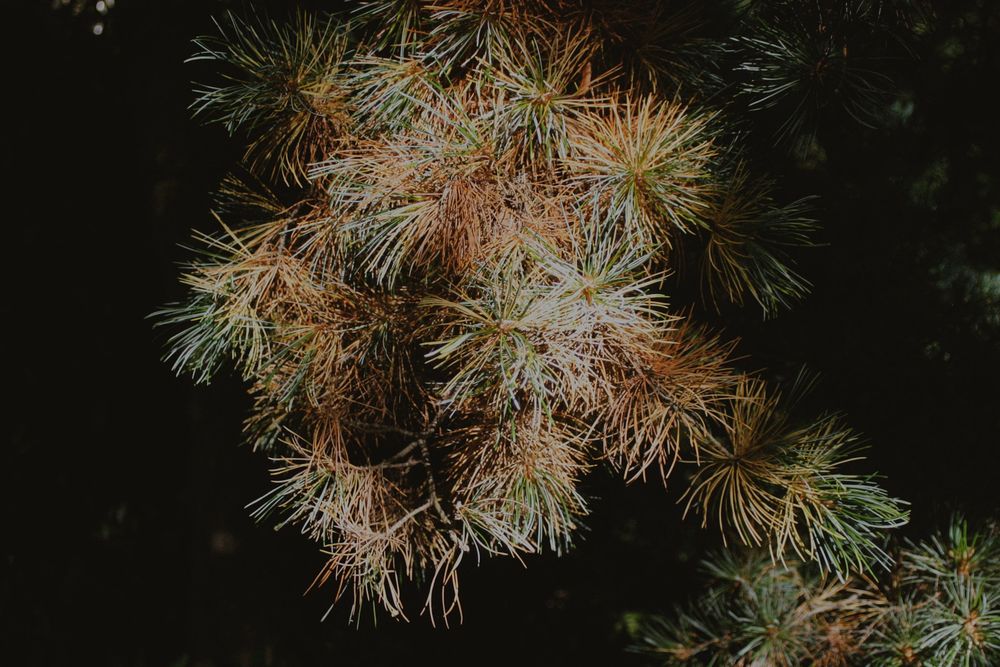
Every October we get two kinds of calls about brown pines. In the first, the needles on the inside of the tree have gone yellow and are raining onto the lawn, while the branch tips are as green as ever. That tree is fine. In the second, a pine that looked healthy at the Fourth of July has faded from green to a dull gray-green to straw brown, top to bottom, in a matter of weeks — and every one of those brown needles is still hanging on. That second tree is almost always pine wilt.
Pine wilt in Kansas has been killing Scots and Austrian pines for more than forty years, and the Wichita area sits squarely inside its range. There is no cure once a tree has it. What a homeowner can control is what happens next: whether the dead tree stands through winter and seeds the disease into every pine around it next spring, or comes out on time. This guide covers how to tell pine wilt from the harmless and treatable things that also turn pines brown, how to get it confirmed, and why Kansas State University puts a date on the removal.
The Short Answer
- Inner needles yellowing and dropping in fall is normal. Every pine sheds its oldest needles. If the branch tips are green, leave it alone.
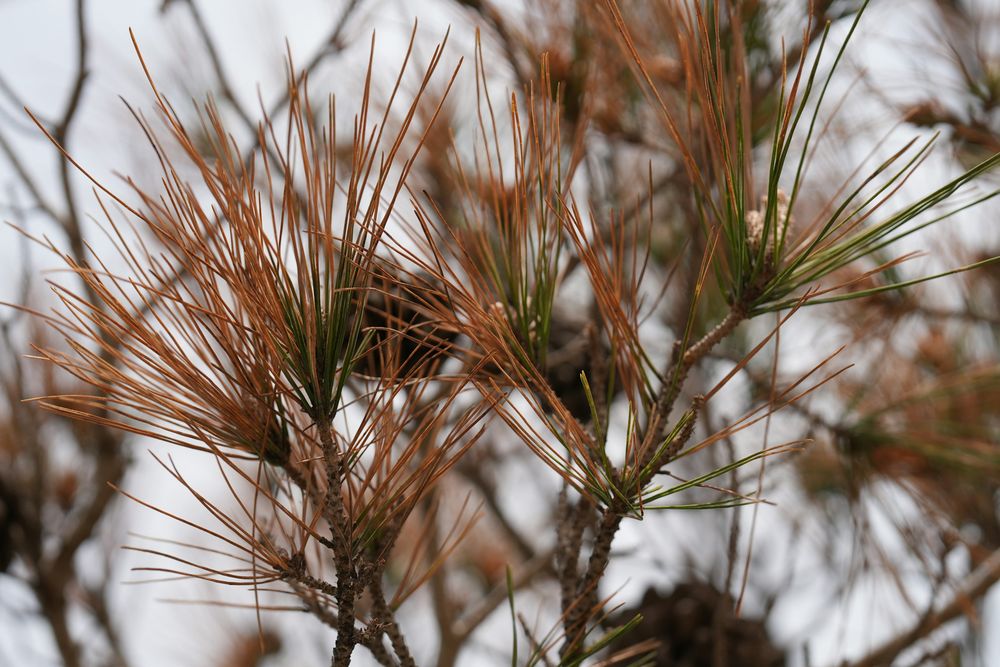
- A whole pine going gray-green, then brown, within weeks is the pine wilt pattern. In Kansas it shows up from August through December, and the dead needles stay on the tree for up to a year.
- There is no treatment for an infected tree. Injections are preventative only, for healthy pines.
- The dead tree is the problem for your other pines. The beetles that carry the disease spend the winter inside it and start leaving around May 1.
- K-State's guidance: take it down by April 1, cut it to the ground with no stump left, and chip or burn the wood right away. Don't keep it for firewood.
- Looking, photographing and taking a low sample is homeowner work. Felling a dead pine is not.
What Pine Wilt Is — and Why There's No Saving the Tree
Pine wilt is caused by the pinewood nematode, a microscopic worm. It can't travel on its own. It rides inside the pine sawyer beetle, a long-horned wood borer up to about an inch long, and gets into a healthy pine through the small wounds the beetle makes when it feeds on young shoots in late spring.
Once inside, the nematodes multiply in the tree's resin canals — the channels that carry pitch through the wood — and shut them down. The tree loses the ability to move water, wilts, and dies. K-State Research and Extension puts the timeline at several weeks to a few months from the first symptoms. Stressed and dying pines then draw in more sawyer beetles, which lay eggs under the bark. The next generation of beetles grows up inside the dead tree alongside the nematodes, and carries them out in spring.
That cycle is why there is nothing to prune out and nothing to spray. By the time the color changes, the nematodes are throughout the tree. The decision left to make is about timing and disposal, and about the pines still standing nearby.
Some context on how established this is: the Kansas Forest Service traces pine wilt in the state to southeast Kansas in 1979. K-State describes it as common across the eastern two-thirds of Kansas and still moving west, both on its own and in infested firewood. Wichita has been inside that range for years. And because beetles are drawn to drought-stressed trees, a dry summer tends to be followed by a bad fall.
Which Pines Around Wichita Are at Risk
Pines aren't native to Kansas. Every pine in a Wichita yard was planted, and the species that were planted most happen to be the ones pine wilt hits hardest.
- Scots (Scotch) pine — the most susceptible by a wide margin. Short, twisted, blue-green needles in pairs, one and a half to three inches long, and orange, flaky bark on the upper trunk and limbs. Scots pine plantings across eastern Kansas have been devastated.
- Austrian pine — less susceptible than Scots, but K-State has reported growing numbers lost. Stiff, dark green needles in pairs, three to six inches long, and gray-brown bark in thick plates. This is the classic Wichita windbreak and corner-lot pine.
- Mugo pine — the low, shrubby pine in foundation beds. Also a host.
- Eastern white pine — soft needles in bundles of five. Also a host, and prone to drought stress here on top of it.
- Ponderosa pine — long needles, mostly in bundles of three. Generally considered resistant, though it gets needle blight.
Mature trees take most of the losses; the Kansas Department of Agriculture notes that pines ten years and older are more susceptible than young ones. And it is a disease of pines. A browning juniper, redcedar, spruce or arborvitae has a different problem.
Around here the pattern is easy to see. On the southwest side of Wichita, Austrian and Scots pines were planted heavily as windbreaks in the 1970s, and the acreages toward Goddard, Maize, Valley Center, Andover and Derby have long pine rows along their north and west lines. A row is the worst case: the trees are the same species, the same age, and a short beetle flight apart. One brown pine left standing through spring is often two or three the next fall.
Pine Wilt or Something Else? What Turns a Pine Brown
Most brown pines we look at don't have pine wilt. K-State's publication on pine diseases in Kansas separates five conditions, and the differences are visible from the ground.
Natural needle drop — normal
Evergreens don't keep their needles forever. Austrian and ponderosa pines hold a needle for three to four years, then shed the oldest ones in fall. The browning is on the inside of the tree, spread evenly through the whole canopy, and each needle is brown from tip to base. It takes two to three months to finish, and the growth at the end of every branch stays green. Nothing to do but rake.
Dothistroma needle blight — slow, and treatable
A fungal disease of Austrian and ponderosa pines. Look at a single needle: the tip is brown, the base is still green, and there's often a reddish band between the two. It starts on the lower, interior branches and thins the tree out over years, leaving tufts of needles at the branch ends. It can eventually kill a pine, but slowly, and correctly timed fungicide applications in late spring control it.
Tip blight — slow, and manageable
Another fungus, mostly on mature Austrian pines twenty years and older. The damage is at the branch tips: in late May and June the new shoots come out stunted, with short, tan needles and dried pitch on them, and tiny black specks appear on the scales of older cones. It works upward from the bottom of the tree over several years. A bad case can be mistaken for early pine wilt, which is one reason a lab test is worth having.
Drought and winter scorch
Needles brown from the tip back, all to about the same length, usually after a hot, dry, windy stretch or a dry winter. It's often worst on the side facing the wind. The scorched needles drop and the tree recovers if it gets water.
Pine wilt
The whole tree, or one large branch after another, turns gray-green, then yellow, then brown. It happens in weeks to a few months, most often between August and December. The needles stay attached. The branches go dry and brittle. And when you break a twig, there's little or no sticky pitch.
Five Checks You Can Do From the Ground
- Identify the tree. Count the needles in a bundle and measure one. Short twisted pairs and orange upper bark is Scots pine. Long stiff pairs is Austrian. If it's a spruce or a juniper, this isn't pine wilt.
- Look at where the brown is. Inside the canopy with green tips means needle drop. Lower branches thinning out over several seasons points to one of the needle fungi. Brown all the way to the branch tips, across the whole tree or a whole section of it, is the pattern to worry about.
- Check how fast it's moving. Take a photo today from a spot you can stand in again, and another in two weeks. Needle blights change over years. Pine wilt changes between photos.
- See whether the needles let go. Run a gloved hand down a brown branch you can reach. Old needles in natural drop fall off at a touch. Pine wilt needles hang on.
- Break a twig. Snap a small branch you can reach from the ground on the affected side. A living pine bleeds sticky resin at the break and the twig bends before it gives. A pine wilt branch snaps dry.
None of that needs a ladder. If the only branches showing symptoms are out of reach, stop there and have it looked at.
Getting It Confirmed
The color pattern is a strong clue, but the only sure answer is a lab finding the nematode in the wood. K-State's Plant Disease Diagnostic Lab runs that test, and samples go through your county Extension office.
- What to bring: a section of branch at least two inches in diameter and six to eight inches long, cut from right against the trunk. A wedge or cross-section of trunk wood also works. Twigs and needles aren't enough — the lab needs wood.
- Where to take it: in Sedgwick County, the Extension Education Center at 7001 W. 21st Street North in Wichita, (316) 660-0100. Call first for the current drop-off hours and lab fee. The Butler and Harvey county offices handle samples the same way.
- How to cut it: a low limb you can reach with a hand saw, both feet on the ground. If getting a two-inch branch means a ladder or a chainsaw overhead, that's not a sample worth getting hurt over.
We can also make the call on site. Joe Kohnen is an ISA Certified Arborist, and a tree health assessment is part of every free in-person estimate. If the tree turns out to have one of the treatable problems, that's a plant health care conversation and not a removal.
Why April 1 Matters
A pine that dies of pine wilt this fall isn't finished causing trouble. The nematodes and the next generation of sawyer beetles spend the winter in the dead wood. According to K-State, the beetles start emerging around May 1, carrying nematodes to whatever healthy pines are close by.
So the guidance comes with dates. K-State's recommendation is to take an infected tree down as soon as possible, by May 1 at the latest — and it calls April 1 the better deadline, to be sure nothing gets out first. A warm spring can move the beetles up, which is another reason to treat April 1 as the real line and not May.
Put plainly: for the pines still alive on your property and your neighbors', removing the dead one on time is the treatment. It's the only step that takes beetles and nematodes out of circulation.
There's also a practical reason not to leave it until March. Fall and winter are generally the easier seasons to get tree work scheduled in the Wichita area. By spring you're competing with storm cleanup for a spot on the calendar.
What "Removed" Has to Mean for a Pine Wilt Tree
Taking down a pine wilt tree isn't quite the same job as taking down a healthy one. The disposal is the point. When you're getting quotes for tree removal, these are the pieces to ask about.
- Cut to the ground, with no stump left. K-State is specific about this, because a tall stump is infested wood too. In practice that means flush-cutting and following up with stump grinding, which also clears the spot for replanting.
- Chip or burn the wood right away. In town, burning isn't a realistic option for most yards, so the tree goes through the chipper the day it comes down. Chipping breaks up the wood the beetle larvae are living in.
- No firewood, no log pile. A stack of pine rounds by the fence or in the garage is the same beetle nursery in a different shape. Don't keep it, and don't give it to a neighbor or haul it out to the lake.
- Haul the debris off the property. Chips and brush leave with the crew as part of the cleanup. As a precaution, don't spread fresh chips from an infected tree as mulch under your other pines.
- Plan for the whole row. When several pines in a windbreak are dead, trunk sections too big for the chipper get loaded by grapple truck and hauled off, so nothing is left sitting in a pile.
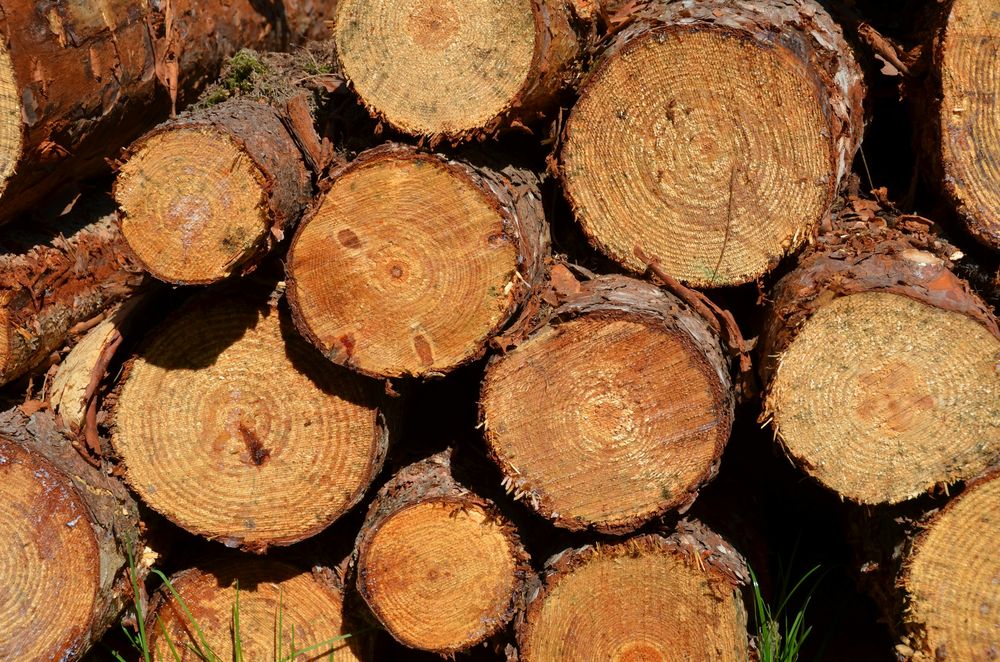
If you've read our guide to emerald ash borer in Wichita, this will sound familiar. It's the same principle with a different insect: the wood moves the pest, so the wood has to be dealt with.
A Dead Pine Doesn't Get Safer by Waiting
Set the disease aside and a dead pine is still a dead tree near a house. Pines killed by pine wilt dry out quickly — K-State notes the branches turn dry and brittle — and because the needles stay on, the crown keeps catching wind and ice through the winter instead of letting it pass through. Limbs start coming down on their own schedule.
Brittle wood is also harder to work in. A climber can't trust dead pine limbs to hold a rope or a boot the way live wood does, and the tree gets less predictable every month it stands. Our article on dead tree removal in Wichita explains why the job gets riskier, and usually more expensive, the longer a dead tree is left.
Inside Wichita city limits there's one more consideration: the city's tree ordinance treats dead and infested trees on private property as a nuisance the owner is responsible for. Our guide to neighbor tree laws in Kansas covers how that works, and what it means when your neighbor's dead pine is the one leaning over your fence.
Protecting the Healthy Pines Next to It
- Get the dead ones out on time. This matters more than everything else on the list combined.
- Water through dry spells. Sawyer beetles are attracted to drought-stressed pines. A deep soaking every few weeks in a dry summer or a dry, open winter is cheap protection.
- Know what injections can and can't do. Trunk injections of abamectin or emamectin benzoate reduced pine wilt infection in research trials when used on healthy trees. They don't cure an infected tree, they aren't 100 percent, and they have to be applied by a trained professional and repeated on the label's schedule. They make sense for a specimen pine you'd hate to lose, not for forty trees in a shelterbelt. Whether one of your pines is a reasonable candidate is a question for an arborist standing in front of it.
- Don't bring pine firewood home. Infested firewood is one of the ways K-State says the disease moves.
- Keep watching. Walk the remaining pines every couple of weeks through December. A tree that starts to fade in November belongs on the same removal list.
What to Plant Where the Pine Was
Not another Scots or Austrian pine. The K-State Extension office in Butler County says outright that it would not recommend planting either one in Kansas.
For an evergreen screen or windbreak, the Dyck Arboretum of the Plains in Hesston — which lost its own Scots pines to pine wilt — suggests eastern redcedar selections such as 'Taylor' and 'Canaertii', Arizona cypress, southwestern white pine, pinyon pine and Black Hills spruce. Their larger point is the one we'd underline: mix species. A windbreak of one kind of tree is a single pest away from being a row of stumps, and that's how most of these pine rows ended up where they are.
If you'd like shade in that spot instead of a screen, our list of native Kansas trees worth planting this fall is the place to start, and late September through mid-November is the window. If the new tree is going where the old stump was, read planting where the stump was ground first — fresh grindings are a poor place for young roots.
What Dead Pine Removal Costs in Wichita
Every quote depends on the tree in front of us, but the same things move the number: height and trunk diameter, how close the tree stands to the house, a fence or a power line, whether a truck can get to it, how brittle it has become, and whether the stump is being ground. Scheduled removals in the Wichita market generally run from around $300 for a small tree to $3,000 or more for a large one in a tight spot, and stump grinding commonly adds about $100 to $400 per stump. Those are general market ranges, not our posted rates; our tree removal cost guide breaks them down.
Two things help with pines specifically. Several trees done in one visit cost less per tree than the same trees done one at a time, so it's worth pricing a whole row together. And a pine removed in its first winter is a more straightforward job than the same tree after two years of drying out.
What You Can Do Yourself — and What Needs a Pro
Reasonable to do yourself:
- Identifying the tree, photographing it on a schedule, and running the ground-level checks above.
- Cutting a low branch sample with a hand saw and taking it to the Extension office.
- Watering the healthy pines and raking up normal needle drop.
Not a DIY job:
- Felling a dead pine of any real size. Dead conifers are brittle and top-heavy with needles, and they don't hinge and fall the way a live tree does. Our case against DIY tree removal goes through what goes wrong.
- Anything that needs a ladder, a chainsaw overhead, or climbing.
- Any tree near a power line, including the service line to the house. Keep yourself and your tools well clear. A limb on a line is a call to Evergy, and to 911 if the line is down or sparking.
- A dead pine that has already dropped limbs or is leaning on something. That's a call to our 24/7 emergency tree service.
Frequently Asked Questions
What does pine wilt look like? The needles fade from green to gray-green, then yellow, then brown, across the whole tree or one large branch after another. It happens over a few weeks to a few months, usually between August and December in Kansas, and the brown needles stay attached for up to a year.
Can a pine tree with pine wilt be saved? No. Once a pine is infected there is no treatment that stops it. Trunk injections are preventative only and are used on healthy trees. An infected pine should be removed and the wood destroyed.
How fast does pine wilt kill a tree? K-State Research and Extension puts it at several weeks to a few months from the first symptoms. That speed is the best clue you have: needle blights thin a pine over years, while pine wilt takes it in a single season.
When should a pine wilt tree be removed in Kansas? As soon as you can arrange it, and before April 1. The beetles that spread the disease overwinter in the dead tree and start emerging around May 1, so K-State gives May 1 as the latest date and April 1 as the safer one.
Can I use a pine wilt tree for firewood? No. The beetles and nematodes are in the wood, and beetles will emerge from stacked logs just as they would from the standing tree. The wood should be chipped or burned right away, not stored.
Does the stump have to come out? K-State's guidance is to cut the tree to the ground and not leave a stump. Grinding it takes care of the infested wood at the base and leaves the spot ready to replant.
Is it normal for a pine to turn brown in the fall? Partly. Pines shed their oldest needles every fall, so yellow and brown needles on the inside of the tree, with green branch tips, are normal. Browning that reaches the ends of the branches is not.
Will pine wilt spread to my other trees? Only to other pines. Scots pine is the most susceptible, followed by Austrian, with mugo and white pine also hosts. It doesn't affect oaks, maples, elms or other shade trees, and it isn't the reason a juniper or spruce is browning.
Is pine wilt in Wichita? Yes. K-State describes pine wilt as common across the eastern two-thirds of Kansas, which includes Sedgwick, Butler and Harvey counties. Dead pine removals are routine work for us, especially in the older pine windbreaks on the southwest side of Wichita.
Brown Pine in the Yard? Get It Looked At Before Spring
If you have a pine that has changed color this fall, the useful thing to know is which kind of brown it is — and fall is the time to find out, while there's still room before the April 1 deadline. Joe Kohnen is an ISA Certified Arborist and looks at every tree in person before we quote it. Kohnen's Tree Service is family-owned, fully insured, and rated 4.9 from 130+ Google reviews.
We work across Wichita and the surrounding communities from our Park City base, including Goddard, Maize, Valley Center, Andover and Derby.
Request a free in-person estimate, or call (316) 207-4740. We respond the same day.