
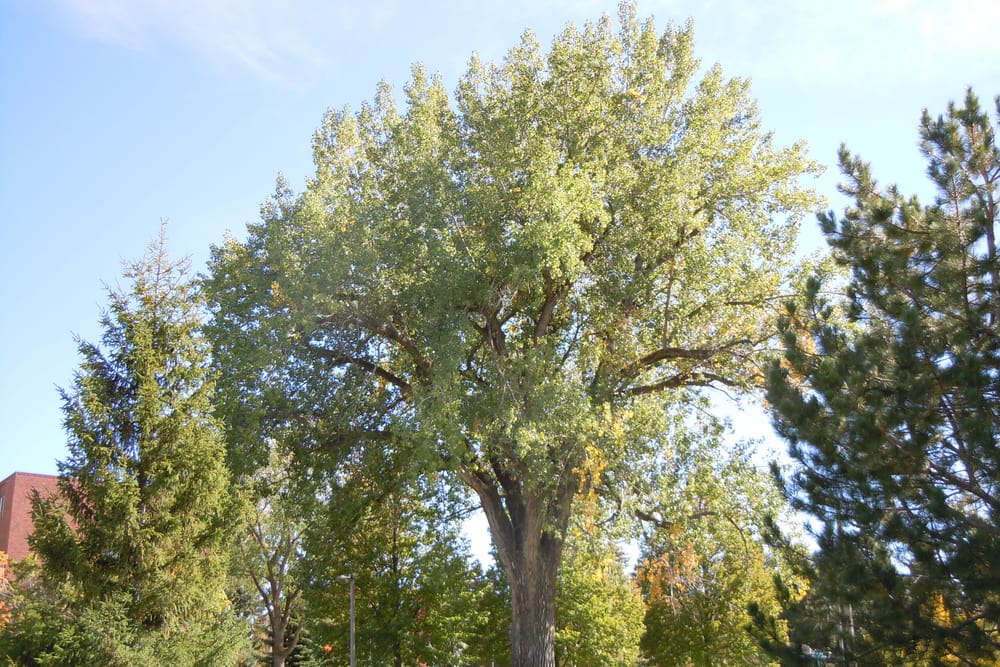
Every fall somebody walks us out to a bare, sunny patch of their yard — often the spot where an ash or a storm-split silver maple used to stand — and asks what should go there. More often than not the shortlist comes down to two native trees at opposite ends of the scale. The Kansas cottonwood tree, our state tree, will shade that spot within a handful of years. A bur oak will take closer to fifteen or twenty, and then keep shading it for a couple of centuries.
Both are true Kansas natives. Both handle our heat, our wind and our clay better than most of what gets sold off a garden-center lot, and both get big. What separates them is everything that comes after the shade: how the wood holds up in a spring thunderstorm, where the roots go looking for water, what ends up on your lawn, and how much pruning — and eventually removal — each one signs you up for. This is the side-by-side we walk Wichita-area homeowners through before they buy a tree this fall. If you're not sure the big tree already in your yard is a cottonwood, our field guide to spotting an eastern cottonwood settles it in about a minute.
The Short Answer
- For most Wichita, Derby, Andover and Bel Aire lots, plant the bur oak. It's slower for the first ten years or so, but it's the stronger, longer-lived, lower-maintenance tree, and it won't turn into a removal job while you own the house.
- A cottonwood only makes sense with room to spare — an acreage, a creek bank, a low corner that stays damp — where a 90-foot tree can drop a limb in any direction without hitting a house, a driveway, a fence or a power line. If you plant one, buy a named male variety so it never makes cotton.
- The fast shade is real, and so is the bill that comes with it. Soft wood, heavy limbs, water-seeking roots, pruning every few years, and eventually one of the bigger removal jobs on the block.
- Late September through mid-November is the right time to plant either one here.
- Planting and shaping a young tree from the ground is a homeowner job. Anything that needs a ladder or a chainsaw, or comes anywhere near a power line, is not.
Cottonwood vs. Bur Oak at a Glance
- Mature size. Cottonwood: 70 to 100 feet tall and 50 to 70 feet wide, by the Kansas Forest Service's numbers. Bur oak: 50 to 80 feet tall and 40 to 60 feet wide, with old open-grown trees spreading wider still.
- Growth rate. Cottonwood: three to six feet a year is common on a watered young yard tree, and the Kansas Forest Service puts the top end near eight. Bur oak: slow for the first couple of years while it builds roots, then roughly a foot a year on a typical lawn and two to three feet on a deep, moist site.
- Useful shade. Cottonwood: about five to eight years. Bur oak: about fifteen to twenty.
- Wood. Cottonwood: light, soft, and brittle once it dies or decays. Bur oak: heavy, hard and strong — U.S. Forest Service wood tables put it at roughly 60 percent denser than cottonwood.
- Roots. Cottonwood: wide, shallow and water-seeking, and one of the species most often found in Wichita sewer lines. Bur oak: deep-rooted from its first season and far less of a pipe problem.
- What falls in the yard. Cottonwood: cotton from female trees in late May and June, twigs in dry spells, a fast October leaf drop, and the occasional large limb. Bur oak: big acorns in fall once the tree is roughly 35 years old, and late, leathery leaves.
- Lifespan. Cottonwood: it can pass 100 on a river bottom, but on a city lot it has often started decaying inside by 60 to 80. Bur oak: 200 to 300 years on a good site.
- Upkeep. Cottonwood: structural pruning every few years and a close eye on deadwood. Bur oak: shaping while it's young, then a cleanup pruning every three to five years once it's mature.
Growth Speed: How Fast Each One Gives You Shade
Cottonwood is built to win a race. In the wild it sprouts on fresh sandbars along the Arkansas and the Little Arkansas, and the seedlings that survive are the ones that outgrow the next flood and everything around them. Put that tree on a watered Wichita lawn with full sun and it does the same thing to your yard. Nothing else native to Kansas gets you a real shade tree as quickly.
Bur oak plays the long game. Forest Service research has found bur oak seedlings with roots four and a half feet deep at the end of their first summer, while the top barely looks like it moved. There's an old nursery saying for slow starters like this — "sleep, creep, leap": the first year or two after planting go almost entirely into roots, then growth picks up, then the tree takes off. That early root investment is exactly what makes it so drought-tough and wind-firm later.
Here is roughly how it plays out if you plant a six-to-eight-foot tree of each this October and water both properly:
- Year 5: the cottonwood is 25 to 35 feet and shading the patio. The bur oak is 10 to 15 feet and just getting going.
- Year 15: the cottonwood is 50 to 60 feet and reaching over the roof. The bur oak is 25 to 30 feet and throwing real afternoon shade.
- Year 30: the cottonwood is 70 feet or more, has been through several rounds of structural pruning, and — if it turned out to be female — has been making cotton for twenty years. The bur oak is 40 to 50 feet and a proper shade tree.
- Year 60: the cottonwood may well be hollowing out inside, and a removal conversation is likely. The bur oak is barely middle-aged.
Treat those numbers as rough; water and soil move every one of them. The shape of the curve doesn't change, though. The cottonwood wins the first fifteen years, and the bur oak wins everything after that.
One buying tip if you go with the oak: smaller is usually faster. A bur oak with a one-to-one-and-a-half-inch caliper — the nursery term for trunk diameter, measured six inches above the soil — establishes much faster than a big balled-and-burlapped tree, because the big one left most of its deep roots behind in the nursery field. The small one often catches the big one within a few seasons, and it costs less.
Mature Size and Clearance: Where Each One Actually Fits
Plant for the tree you'll have in thirty years, not the one in the pot. That's where most cottonwood regret starts: a ten-foot sapling looks harmless fifteen feet from the back deck.
- The house. Our guide to tree roots and foundation damage recommends at least 25 to 30 feet between a foundation and any tree that will top 60 feet, and more is better. That's workable for a bur oak. For a cottonwood, we'd want 50 feet or more from the house, the sewer line and any septic field — partly for the roots, partly for how far a failing limb can reach.
- Power lines. The standard utility guidance is to keep any tree that will grow past 40 feet at least 50 feet from overhead lines, and to plant only trees that top out under about 25 feet within 20 feet of them. Both of these trees belong in the 50-foot category, and that includes the service line running from the pole to your house. A big tree that grows into the lines gets cut back for clearance, not for looks.
- Property lines. If you don't want your limbs over the neighbor's garage, set the trunk back from the line by at least half the tree's mature spread: roughly 25 to 35 feet for a cottonwood and 20 to 30 feet for a bur oak.
- Driveways, patios and sidewalks. Keep either one well off the concrete. Cottonwood roots are the ones that lift slabs.
- What's underground. Call 811 a few days before you dig, even for one tree. The locate marks public utility lines. Sprinkler lines, invisible dog fences and private lines are up to you to find.
The City of Wichita has made its own view of cottonwoods fairly clear: its landscape code does not allow female, cotton-bearing cottonwoods in the landscaping required for new commercial and apartment developments. Single-family homes are exempt from those rules, so the choice in your own yard is yours — but it tells you how the species behaves once it's planted close to buildings and parking lots.
Limb Strength in Kansas Wind
This is the biggest practical difference between the two trees, and it gets bigger every year they grow.
Cottonwood
Fast growth builds light, soft wood. On top of that, cottonwoods tend to grow long, heavy side limbs and to fork low into two or three co-dominant stems — competing trunks of about the same size rising from the same point. Where those stems meet, bark often gets folded into the joint instead of solid wood forming around it. Arborists call that included bark, and it makes a weak seam that can hold for forty years and then split in one gust.
Cottonwood is also one of a handful of species prone to summer branch drop: a large limb that lets go on a hot, calm afternoon with no storm and no warning. Add Wichita's spring straight-line winds, the ice storm that comes through every few winters, and a species that decays quickly behind any wound, and you have a tree whose risk climbs as it gets bigger. Our guide to cottonwood trees in Wichita covers those structural risks in detail, along with what removal typically costs.
Bur oak
Bur oak wood is heavy, hard and strong, its branches usually attach at wide, sturdy angles, and its thick, corky bark shrugs off the kind of scrapes and sunscald that let decay into softer trees. The deep root system anchors it well in clay. It's one of the most wind-resistant trees we work on in the Wichita area.
It isn't storm-proof. Old bur oaks collect deadwood in the crown, and a big dead limb coming down in an ice storm does real damage no matter what species it came from. That's why mature oaks get periodic crown cleaning — removing the dead, dying and broken branches from the canopy. But the difference in trajectory is the point: a cottonwood's risk tends to rise with size, while a well-pruned bur oak's mostly doesn't.
Litter: Cotton vs. Acorns
Neither tree is tidy. They're messy in different ways and on different schedules.
Cottonwood. Only female trees make cotton — it's seed fluff, not pollen — and each tree releases it over a week or two in late May and early June. It clogs AC condenser coils, window screens and pool skimmers. Male trees drop reddish catkins in April instead. Beyond that, expect small twigs during dry spells, a full canopy of big leaves coming down over two or three weeks in October, and now and then a limb. The catch when you're buying: a cottonwood can't be sexed until it flowers at roughly seven to ten years old. A seedling or a volunteer from the creek is a coin flip. A named male variety, sold as a cottonless cottonwood, is not — get the variety name in writing from the nursery.
Bur oak. Bur oak has the largest acorns of any native oak, with a fringed, mossy cap that gives the tree its name. The good news for a new planting: bur oak doesn't bear seed until it's roughly 35 years old, and even then heavy crops come every two to three years. When they do, acorns roll underfoot, get thrown by mowers, and bring every squirrel in the neighborhood. The leaves drop late — usually well into November — and they're thick and leathery, so they break down slowly. Mulching them with the mower handles most of it.
Roots Near Driveways, Foundations and Sewer Lines
Cottonwood is a floodplain tree, and its roots behave like it: wide, shallow, and always looking for water. On a clay lot in town, the most reliable water around is often a slightly cracked clay sewer lateral. Cottonwood and willow are the two species we see most often in residential sewer problems, and cottonwood roots near the surface are what lift sidewalks and patios.
Bur oak goes deep early, which is where its drought tolerance comes from. Like any tree, most of its fine feeder roots still live in the top 12 to 18 inches of soil and spread well past the edge of the canopy, so it's not a tree to crowd against a foundation. But it isn't a pipe-seeker the way cottonwood is. At the same distance from a house, a bur oak is rarely the problem a cottonwood can be.
One point in the cottonwood's favor: bur oak doesn't like wet feet, and the Kansas Forest Service rates its tolerance for saturated soil as low. If water stands in a spot for days after a heavy rain, a bur oak will struggle there. That low, damp corner is exactly where a cottonwood — planted far from the house — is happiest.
The Long-Run Commitment: Pruning, Problems and Removal
What a cottonwood signs you up for
- Early structural pruning. Choose one central leader — the main upright trunk — and shorten or remove competing ones while they're still small. On a tree growing five feet a year, "small" doesn't last long.
- Pruning every few years after that. Thinning and shortening the long side limbs that are prone to summer drop, and removing deadwood. Never topping: a topped cottonwood regrows weakly attached sprouts and decays fast at the cuts.
- Stress problems. Cytospora canker, borers and leaf diseases mostly go after cottonwoods that are already stressed, and drought is the most common stress here.
- An eventual removal. On a city lot, a mature cottonwood is one of the bigger residential removal jobs: tall, heavy, brittle once it's decayed, and usually close to something that matters.
What a bur oak signs you up for
- Shaping in the first ten to fifteen years. Small cuts to set a single leader and well-spaced branches. This is the cheapest pruning the tree will ever need, and a lot of it can be done from the ground.
- Crown cleaning every three to five years once it's mature to take out deadwood before it falls.
- Winter-only pruning. Oaks should be cut in the dead of winter, January and February. Oak wilt — a fungal disease that kills red oaks quickly and can badly damage bur oaks — is spread by sap beetles drawn to fresh cuts, and in Kansas they're active roughly April through July. Our guide to the best time to prune trees in Kansas explains the timing.
- Few serious pests. The Kansas Forest Service lists few major insect or disease problems. Leaf galls are mostly cosmetic, and bur oak blight, a leaf disease, has been found in northeast Kansas. Unlike pin oak, bur oak handles our alkaline clay without the yellow, iron-starved leaves known as iron chlorosis.
- No removal on your watch. Barring storm damage or construction injury, a bur oak planted this fall will almost certainly outlive the mortgage — and the house.
Which One Belongs in Your Yard?
Plant a bur oak if:
- It's a typical city or subdivision lot in Wichita, Derby, Andover, Bel Aire or Maize.
- You can give it 25 to 30 feet or more from the house and 50 feet from overhead lines.
- The ground drains — water doesn't sit there for days after a storm.
- You want a tree that adds value when you sell, instead of a line item on the buyer's inspection report.
A cottonwood can make sense if:
- You have acreage, a creek bank, or a low spot that stays moist.
- Nothing you care about sits within the tree's mature height — call it 80 to 100 feet in every direction.
- You want fast shade, a windbreak or wildlife cover, and you're comfortable planting a shorter-lived tree.
- You buy a named male, cottonless variety.
If neither fits, there are good native options in between. Shumard oak grows faster than bur oak and still builds a strong structure, chinkapin oak is made for alkaline soil, and Kentucky coffeetree is tough, drought-resistant and open-canopied. Our list of native Kansas trees worth planting this fall covers them.
A word on the "plant both" plan — a cottonwood for shade now, taken out once the oak catches up. It sounds sensible, and it almost never happens on schedule. By year fifteen the placeholder is a 50-foot tree shading and crowding the oak you actually wanted, and taking it out is a real removal job with a young tree in the drop zone.
Already Have a Big Cottonwood? Start Its Replacement Now
Plenty of homeowners reading this aren't choosing between two saplings — they already have a 70-foot cottonwood and are wondering what comes next. A healthy, well-placed cottonwood doesn't need to come down because of anything in this article. If yours is close to the house, over the driveway, near the lines, or showing dead limbs, cracks or fungus at the base, get it looked at, and let an in-person assessment decide the timing.
Either way, this fall is a good time to plant its successor. Put the bur oak in full sun, out from under the cottonwood's canopy — 30 feet or more from its trunk — in a spot a crew can work around later. When the cottonwood eventually comes out, tell whoever does the removal where the young oak is so the drop zone and the equipment path stay clear of it. You'll have given the replacement a ten-year head start. If the only good spot is where an old stump was ground out, see our how-to on planting a new shade tree where the stump was.
Planting Either One This Fall
- Timing: late September through mid-November. Roots keep growing in warm soil after the leaves drop, so a fall-planted tree starts spring with a head start.
- Depth: find the root flare — the spot where the trunk widens out into the roots — and set it at or slightly above grade. Dig wide and shallow, two to three times the width of the root ball, not deeper than it.
- Roots: cut any roots circling the root ball. With a container bur oak, check that the taproot hasn't spiraled around the bottom of the pot.
- Backfill and mulch: use the soil you dug out, with no amendments, then spread two to four inches of wood-chip mulch in a wide ring, kept a few inches off the bark.
- Water: deeply and regularly until the ground freezes, then monthly during a dry winter. A cottonwood in particular needs steady water for its first three years; that river-bottom speed depends on it.
What You Can Do Yourself — and What Needs a Pro
Reasonable to do yourself:
- Planting a container or small balled tree after the 811 locate, plus watering and mulching.
- Early shaping of a young tree with hand pruners or loppers, both feet on the ground — branches thinner than your thumb, including trimming back a competing leader while it's still small.
- Mulch-mowing oak leaves, raking up cottonwood leaves and twigs, and covering the AC condenser intake with mesh during cotton season.
Not a DIY job:
- Any cut that needs a ladder or a chainsaw, and any limb thicker than your wrist. Ladder-and-chainsaw work is where the worst homeowner tree injuries come from.
- Climbing, or removing a tree of any real size, especially near a house, a fence or a garage. Our case against DIY tree removal explains why.
- Anything near a power line, including the service line to your house. Keep yourself and every tool well clear, and leave the work to a qualified crew. A limb on a line is a call to Evergy, and to 911 if the line is down or sparking.
- Storm damage: split trunks, hanging limbs, or a tree down on a roof, a car or a fence. That's a job for our 24/7 emergency tree service. Stay out from under it until help arrives.
Planting Near a Property Line: The Neighbor Questions
A big shade tree near the line is also a decision about your neighbor's yard. These are the questions that come up most. They're general information, not legal advice; our guide to neighbor tree laws in Kansas goes deeper.
Who is responsible if a tree falls on my house — my neighbor or me?
Usually your own homeowner's policy covers damage to your house, no matter whose tree it was. The tree's owner generally becomes responsible when the tree was visibly dead, dying or hazardous and they knew or should have known about it — which is why dated photos, a written notice and an arborist's assessment matter. A tree that falls and hits nothing is usually nobody's covered loss. For planting, the takeaway is simple: a cottonwood whose limbs will hang over the neighbor's garage in fifteen years is a future insurance conversation.
What can I do if my neighbor's tree is in my yard?
Kansas lets you trim branches and roots that cross onto your property back to the property line, at your own expense and from your own side, as long as you don't destroy the tree. Talking first usually gets a better result, often a shared bill for proper pruning instead of a flat cut at the line. Be careful with roots: cutting big ones close to the trunk can destabilize the tree, which then leans toward whoever cut them. Leaves, cotton and acorns that blow over are yours to clean up.
Does Kansas have a good neighbor fence law?
Kansas has a partition fence statute, K.S.A. 29-301, which says adjoining owners keep up the fences between them in equal shares while both occupy or improve the land, unless they agree otherwise. It was written with farm and livestock fencing in mind, and the details get complicated quickly. For a fence between two town lots, start with your city's fence rules and a conversation with the neighbor, and talk to an attorney if it turns into a real dispute. The tree angle: anything planted right on a fence line will eventually lift the fence, push it over, or drop limbs on it. Plant well off the line.
Frequently Asked Questions
Is the cottonwood the Kansas state tree? Yes. The eastern cottonwood, Populus deltoides, was named the Kansas state tree in 1937, in honor of the role it played for settlers on a mostly treeless prairie, where a line of cottonwoods meant water, shade and timber.
How fast does a cottonwood grow in Kansas? Very fast when it has water. Three to six feet a year is common on a young yard tree, and the Kansas Forest Service notes up to eight feet a year. Growth slows as the tree matures, and on a dry upland lot it's much slower.
How fast does a bur oak grow? Slowly at first. The first year or two go mostly into roots. After that, expect roughly a foot a year on a typical lawn and two to three feet on a deep, moist site. Plan on fifteen to twenty years for meaningful shade.
Is a cottonwood a good tree for a home yard? Only a big one. With 80 to 100 feet of clearance from buildings, drives and power lines, a male cottonwood is a fine, fast shade tree. On a typical city lot, its soft wood, heavy limbs and water-seeking roots usually make a bur oak or another native oak the better choice.
How far from the house should I plant a cottonwood? We'd want at least 50 feet from the house, the sewer line and any septic field, and at least 50 feet from overhead power lines. For comparison, a bur oak needs at least 25 to 30 feet from a foundation.
Do bur oaks have invasive roots? Not in the way cottonwoods, willows and silver maples do. Bur oak roots deep and isn't a notorious sewer-line invader. Like any big tree, though, it has a wide root zone and shouldn't be crowded against a foundation or a driveway.
Can I buy a cottonwood that doesn't make cotton? Yes. Named male varieties, sold as cottonless cottonwoods, never produce cotton. Get the variety name in writing, because seedlings and volunteers can't be sexed until they flower at around seven to ten years old.
How long does a bur oak live? Commonly 200 to 300 years on a good site. It's one of the longest-lived hardwoods in Kansas, and some bur oaks still standing in Wichita's older parks and neighborhoods predate European settlement.
When should a bur oak be pruned? In the dead of winter, January and February. Fresh cuts during the growing season can attract the sap beetles that spread oak wilt, and in Kansas those beetles are active roughly April through July.
Choosing a Tree, or Deciding About One You Already Have?
If you'd like a second opinion on a planting spot — or on the big tree already standing near it — that's what an on-site visit is for. Joe Kohnen is an ISA Certified Arborist and can tell you in person what a spot can realistically hold, and whether an existing cottonwood needs pruning, monitoring or removal. Kohnen's Tree Service is family-owned, fully insured, and rated 4.9 from 130+ Google reviews.
We work across Wichita and the surrounding communities from our Park City base, including Derby, Andover, Bel Aire and Maize.
Request a free in-person estimate, or call (316) 207-4740. We respond the same day.