Search "tree service Wichita" and you will get pages of options — national directory listings, franchise brands, a handful of real local crews, and, especially after a storm rolls through, a stack of business cards left on your door by people you have never heard of. From the outside, most of them look about the same. They all have a truck, a chainsaw, and a five-star rating somewhere. The hard part is that the differences that actually matter — insurance, skill, accountability — are exactly the ones you cannot see in an ad.
That gap is a real problem, because tree work is genuinely dangerous and genuinely expensive to get wrong. A dropped limb can crush a roof or a car. An uninsured groundman who gets hurt in your yard can become your financial problem. A "topping" job done by someone who does not know better can wreck a healthy tree and cost you thousands down the road. This guide walks through exactly how to choose a tree service in Wichita with confidence — what to verify, the questions to ask, the red flags that should make you walk away, and why hiring local matters more here than almost anywhere. It is written by the owner of a local crew, so it is honest about the parts of this industry most companies would rather you not look at too closely.
First, Understand What's Actually at Stake
Before we get to checklists, it helps to be clear about why this decision deserves more scrutiny than hiring, say, a lawn-mowing service. When a crew removes or prunes a large tree on your property, three kinds of risk are in play at the same time:
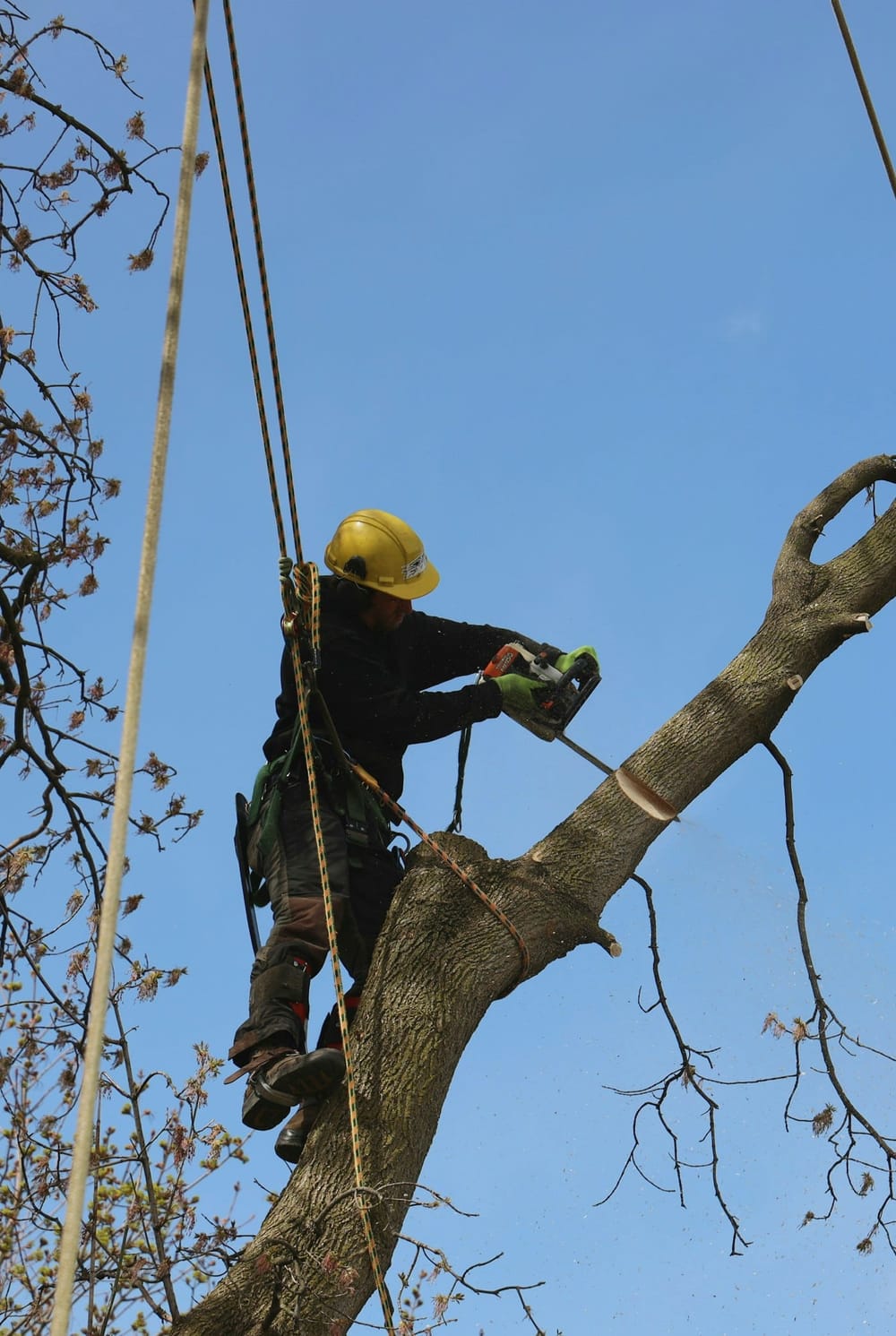
- Physical risk to the crew. Climbing, rigging, and running a chainsaw 40 feet up is one of the most injury-prone jobs in the country. If the company is not carrying workers' compensation insurance, an injury on your property can come back on your homeowner's policy.
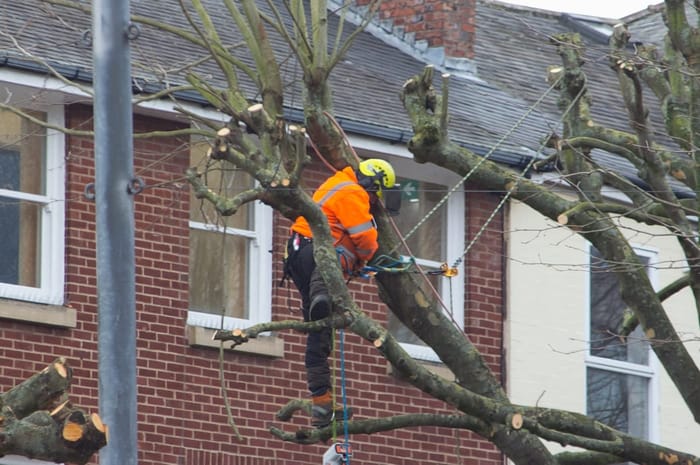
- Property damage risk. Heavy limbs come down with enormous force. A misjudged rigging cut can put a limb through a roof, a fence, a deck, or a neighbor's car. Without the right liability coverage, you may be left holding that bill.
- Risk to the tree and your property value. Bad pruning and tree topping cause long-term decline, decay, and weak regrowth. The damage is not always visible for a year or two — which is exactly why cut-rate operators get away with it.
The cheapest bid is very often the one carrying the most of this hidden risk. A company that skips insurance, skips training, and skips proper equipment can always underbid one that does not. Understanding that trade-off is the foundation of everything below. (If you are weighing doing the work yourself to save money, read our piece on why DIY tree removal is so dangerous first.)
Is a Tree Service Required to Be Licensed in Kansas?
This is the question that trips up most homeowners, because "licensed and insured" gets used as one phrase — and in Kansas they are very different things. Here is the accurate picture:
Kansas does not issue a statewide license for general tree work on private property. There is no state exam or state license a company must hold to remove or prune a tree in your backyard. That surprises people, but it is true across most of the country. What this means in practice is that the word "licensed" on a tree-service ad does not, by itself, guarantee much — so you cannot stop your vetting there.
There are two important exceptions where licensing genuinely applies:
- Pesticide and herbicide application — including injecting or spraying trees for pests like the emerald ash borer — requires a license through the Kansas Department of Agriculture. If a company is treating your trees with chemicals, that work should be done by a licensed applicator.
- Work on public trees and city right-of-way — the strip of land between the sidewalk and the street, and trees the City owns — is managed by the City of Wichita's Forestry Division and requires coordination and approval before anyone touches those trees. A reputable local company knows this and handles it; an out-of-town crew often does not.
So if a statewide license is not the trust signal, what is? Insurance and a verifiable local track record. Those are the two things that actually protect you, and they are where your attention belongs.
The Non-Negotiable: Proof of Insurance
If you remember one thing from this guide, make it this: never let a crew start work without seeing proof of insurance first. A real tree service carries two separate coverages, and you want both:
- General liability insurance — covers damage to your home, fence, vehicles, or landscaping if something goes wrong during the job.
- Workers' compensation insurance — covers the crew if someone is injured on your property. This is the one homeowners forget, and it is the one that can cost you the most. In a worst-case scenario, an injured worker on an uninsured crew can pursue the property owner.
"We're insured, don't worry about it" is not proof. The right move is simple and completely normal to ask for: request a Certificate of Insurance (COI), sent directly from the company's insurance carrier, that shows both coverages are active. A legitimate company will not blink at this — we send certificates of insurance on request as a matter of routine, and any company that hesitates or makes excuses is telling you something important.
Credentials and Standards That Actually Mean Something
Beyond insurance, a few voluntary credentials and industry standards separate a skilled operation from a guy with a saw. None of these are legally required in Kansas, but they signal that a company takes the craft seriously:
- ISA Certified Arborist — a credential from the International Society of Arboriculture that requires passing an exam and maintaining continuing education. It tells you someone on the team understands tree biology, not just cutting. For the record: owner Joe Kohnen carries this credential — MW-389993A.
- Kansas Arborists Association certification — a respected state-level credential specific to Kansas species and conditions.
- ANSI A300 and ANSI Z133 standards — A300 is the national standard for proper pruning; Z133 is the safety standard for the work itself. Ask whether the company follows them. We follow ANSI A300 on every pruning job.
Here is the honest version, though: certifications are a plus, not the whole story. Plenty of excellent, safe, experienced crews are owner-operated rather than corporate. What most Wichita homeowners actually need is a company that is fully insured, genuinely experienced, well-reviewed by real local customers, and committed to doing the work to standard — including refusing to do harmful work like tree topping. A company that will happily top a healthy tree for a quick paycheck is showing you its priorities, certification or not.
Get It in Writing: Free, In-Person, Detailed Estimates
A trustworthy tree service gives you a free, in-person estimate — not a number guessed over the phone or from a photo you texted. There is a real reason for the in-person part: an accurate quote depends on things you cannot see in a picture, like access for equipment, proximity to power lines, the condition of the wood, and how close the work is to your house or your neighbor's. A company that quotes a firm price sight-unseen is either padding it heavily or about to surprise you later.
The written estimate should spell out, in plain language:
- Exactly what is being done — which trees, removal versus pruning, how much canopy is coming off.
- Whether stump grinding is included or separate.
- Who handles cleanup and haul-off, and whether it is included in the price.
- The total price, and what could change it.
- Timeline and who is liable for what.
It is smart to get more than one bid so you can compare scope and price. Just compare like for like — the cheapest number on the page does not always cover the same work, the same cleanup, or the same insurance. For a sense of what realistic pricing looks like in our market, see our breakdown of what tree removal costs in Wichita.
Questions to Ask Before You Choose a Tree Service
Print this list, or keep it on your phone, and run through it with any company you are considering. The answers tell you almost everything you need to know:
- Are you insured for both general liability and workers' compensation — and can you send me a certificate of insurance?
- Is the estimate free and done in person?
- Will the price be in writing and itemized?
- Who does the cleanup and haul-off, and is it included?
- Do you grind the stump, or is that a separate company?
- Do you ever top trees? (The right answer is no.)
- Are you local, and how long have you worked in the Wichita area?
- Can I see recent reviews or examples of your work?
- How soon can you start, and do you offer 24/7 emergency service?
- For storm damage, do you handle insurance direct billing?
Red Flags: When to Walk Away
Some warning signs are worth treating as deal-breakers. If you see these, keep looking — there are plenty of good options:
- No proof of insurance, or a "trust me, we're covered" when you ask for a certificate.
- Door-to-door solicitation right after a storm, especially from someone with out-of-state plates or a phone number that is not local.
- A demand for a large cash deposit or full payment up front. A reasonable deposit on a big job can be normal; paying the whole thing before any work is done is not.
- High-pressure urgency — "this price is only good today," or "your tree could fall any minute, sign now."
- A price dramatically below everyone else's. That gap is usually skipped insurance, skipped cleanup, or skipped skill.
- They offer to "top" your tree or "round it over" as a routine service.
- Verbal-only estimates and a refusal to put the scope and price in writing.
- No reviews, no online presence, no local address you can verify.
The Storm-Chaser Problem in Kansas
This deserves its own section, because in south-central Kansas it is a seasonal certainty. Every spring and summer, hail, straight-line winds, and tornadoes move through the Wichita area — and within days, out-of-town "storm chasers" follow the damage, going door to door offering fast, cheap tree and roof work. The Kansas Attorney General's office regularly warns residents about exactly this: unregistered, out-of-area contractors who count on the urgency you feel after a storm to push you into signing before you have checked anything.
The same protections the Attorney General recommends for roofing scams apply directly to tree work: get more than one written estimate, verify insurance before you hire, and never pay in full up front. The instinct after a storm is to clean up as fast as possible — and that instinct is exactly what a scammer is counting on. Slowing down for one phone call to confirm insurance is almost always worth it.
The cleaner solution is to know who you would call before the storm. If a tree comes down on your house, our guide to the first 60 minutes after a tree falls on your home walks through the right order of operations, and our explainer on insurance coverage for storm-damage tree removal covers how direct billing works. For the emergency itself, a real local crew with 24/7 emergency tree service beats a stranger with a flyer every time. Our overview of how to handle storm-damaged trees rounds out the picture.
Why "Local" Matters More Than You Think
"Hire local" can sound like a slogan, but for tree work it is a practical advantage that shows up in real ways:
- Accountability. A local company is still here next month and next year if a stump needs a touch-up or a question comes up. A truck from three states away is not.
- They know your trees. Wichita's mix — cottonwood, ash, hackberry, silver maple, pin oak — each has its own quirks. A local crew that has worked these species for years reads them faster. Our guides to common Wichita tree species and the demanding cottonwoods all over town show how much that local knowledge matters.
- They know the storms and the soil. Local crews understand our wind patterns, our ice loading, and our clay soils — and they often already have working relationships with local insurance adjusters.
- They know the rules. From right-of-way coordination with the City to neighborhood and HOA expectations, a local company has done it before.
We are based in Park City and work throughout Wichita and the surrounding communities — Derby, Andover, Goddard, Maize, Valley Center, Bel Aire, and Newton — typically within a 40-mile radius.
A Full-Service Crew Means One Call, One Cleanup
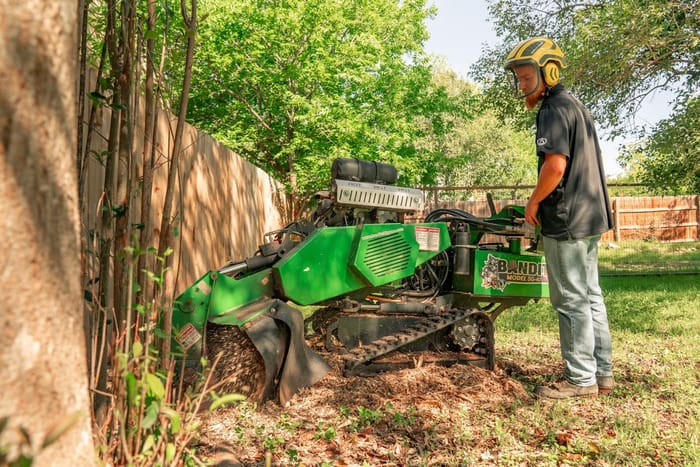
One underrated factor when you choose a tree service: whether they can handle the whole job in-house. Some companies do the cutting and then leave the wood on your curb, or subcontract the stump and the haul-off to other outfits — which means more vendors, more scheduling, and a yard that stays a mess for weeks. A full-service operation handles removal, pruning, stump grinding, and debris hauling with its own equipment and crew — one call, one day on site, one cleanup, one invoice.
How Kohnen's Tree Service Measures Up
We will be direct about why we think we are a strong answer to "how do I choose a tree service in Wichita" — measured against the exact checklist above:
- Fully insured for both general liability and workers' compensation, with certificates of insurance available on request.
- Family-owned and locally operated out of Park City — owner Joe Kohnen personally climbs and works every job, rather than managing from a distance.
- Free, in-person estimates with same-day response, and written, itemized pricing so you always know where your dollars go.
- We follow ANSI A300 pruning standards and we never top trees — on any species.
- More than 135 five-star reviews from Wichita-area homeowners, with cleanup and communication called out again and again.
- 24/7 emergency response and insurance direct billing for storm-damage work, so you are not paying out of pocket and chasing reimbursement.
- Our own trucks, chippers, and grapple trucks — we do not subcontract the cleanup, and we leave your property cleaner than we found it.
"The best thing a homeowner can do is slow down and ask for the certificate of insurance. If a company won't send one, you've already learned what you needed to know. Everything else — the price, the reviews, the equipment — comes after that."
— Joe Kohnen, Owner, Kohnen's Tree Service
If you have tree work coming up — a removal you have been putting off, pruning before storm season, a stump to grind, or a tree that just came down — the right next step is a free, in-person assessment. We will look at the job, explain our approach, answer every question on the checklist above, and give you written pricing you can compare with confidence.
Request your free estimate online, or call (316) 207-4740 any time. Same-day response across the Wichita metro, 24/7 for storm emergencies. Have a general question first? Our FAQ page and about page cover the details.