
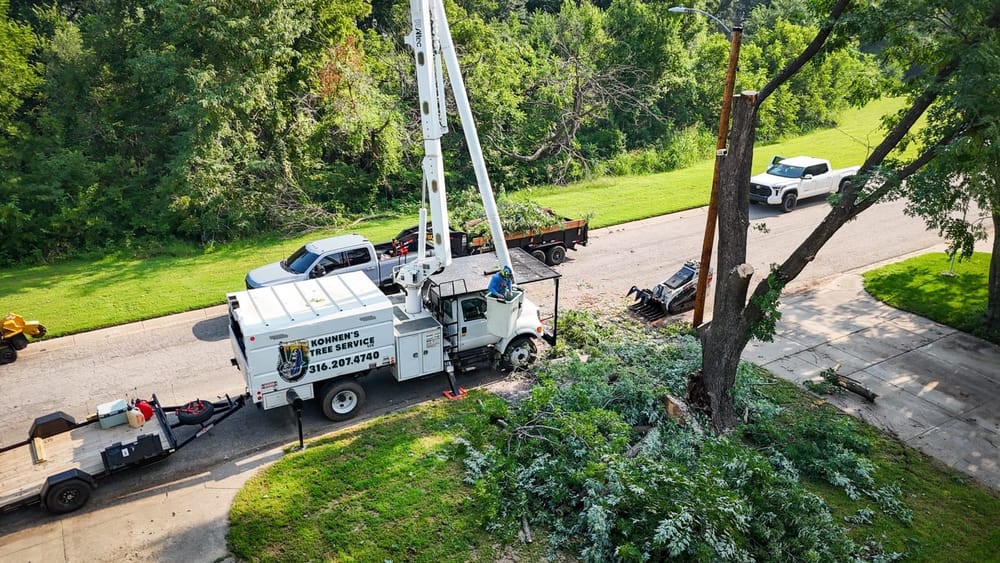
"How much is this going to run me?" is usually the second thing a Wichita homeowner asks when they call about a tree — right after describing which limbs are bothering them. It's a fair question, and it deserves a straight answer instead of a vague "it depends." The honest version of "it depends" is that three things drive almost all of the variation in tree trimming price: how big the tree is, how tall it is, and how hard it is for a crew to get to it. Once you understand how those three factors stack, you can look at almost any tree on your property and land within a reasonable range before anyone shows up with a truck.
This guide breaks down typical tree trimming and pruning costs across the Wichita metro, tier by tier, and explains exactly what pushes a quote toward the low end or the high end. If your tree's real problem is bigger than trimming can fix, our companion guide on tree removal costs in Wichita covers that separate pricing picture.
Pruning vs. Trimming: A Quick Note Before the Numbers
Most homeowners use "trimming" and "pruning" as the same word, and for pricing purposes that's fine — a reputable crew prices the work the same way regardless of which term you use on the phone. Technically, trimming leans toward shaping and clearance (getting limbs off the roofline, opening up a driveway), while pruning is about the tree's health and structure (removing dead, crossing, or weak wood). In practice, most jobs are a mix of both, and the price is driven by the same variables either way. If you want the fuller explanation — plus the 1/2/3 rule, the 25% rule, and when to leave the saw alone entirely — we cover that in our practical tree trimming checklist. This guide focuses on the one question that checklist doesn't answer: what it costs to hire it out.
Average Tree Trimming Cost in Wichita by Tree Size and Height
Height is the single biggest driver of trimming price because it determines how the work gets done. A tree a person can reach from the ground or a short ladder is a fundamentally different job than one that requires a climber on rope and saddle, or a bucket truck. Here's how that typically breaks down per tree in our service area:
- Small ornamental and young trees (under 20 feet): $75 to $200. This covers young shade trees, crepe myrtles, redbuds, and small fruit or ornamental trees that a crew can usually work from the ground or a short ladder. Most of these jobs take under an hour.
- Medium trees (20 to 40 feet): $200 to $450. This is where a lot of established Wichita yard trees fall — maturing maples, ash, and hackberry that haven't reached full height. Some canopy work requires a small ladder or light climbing, but access is usually still straightforward.
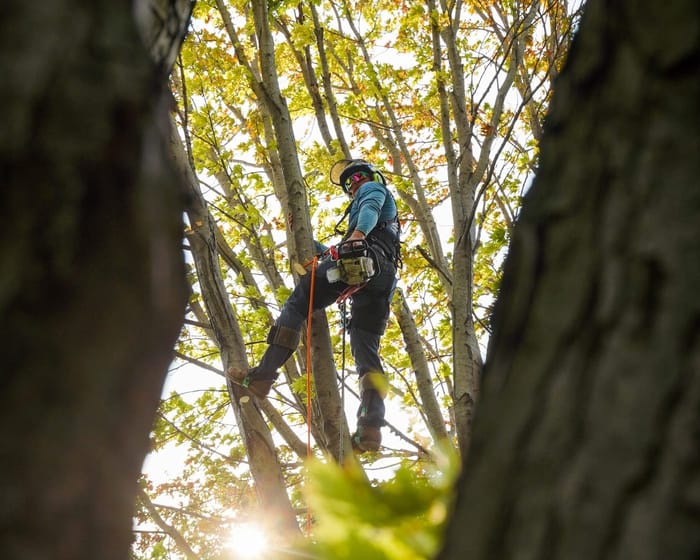
- Large mature trees (40 to 60 feet): $400 to $800. Full-size shade trees like mature silver maples, oaks, and cottonwoods in this range typically need a certified climber working on rope, more time aloft, and more debris to chip and haul.
- Very large or oversized trees (60 feet and up): $700 to $1,500 or more. Mature oaks, large cottonwoods, and other tall canopy trees at this height require the most climbing time, the most careful rigging of heavy limbs, and often a bucket truck if the site allows one.
Notice these ranges run well below what the same tree would cost to remove outright — trimming leaves the trunk and root system in place, so there's no felling, no stump, and typically less wood to haul. If you're weighing whether a tree needs a trim or needs to come down entirely, our tree removal cost guide walks through that side of the pricing.
These figures are typical starting points, not a quote. Kohnen's Tree Service provides free, in-person estimates because trimming price also depends on how much work a specific tree actually needs — a light deadwood cleanup and a full structural reduction on the same 50-foot tree are not the same price, even though the tree is identical.
What Actually Moves the Price: Access, Not Just Height
Height sets the baseline, but access is what separates the low end of a price range from the high end — and it's the factor homeowners most often forget to think about until an estimator points it out.
Open, easy access. A tree in a front yard with clear sight lines from the street, room to park a truck and chipper close by, and no fences to work around is the cheapest scenario at any given height. Cut limbs can be dropped or lowered straight to the ground and fed to the chipper with minimal carrying.
Fenced or tight backyards. If equipment can't reach the tree directly, every cut limb has to be carried out by hand, or a gate section has to come off temporarily to get the chipper closer. That adds labor time even on a tree that would otherwise be a straightforward trim.
Proximity to the house, garage, or fence line. Limbs hanging over a roof, a deck, or a neighbor's fence usually can't just be dropped — they need to be roped and lowered piece by piece so nothing damages the structure below. That precision work takes more time than a limb that can be cut and simply fall clear.
Power lines nearby. Trimming anywhere near an overhead line requires extra caution and, depending on the line, may not be something a tree crew can do at all — Evergy handles clearance work on their own lines. If branches are growing into a service line, that's worth mentioning when you call, since it changes the plan before anyone arrives.
Slope, soft ground, or narrow side yards. A tree on a slope or accessible only through a narrow side yard between two houses limits where a chipper or truck can sit, which usually means more hand-carrying and more time.
Number of Trees: Bundling Brings the Per-Tree Price Down
Trimming is often a whole-yard job rather than a single-tree job — a homeowner doing annual maintenance might have four or five trees that all need some combination of deadwooding, clearance, and shaping. Because the crew, equipment, and chipper are already on site, the mobilization cost gets spread across every tree instead of charged once per visit. If you have multiple trees due for attention, mentioning that upfront usually gets you a better per-tree rate than scheduling each one separately.
What's Usually Included, and What Can Cost Extra
A trimming estimate should spell out the scope clearly. In general:
- Included in most trimming jobs: the cuts themselves, chipping the brush and small wood, and hauling that debris off the property. At Kohnen's, cleanup is part of every job — we don't leave a yard full of brush behind.
- Often priced separately: removing large trunk sections if a tree is being reduced significantly, grinding a stump if a smaller tree is coming out entirely rather than being trimmed back, and any work that requires a second visit due to weather.
- Emergency or storm-related trimming — cutting back a cracked limb hanging over a driveway after a windstorm, for example — is priced differently than routine seasonal maintenance because of the urgency and risk involved. Our emergency tree service covers that scenario around the clock, with no after-hours surcharge.
Frequently Asked Questions
How much does tree trimming cost in Wichita? Most single-tree trims in our service area run between $75 and $1,500, depending mainly on the tree's height and how accessible it is. Small ornamental trees fall at the low end; tall, mature shade trees in tight or obstructed yards fall at the high end. A free in-person estimate is the only way to get an exact number for your tree.
Is there a difference between pruning a tree and trimming a tree? Loosely, yes — trimming is about shape and clearance, while pruning targets the tree's health and structure by removing dead, diseased, or weak wood. Most homeowner "trimming" jobs are really light pruning once you look closely, and pricing works the same way regardless of which word you use. Our tree trimming checklist explains the distinction in more depth.
Is October too late to prune a tree in Kansas? For heavy structural cuts, yes — early-to-mid fall is the worst window, because the tree is heading into dormancy and a fresh wound may sit open through winter instead of closing quickly. Removing clearly dead or hazardous wood is fine any time of year; it's the larger, non-urgent cuts that are worth waiting on until late winter.
What is the 1/2/3 rule of pruning? It's the three-cut method for removing a heavier limb without tearing bark down the trunk: an undercut partway through from below, a second cut farther out that lets the limb drop cleanly, and a final finishing cut just outside the branch collar. It's standard practice on any limb too thick to remove in one pass.
When should you not trim tree branches? Hold off if the tree is an oak or elm outside of deep winter dormancy (disease risk), if the tree is already stressed from drought, transplanting, or recent storm damage, if the cut would require topping the tree, or if the branch is anywhere near a power line. In any of those cases, waiting or calling a professional is the safer call.
How much does it cost to remove a tree stump? Stump grinding in the Wichita area typically runs $100 to $400 per stump, depending on diameter and root flare. If a tree is coming out entirely rather than just being trimmed, our complete stump grinding guide covers pricing, how deep the grind goes, and why leaving a stump in the ground usually costs more in the long run — from tripping hazards to regrowth to the mower damage a hidden root flare can cause.
Getting an Accurate Trimming Quote
A photo can give a rough idea of scope, but an accurate trimming price requires seeing the tree, the yard, and the obstacles in person — the same tree can price differently depending on how much of the crown actually needs work. Kohnen's Tree Service is family-owned and owner-operated: Joe Kohnen, an ISA Certified Arborist, is typically the one climbing and making the cuts, not just managing from the truck. We're fully insured, and with over 120 five-star Google reviews, homeowners across Wichita and surrounding communities consistently point to fair pricing and thorough cleanup as reasons they'd call us again.
"I'd rather walk your yard and give you a real number than guess over the phone. And if you've got a few trees that all need attention, tell me upfront — bundling them into one visit almost always saves you money."
— Joe Kohnen, Owner, Kohnen's Tree Service
We serve Wichita and the surrounding communities within a roughly 40-mile radius, including Park City — where we're based on 61st Street — along with Derby, Bel Aire, Andover, Goddard, El Dorado, and Newton.
Ready to find out what your trees actually need? Request a free in-person estimate online, or call (316) 207-4740. We respond the same day.