
The saws go quiet, the last cut section thuds to the ground, and the tree that used to shade half your Maize backyard is now a pile of rounds, limb wood, and brush stacked across the lawn. This is the part homeowners rarely picture when they schedule a tree removal — the cutting itself is usually the fast part. What's left behind is a yard that doesn't look "done" at all, and the question that comes next is simple: how does all of that actually leave the property?
For a small trim or a single ornamental tree, the answer is often a crew with a chipper and a trailer, done in an hour. For a big removal — the kind Maize sees regularly, where newer subdivisions sit next to older parcels with decades-old hackberries, elms, and cottonwoods — that same manual approach can turn a one-day job into a two-day job. This is where a grapple truck earns its keep, and this guide walks through what it actually clears, what it leaves for other methods, and what a balanced homeowner should expect on cleanup day.
What's Actually Left Behind After a Big Removal
A mature tree doesn't disappear when it comes down — it just changes shape. A large hackberry or cottonwood removal in a Maize yard typically leaves behind trunk rounds cut to a manageable length, a substantial pile of limb wood and brush from the canopy, and, if the stump was popped or partially excavated, chunks of root mass mixed with soil. On a rural-adjacent property with a mature, unmanaged tree line — common in Maize's older parcels — that pile can easily fill a good portion of the yard.
None of that is a problem the tree crew created by mistake. It's simply the physical reality of taking down a large tree: the wood has to go somewhere before it can go away. The question is how it moves from "pile in your yard" to "gone."
Grapple Truck vs. Crew-and-Trailer: Two Honest Options
There are really only two ways debris leaves a property after a removal, and each one makes sense in different situations.
Manual loading means a crew physically carries, drags, or wheelbarrows material to a trailer or truck bed, makes as many trips as it takes, and hauls it away — sometimes in multiple loads. For a modest pile from a pruning job or a small tree, this is fast enough and doesn't need special equipment. For a large removal, it's slow: four workers loading a big pile by hand can easily eat most of a working day, and that labor time shows up in the bill.
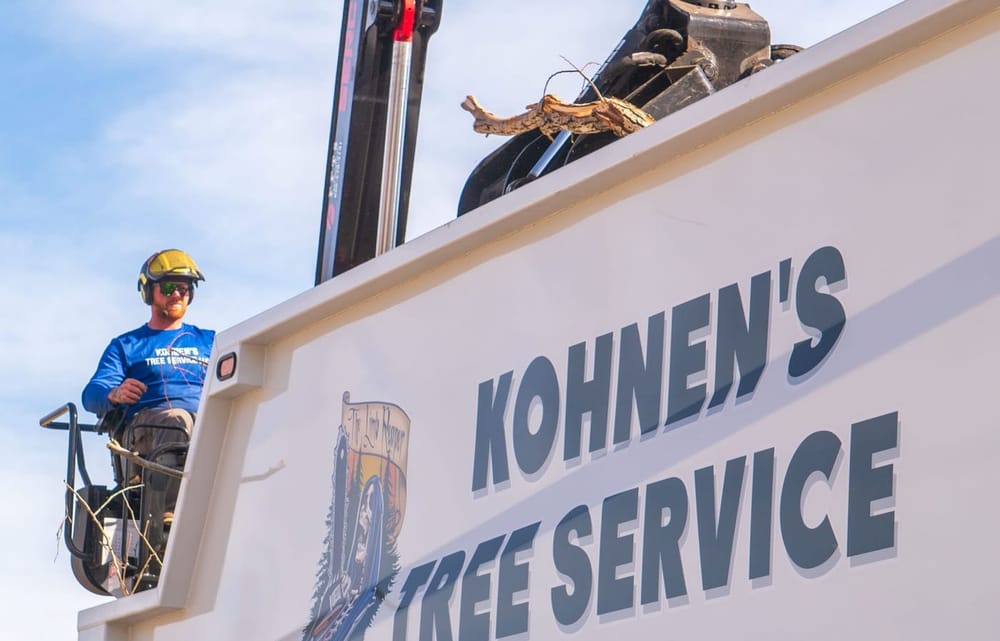
Grapple truck hauling replaces the hand-loading with a hydraulic boom arm and claw mounted on the truck itself. The operator swings the arm out, closes the grapple around a section of the pile — logs, root balls, tangled brush, it doesn't matter — lifts it, and drops it straight into the truck bed. Each cycle takes about thirty seconds, and there's no carrying involved at all. If you want the full mechanical rundown of how the equipment itself works, we cover that in detail in our guide to what a grapple truck does; this post is specifically about what happens on a big removal cleanup day.
The honest answer on which one you need: if your debris pile is small enough that two people could clear it in under an hour, a grapple truck is overkill and a standard crew-and-trailer approach is the more economical choice. Once you're looking at a full mature tree — trunk, canopy, and everything in between — the math flips, and the grapple truck almost always finishes faster and cheaper than the labor-hour alternative.
What "Fast" Actually Looks Like in Maize
Numbers make this concrete. A single large removal — say, a mature hackberry with a full canopy and a trunk cut into rounds — that would take a four-person crew most of a working day to load by hand typically clears in two to three hours with a grapple truck, using one operator and one ground worker to position outlying material within boom reach. That difference matters most on exactly the jobs Maize sees a lot of: older, rural-adjacent properties where trees were never pruned down to a manageable size and a single removal produces a genuinely large volume of wood.
Kohnen's Tree Service operates from our Park City headquarters, about 20 minutes from most points in Maize, so scheduling the grapple truck alongside the removal crew for the same visit is usually straightforward rather than a separate trip on a separate day. When the cutting and the hauling happen on the same visit, "the tree is down" and "the yard is clear" end up being the same afternoon instead of two different ones.
What Your Lawn Looks Like When It's Over
This is where the comparison gets genuinely practical instead of just a matter of speed. Manual loading means a crew crossing your lawn dozens of times — carrying logs, dragging brush, making repeated trips to a trailer parked at the curb. On dry ground in the middle of summer, that foot traffic is a minor nuisance. On the kind of wet clay soil Kansas produces after a spring rain, it leaves ruts, compresses turf, and can take a season to fully recover from.
A grapple truck changes that equation because it works from a fixed position. The truck parks on the driveway or street, the boom reaches into the yard, and the material gets pulled to the truck rather than carried across the lawn by hand. The footprint is limited to wherever the truck itself sits — not the entire path between the pile and the curb. For a big cleanup on soft ground, that's often the bigger practical advantage over raw speed.
To be fair to the manual approach: for a small, dry-weather job, the lawn impact difference is negligible either way. The grapple truck's advantage on turf grows in direct proportion to how much material has to move and how wet the ground is — which is exactly the combination a large Maize removal often produces.
What the Grapple Truck Hauls — and What It Skips
The grapple truck handles anything that came off the tree: trunk sections, limb wood of any size, root balls, tangled brush, and stump grindings mixed with soil if grapple truck service is paired with a grinding job. What it does not handle is non-organic material — fencing, construction debris, concrete, or general household trash. The truck bed and disposal destination are set up for tree and landscape waste specifically, so if your property has both tree debris and something like storm-damaged fencing, those are two separate hauls.
Worth knowing if your yard is fenced: most residential grapple trucks work from outside the fence line, reaching in with the boom, or need a gate opening in the neighborhood of 36 to 48 inches if the truck has to get closer. Mentioning your gate width and yard layout when you request an estimate lets us plan the approach ahead of the crew showing up.
Frequently Asked Questions
Do I need to be home when the grapple truck comes to clear debris? Not necessarily, as long as the crew has clear access to the pile and any gates are unlocked. Many homeowners schedule debris hauling to happen while they're at work; we'll confirm access details when you book.
Will a grapple truck tear up my yard the way I've heard heavy equipment can? It's actually the opposite of most heavy equipment concerns — the truck stays in one fixed spot (driveway or street) and reaches in with the boom, rather than driving across the lawn. The main thing to watch is the ground directly under where the truck parks, which is a much smaller footprint than a crew walking the whole property repeatedly.
Is debris hauling included in the price of tree removal, or is it a separate charge? It depends on the job. For many removals, cleanup and hauling are bundled into the overall price. For larger volumes or standalone hauling requests, it's quoted separately based on how much material there is. We'll tell you which applies to your job during the free estimate — no guessing after the fact.
Can the grapple truck reach a fenced backyard? Often, yes, if there's a gate wide enough for the truck or if the boom can reach the pile from outside the fence. Tight access is workable in most cases; it just helps to describe your yard layout when you call so the right approach is planned in advance.
What if another company already cut the tree down and left the debris? That happens more often than you'd think, and it's a job a grapple truck was built for. We can quote standalone debris hauling without having done the original cutting — just describe what's on the ground and we'll give you a straightforward price.
"People are always surprised by how little of the job is actually the cutting. The grapple truck is what turns 'the tree is finally down' into 'my yard is back' on the same afternoon instead of a week later."
— Joe Kohnen, Owner, Kohnen's Tree Service
Kohnen's Tree Service is family-owned and owner-operated, fully insured and licensed for tree work in Kansas, and backed by 120+ five-star Google reviews from homeowners across the Wichita metro. We serve Maize from our Park City headquarters, about 20 minutes east, along with Wichita, Park City, Derby, Bel Aire, and the rest of the surrounding area. Whether your removal is already scheduled or the debris is already sitting in your yard from a previous job, request a free in-person estimate online, or call (316) 207-4740. We respond the same day.