
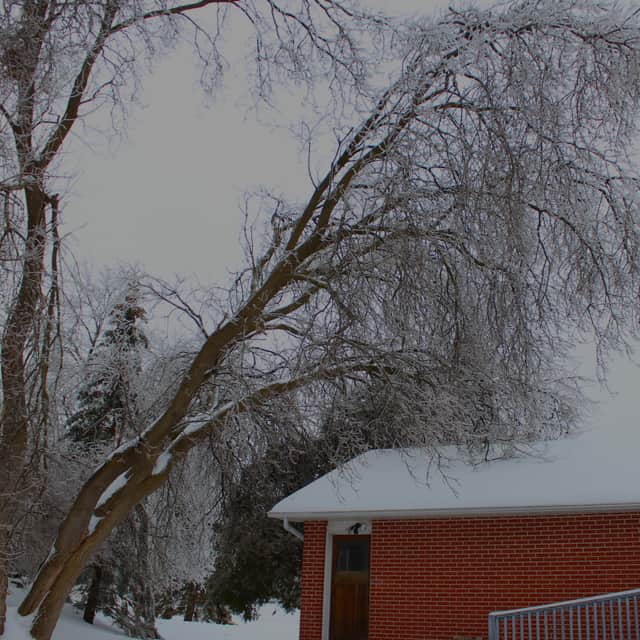
The trees that break in a Kansas ice storm almost never surprise the crew that comes to clean them up. The limb that ends up through the roof was dead last summer. The tree that split in half had a seam running down from its fork for years. The branch on the line to the house was already brushing it in October. Ice doesn't find new weak spots. It finds the ones that were already there.
That's good news, because late fall is when those weak spots are easiest to see and cheapest to fix. The leaves are down, the structure of every tree is in plain view, and there's still time to get work done on a calm day instead of in the middle of the night. This checklist walks you around your own yard the way we walk it at an estimate: what each tree could hit, what to look for on the way, and how to sort what you find into "leave it," "prune it," "remove it," and "call now."
The short version:
- Start with targets, not trees. Mark the roof, the driveway, the line to the house, walkways, play areas, the fence and the street. A tree only matters as much as what it can reach.
- Look for five things: dead wood and hanging broken limbs, tight V-shaped forks, long limbs with their weight out at the tips, cracks or decay in the trunk and base, and a lean that's new.
- Prune dead and overextended limbs over the house, the driveway and anywhere people walk. Remove trees that are dead, split, or decaying at the base within reach of something you care about.
- Do the small stuff yourself: walk the yard, take photos, clip small dead twigs from the ground, and tie up small multi-stem evergreens. Leave ladders, saws, big limbs and anything near a power line to a pro.
- Get it done before the first ice warning. After the first big storm, every tree crew in town has a waiting list.
Why Late Fall Is the Time to Do This
Ice season in south-central Kansas runs roughly December through March, and January is usually the worst of it. Freezing rain coats every twig on every side, and that coating can multiply a branch's weight many times over. All of that load ends up at the places where limbs join the trunk, and wind on top of it does the rest. The December 2007 storm, which the National Weather Service called the costliest ice storm in Kansas history, is the one most Wichita homeowners still remember.
November gives you three advantages you won't have in January:
- You can see the whole tree. With the leaves off, dead limbs, weak forks and broken branches stuck in the canopy are visible from the ground.
- Work can happen on your schedule. A dead limb over the bedroom is a routine pruning job in November. After the ice, it's an emergency call along with everyone else's.
- Some trees still have leaves. Bradford pears and some oaks hang onto their leaves into late fall, and an early ice storm on a tree in leaf is the worst case, because every leaf collects ice too. Those trees deserve a look first.
If you want the full story on which species break first and what to do once the ice has come and gone, our guide to ice storm tree damage in Wichita covers it. This page is the walk-around.
Step 1: Mark What Each Tree Could Hit
Before you look up at a single branch, stand in the yard and look at what's underneath. A defect only makes a tree hazardous when there's something within reach, so the same dead limb is a different job over open lawn than over the bedroom. A tree can reach about as far as it is tall, and a limb can land anywhere under it and a little beyond.
Make a quick list, or mark up a photo of the yard on your phone. Note every tree whose height could reach:
- The roof, especially over bedrooms and the rooms where people spend the most time
- The driveway and wherever cars park, including the street out front
- The line that runs from the pole to your house (the service line)
- Walkways, the front door, the back door and the path to the trash cans
- Play sets, patios and the dog run
- The fence, the garage, a shed, or the neighbor's house and yard
Trees that can't reach any of those still get a look, but they go to the bottom of the list. Trees that can reach two or three of them go to the top.
Step 2: The Walk-Around Checklist
Do this on a calm, dry day, from the ground, with a pair of binoculars if you have them. Walk all the way around each tree on your list. You're not diagnosing anything yet, just noting what you see.
1. Limbs over the roof
Stand back far enough to see where each limb over the house actually ends. Note limbs that rest on the shingles or rub the gutters, and limbs that reach well out over the roof. Look at how much each one already sags. Ice pulls limbs lower, and a branch that clears the roof by a few feet in November can end up lying on it under a load of ice, the way the tree in the photo at the top of this page did.
2. Over the driveway, the street and the walkways
Do the same over everywhere people park and walk. Low, long limbs over the driveway are the ones that come down on cars. Limbs over the street or sidewalk deserve a look too, because a limb across the street blocks your neighbors as well as you. If the tree stands in the strip between the sidewalk and the street, it is generally the City of Wichita's tree, not yours, so report it to the City rather than paying to have it cut.
3. The line to your house
Follow the service line from the pole to where it meets the house. Note any branch that touches it, sits right above it, or would land on it if it broke. Don't trim near that line yourself, and don't let anyone else until Evergy has been involved: it's live. Branches in the main lines along the street or alley are a matter for Evergy too, so report those rather than cutting near them.
4. Dead wood and hanging limbs
Dead wood is the first thing ice takes down. Without leaves to go by, look for:
- Bark that's peeling or gone, showing smooth gray or bleached wood underneath.
- No buds. Living twigs carry next spring's buds at their tips and along their length. Dead twigs are bare, dry and brittle.
- A color that doesn't match. Dead limbs often look grayer or paler than the rest of the crown.
- Brown leaves that stayed put. On most shade trees, a branch still holding dry, curled leaves after the rest of the tree has dropped its leaves may have died during the season. Oaks are the exception, since many of them hold dry leaves into winter.
- Fungus or woodpecker holes on a limb, both signs that the wood inside is rotting.
On a twig you can reach from the ground, scrape a little bark with your thumbnail. Green underneath means it's alive. Brown and dry means that twig is dead.
While you're looking up, check for hangers: broken limbs from a summer storm that are lodged in the canopy instead of on the ground. They're the first thing to come down when ice adds weight, and they can drop with no storm at all. Don't pull on them or stand under them.
5. Tight V-shaped forks
Look at the places where the trunk splits into two or more main stems. A wide, U-shaped joint is usually solid wood grown together. A tight V where two stems of about the same size squeeze against each other, called co-dominant stems, often has bark trapped in the joint instead of wood knitting across it. Arborists call that included bark, and it has a fraction of the strength of wood. A dark seam running down from the fork, or swollen ridges of bark bulging out on either side of it, are the signs to look for.
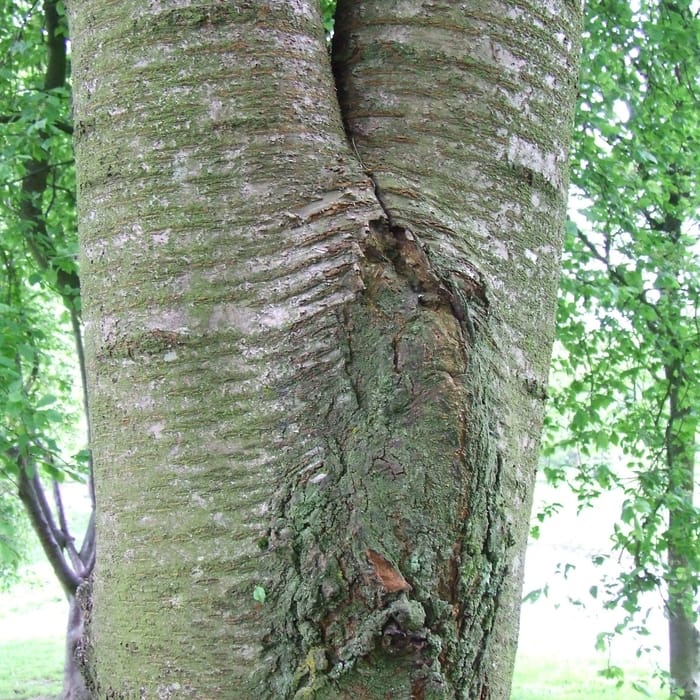
Bradford pears are famous for this, and silver maples and Siberian elms do it too. Under ice, these forks pull apart, and when the tree is big, half of it comes down at once.
6. Long, end-heavy and lopsided limbs
Ice collects on the fine twigs out at the ends of the branches, where it has the most leverage on the joint. Note long, nearly horizontal limbs that reach far from the trunk with most of their twigs out at the tip. Watch for lion-tailed limbs too: branches that have had their inner side branches stripped off, leaving a bare limb with a tuft of growth at the end. That's a common result of over-thinning, and it makes the limb more likely to break, not less.
Also note trees that are lopsided, like a tree cut back hard on one side for a line or a neighbor, and trees that were topped in the past. The clusters of upright sprouts that grow back from old topping cuts are weakly attached, and ice strips them off.
7. Cracks, cavities and fungus on the trunk and base
Walk around the trunk and look for vertical cracks, open cavities, missing bark and soft or crumbling wood. Then look at the root flare, where the trunk widens into the ground. Mushrooms or hard shelf-shaped growths called conks on the trunk or root flare mean a decay fungus is feeding on the wood. Note all of it. A crack or decay on its own may be something to watch. Together, or on a tree over the house, they're a reason to have it looked at before winter.
8. Lean and roots
A tree that has always grown at an angle isn't necessarily a problem. A lean that is new or getting worse is. Look at the soil on the side away from the lean: cracked, lifted or mounded soil there means the roots are letting go. Note trees that had roots cut in the last few years for a new driveway, a patio, a fence or a utility trench, because cut roots mean less holding strength when ice and wind load the crown.
9. Small evergreens and young trees
Arborvitae and other upright evergreens with several stems tend to splay open and split under ice and heavy snow. Iowa State University Extension recommends wrapping these plants with twine or rope in the fall and removing it promptly in spring. That's a fair job for a homeowner on a small plant you can reach from the ground. Young shade trees usually bend under ice and straighten again over the following months, so leave them be.
Step 3: Sort What You Found
Go back through your notes, tree by tree, and put each one in the most serious group that fits. What a tree could hit counts as much as what's wrong with it.
Leave it and watch it if:
- It can't reach anything on your list, or only open lawn.
- The only dead wood is small twigs.
- The trunk is sound, with no cracks, decay, weak fork or new lean.
Take a dated photo and look again after the first ice or high wind.
Have it pruned before ice season if:
- There are dead limbs over the roof, the driveway, walkways, a play area or the street.
- Long, end-heavy limbs reach out over the house, or limbs already rest on or rub the roof.
- Branches are crowding the line to the house (with Evergy involved first).
- An otherwise healthy tree has a weak fork where taking weight off one side may be enough.
- Storm-torn stubs or old topping sprouts hang over something you care about.
Plan a removal before ice season if:
- The tree is dead or mostly dead and can reach the house, the driveway, a neighbor or a line.
- The trunk or a main fork is already cracked or split.
- There's decay in the trunk or at the base, such as cavities or conks on the root flare, on a tree that could reach something.
- The tree has a lean that's new or getting worse.
- It's already failing: an ash killed by emerald ash borer, a pine killed by pine wilt, or a Bradford pear that has started to split.
Call now, without waiting for a forecast, if:
- A broken limb is hanging over a door, the driveway, a sidewalk or a play area.
- A crack opens and closes as the tree moves in the wind.
- A tree has a new lean and the soil on the far side is lifting.
- A limb is resting on or tangled in any power line. Stay well back and call Evergy first.
What to Fix First
If you can't get everything done before Christmas, here's the order we'd work in:
- Anything hanging, cracked or dead over the places people sleep, park, walk or play.
- Dead or failing whole trees within reach of the house or a line.
- Dead limbs and long, heavy limbs over the roof and driveway.
- Weak forks on big trees near anything on your list.
- Everything over open lawn, which can wait for a scheduled visit.
At a free estimate, Joe walks the yard with you, tells you which items matter before ice season and which can wait, and puts the price in writing before anything is scheduled.
What Pruning Before Ice Season Looks Like
Good pre-winter pruning removes specific problems. It doesn't just make the tree smaller. On a typical job that means:
- Crown cleaning: taking out dead, dying, broken and hanging limbs. This is the single biggest thing you can do before ice, and dead wood can come out in any season.
- Reduction cuts: shortening a long, heavy limb back to a smaller side branch so it carries less weight out at the tip. The limb stays, with less leverage on the joint.
- Clearance: shortening or removing limbs that rest on the roof or crowd the house, and around the service line once Evergy has been involved.
- Weak forks: on a healthy tree, sometimes reducing the weight on one stem is enough. On a fork that has already started to split, it usually isn't.
What it shouldn't include: topping, which leaves big wounds and grows back as the same weak sprouts ice breaks, or stripping out the inside of the crown, which leaves lion-tailed limbs. As a standard practice, a healthy tree shouldn't lose more than about a quarter of its live crown in a year. If the limb in question is on an oak or an elm, ask about timing at the estimate. Our tree trimming and pruning page covers how a visit works.
When Removal Is the Safer Call
Some trees can't be pruned into shape for winter. A dead tree gets drier and more brittle every month it stands, and one that has been dead for years often can't hold a climber or a rigging line, which makes the job slower and more expensive the longer it waits. A trunk that has split, or decay at the base of a tree that leans toward the house, isn't something a few cuts will fix. Our guide to the signs of a dead tree and when to remove it goes deeper on how to tell.
These are the trees our dead and hazardous tree removal service is built around. The crown comes down first, then the trunk in sections, each piece lowered on ropes away from the roof, the fence and the lines. That's much easier on a calm, dry day in November than after an ice storm, when the tree is loaded, the ground is slick and the damage may already be done.
One money note: homeowners insurance generally pays to remove a tree only after it damages a covered structure, not to take a dangerous tree down before it falls. And if you know a tree is dead or dangerous and it lands on a neighbor's house, you can be held responsible. Taking care of it now is almost always the cheaper path.
What You Can Do Yourself, and What Needs a Pro
Reasonable for a homeowner:
- Walking the yard, marking targets and taking dated photos of anything you're unsure about.
- Picking up fallen limbs and sticks so they don't freeze into the lawn.
- Clipping small dead twigs you can reach with hand pruners or loppers, both feet on the ground. Cut just outside the slight swelling where a twig meets the branch, and don't leave stubs.
- Tying up small multi-stem evergreens with twine, and taking it off in spring.
- Watering in a dry fall. K-State Research and Extension recommends soaking the soil around established trees and shrubs before the ground freezes, and watering during a mid-winter thaw if the winter is dry.
Not a DIY job:
- Anything that needs a ladder and a saw at the same time.
- Limbs over the roof, the driveway, a fence or the neighbor's yard.
- Anything near any power line, including the line to the house.
- Hangers. Never pull on a broken limb from below.
- Cracked or split trunks and forks, dead trees and every removal.
- Climbing. Big limbs and removals take rigging, and they go wrong fast without it.
When Ice Is in the Forecast
By the time a warning goes out, it's too late for tree work. What's left is keeping people and property out of the way:
- Move cars into the garage or out from under big limbs.
- Keep kids and pets out from under trees until the ice is gone.
- Don't knock ice off branches or prop up sagging limbs. Frozen wood is brittle, and you'll break more than you save.
- Charge your phones. Save our number, (316) 207-4740, and Evergy's outage line, 800-LIGHT-KS (800-544-4857).
- Treat every downed line as live. Call 911 if a line is down or sparking.
If a tree does come down on the house, our guide to what to do when a tree falls on your house walks through the first hour, from safety to photos to the insurance call. Our 24/7 emergency tree service line is answered around the clock, and true hazards go ahead of scheduled work.
Frequently Asked Questions
How do you prepare trees for an ice storm?
Walk the yard in late fall with the leaves off and note what each tree could hit: the roof, the driveway, the line to the house, walkways and play areas. On those trees, look for dead wood, broken limbs caught in the canopy, tight V-shaped forks, long end-heavy limbs, cracks, decay and a new lean. Have dead and overextended limbs over the house and driveway pruned out, remove trees that are dead or failing, and loosely tie small multi-stem evergreens with twine.
Should I trim my trees before an ice storm?
Yes, if the trimming targets the right things: dead wood, hanging broken limbs, and long limbs over the house or driveway shortened back to a side branch. Topping or heavy thinning does the opposite and leaves the tree weaker. A healthy tree shouldn't lose more than about a quarter of its live crown in a year.
Is it too late to prune trees in November or December?
No. Dead and broken wood can come out any time of year, and late fall and winter work for structural pruning on most shade trees, because the leaves are off and the structure is easy to see. Oaks and elms have their own timing, so ask at the estimate. The real deadline is the first ice storm, after which crews are booked up with emergency work.
Can I wrap or tie my trees to protect them from ice?
Only small ones. Arborvitae and other multi-stem evergreens can be wrapped loosely with twine or rope in the fall and unwrapped in spring, so their stems don't splay open under ice and snow. Large trees can't be protected that way. Don't prop up limbs or knock ice off branches; frozen wood is brittle and breaks easily.
Which trees should be removed before winter?
Trees that are dead or mostly dead, trees with a trunk or main fork that is already split, trees with decay at the base or a lean that is getting worse, and trees that are already failing, such as ash killed by emerald ash borer or a Bradford pear that has started to split. They come first when they can reach the house, the driveway, a neighbor or a power line.
Will insurance pay to remove a dangerous tree before it falls?
Generally no. Homeowners insurance usually pays for tree removal only after a tree damages a covered structure, such as the house or a fence. Removing a known hazard ahead of time is usually cheaper than the damage, and if a tree you knew was dangerous falls on a neighbor's property, you can be held responsible.
Get a Second Set of Eyes Before the Ice
Kohnen's Tree Service is family-owned, fully insured, and based right here in the Wichita area. Owner Joe Kohnen is an ISA Certified Arborist (credential MW-389993A), and he climbs and works every job himself, so the person who walks your yard at the estimate is the same person who does the work. We'll tell you which trees can wait and which shouldn't, and we take the hard removals over roofs and lines that other companies pass on. When trees become a threat, we answer the call, across Wichita, Park City, Derby, Andover, Bel Aire and the surrounding towns.
Request a free in-person estimate online, or call (316) 207-4740. If something is already cracking or hanging, call any time, day or night.